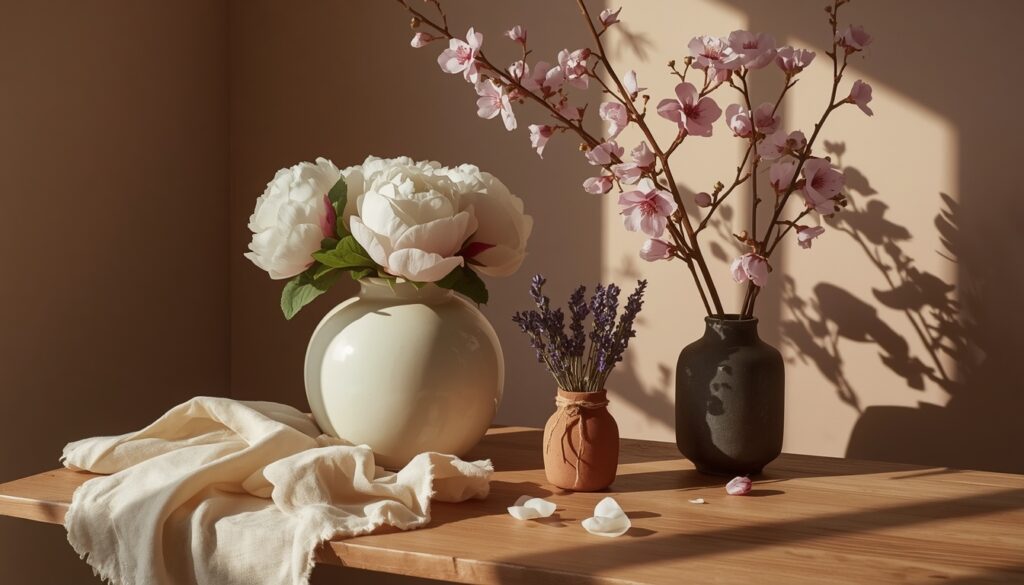
Decorating with real flowers sounds romantic until you are throwing out dead blooms every five days and scrubbing water stains off your furniture. I made that switch to faux flowers three years ago, and honestly, I have never looked back. The quality available today is genuinely shocking. I have had guests pick up a stem from my dining table to smell it — that is how realistic the good ones look. Faux flowers give you the beauty of a styled, flower filled home without the weekly cost, the drooping petals, or the guilt of watching something beautiful die. They work in every room, every season, and every budget.
What makes faux flowers worth talking about right now is how far the materials have come. Real touch silicone petals, bendable wire stems, natural color gradients, and subtle texture details have completely changed the game. You can find faux blooms that photograph beautifully, hold their shape for years, and cost a fraction of what you would spend on fresh flowers over a single month. This guide covers the 13 best faux flowers for home decor — chosen for realism, styling versatility, and long term value. Whether you are starting fresh or upgrading what you already have, you will find exactly what your space needs right here.
1. Faux White Peonies — The Gold Standard of Luxury Home Styling
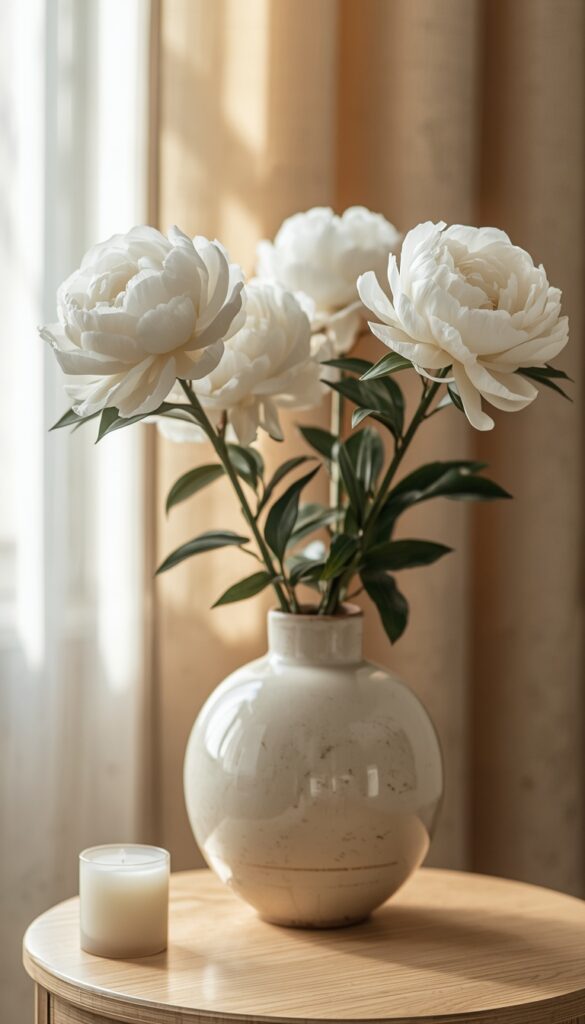
If I could only keep one type of faux flower in my home, it would be white peonies. No other bloom delivers that combination of fullness, softness, and pure elegance so effortlessly. White peonies brighten any room immediately. They work on a dining table, a bedroom dresser, a bathroom shelf, or a living room console. The round, ruffled shape fills a vase beautifully with just three or four stems, which makes them incredibly cost effective. They suit every interior style — from classic to contemporary to soft cottagecore. A good faux white peony in the right vase looks like something straight out of a high end interior magazine, and that is not an exaggeration.
Styling faux white peonies well comes down to two things — vase choice and stem height variation. Always use stems of at least two different heights. Let one or two blooms sit slightly lower than the others, even letting them rest gently against the vase rim. This creates that natural, just arranged look that feels genuinely organic rather than stiff. For vases, cream ceramic, aged white stone, and soft beige linen textured finishes all complement white peonies beautifully. Clear glass works too, especially in bathrooms where light passes through and creates a delicate, luminous effect. Avoid bright white or very shiny vases — they compete with the blooms instead of supporting them.
The single most important quality indicator for faux white peonies is petal layering. Cheap versions have maybe two or three layers of petals that sit flat and stiff. A high quality faux peony has five or more distinct petal layers, each one slightly different in size and curve. The outer petals should be wider and gently cupped. The inner petals should tighten toward a soft, slightly creamy center. Real peonies are never pure white throughout — they have warm ivory tones in the center that graduate to brighter white at the outer petals. Any faux version that nails this color transition is worth every penny. Brands using real touch silicone material for the petals are the ones to look for.
2. Faux Dusty Pink Ranunculus — Delicate, Layered, and Endlessly Stylish
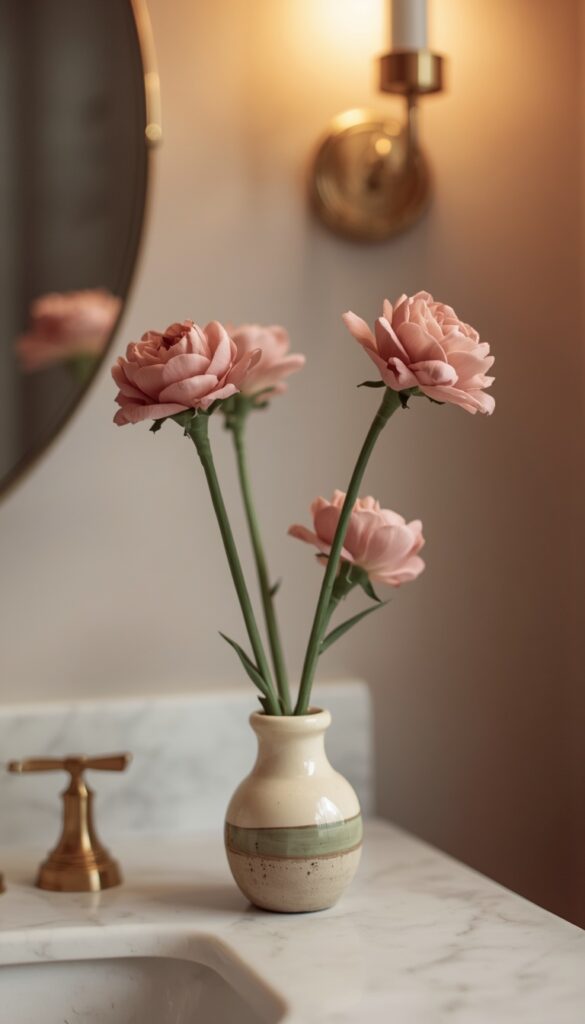
Ranunculus is one of those flowers that people recognize as beautiful without always knowing its name. Those dozens of tissue thin petals layered tightly around a small center create a bloom that looks almost too intricate to be real — which makes the faux version especially impressive when done well. Dusty pink is the most versatile color choice for home decor. It sits somewhere between blush and mauve, which means it works with warm neutrals, soft grays, sage greens, and even deep charcoal tones. One ranunculus stem in a small bud vase on a bedside table creates a moment of quiet beauty that feels genuinely curated and personal.
What I love most about ranunculus in a styled arrangement is how they behave differently from rounder flowers like roses or peonies. Their stems are naturally slender and slightly curved, which gives them a graceful, nodding quality. They do not dominate an arrangement — they complement it. Mix three or four faux dusty pink ranunculus stems with soft eucalyptus and one or two cream garden roses for a centerpiece that looks florist designed without any professional help. They also work beautifully in a small cluster on a vanity tray or alongside a candle on a bathroom shelf. Because the blooms are compact, you get a refined look without heaviness.
Buying quality faux ranunculus means paying close attention to petal thinness and color variation. The best versions have petals that are genuinely thin and slightly translucent at the edges — not thick, opaque, or plasticky. Each petal should show a subtle color shift, a little deeper at the base and softer toward the tip. The center of the bloom should remain tightly packed and slightly darker than the outer petals, exactly like the real thing at peak bloom. Stems should be flexible enough to bend naturally but sturdy enough to stand upright in a vase. Sets that include a mix of fully open blooms and slightly tighter buds on the same stem look dramatically more realistic and give your arrangements a natural progression that flat, uniform blooms simply cannot achieve.
3. Faux Lavender Stems — Simple, Calming, and Surprisingly Versatile
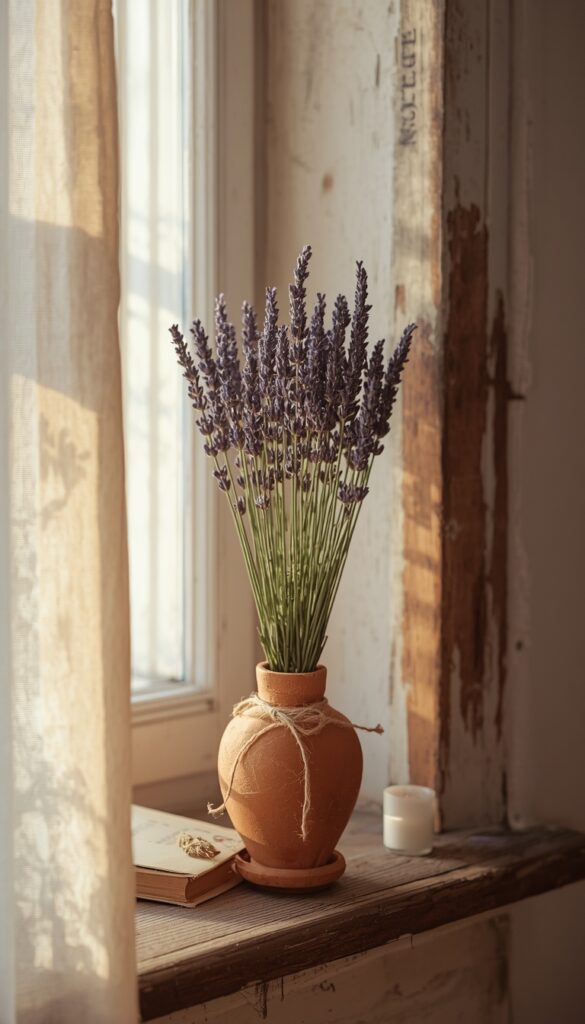
Lavender might seem like a simple choice, but it is one of the most hardworking faux stems you can own. That slender silhouette, the soft purple gray color, and the relaxed, upright posture of lavender stems add a very specific kind of calm to a room. It suits kitchens, bathrooms, reading corners, and bedroom shelves equally well. Lavender has a visual language that people associate with rest, freshness, and natural beauty — and the best faux versions carry that feeling even without the scent. Bundle five or six stems with raw twine and lean the bundle against a stack of books or tuck it into a small terracotta pot for an arrangement that takes thirty seconds and looks genuinely lovely.
The versatility of faux lavender comes from its neutral purple tone and its slim profile. It fills space without dominating it. Use it to add height to a small arrangement where a full bloom would look too heavy. Tuck a few stems into a narrow glass bottle on a kitchen windowsill. Layer it into a wreath alongside faux eucalyptus and dried style cotton stems. Add it to a wooden tray display between candles and small ceramic objects. Because lavender stems are lightweight, you can use many of them together without the arrangement looking crowded or top heavy. This makes them ideal for tall, slim vases where chunkier flowers would simply look wrong. They also photograph with a beautiful soft focus quality that works really well in styled flat lays.
Quality faux lavender is all about the floret texture along each spike. The individual tiny flowers on a real lavender stem are slightly fuzzy and uneven — they have a soft, almost downy quality that gives the spike its characteristic dusty appearance. Good faux versions replicate this with fabric or foam florets that have subtle texture variation. Avoid any stem where the florets look painted on, smooth, or hard — these read as fake immediately, even from a distance. The color should be muted and dusty, not bright or saturated. True lavender leans more gray purple than violet purple. Stems with multiple spikes branching from a single base look more natural and give you more volume per stem, which is always worth paying slightly more for.
4. Faux Protea — The Bold, Architectural Bloom for Modern Interiors
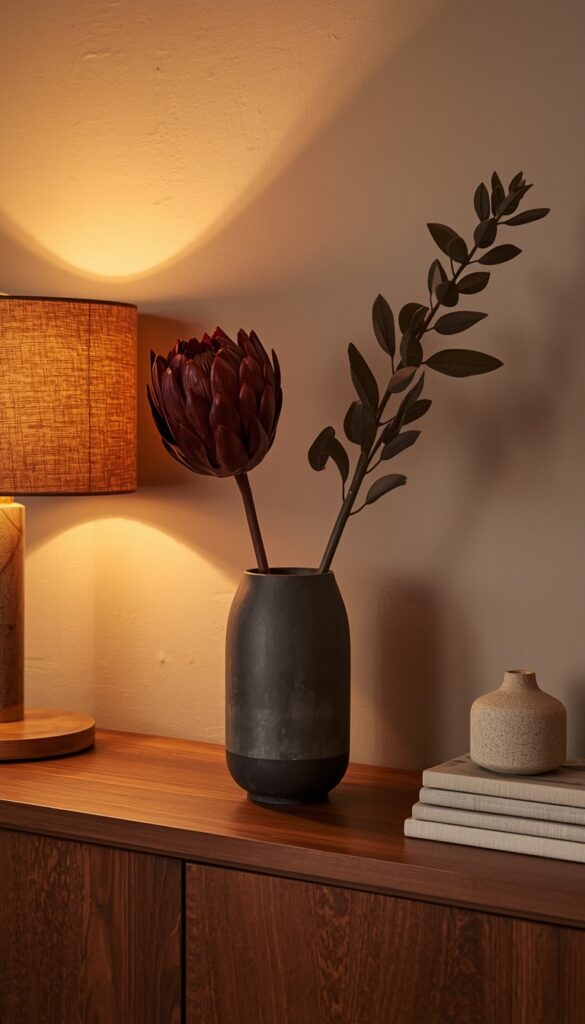
Protea is the flower for people who want their home decor to make a statement without trying too hard. It has an almost sculptural quality — that large, dome shaped bloom surrounded by pointed, layered bracts looks like something between a flower and a work of art. Proteas suit modern, earthy, and bohemian interiors in a way that softer flowers simply cannot match. One or two faux protea stems in a matte ceramic or concrete vase create an arrangement that looks completely intentional and design forward. Deep burgundy, dusty terracotta, warm blush, and smoky mauve are all stunning color options that complement wood tones, linen textures, and neutral wall colors beautifully.
Because proteas have such a commanding presence, less is genuinely more with these stems. Two stems in the right vase outperform a crowded bunch every single time. Pair a deep burgundy faux protea with a long faux banksia stem and two or three trailing eucalyptus branches for an arrangement that looks like it came from a high end floral studio. Proteas also work beautifully in earthy, natural material vases — woven seagrass, rough textured terracotta, raw concrete, and dark stained wood all complement their rugged elegance. On a console table or entry shelf, a single large protea bloom in a tall, simple vessel creates an entry moment that is both welcoming and genuinely impressive. It is the kind of arrangement guests always ask about.
The quality details that separate a convincing faux protea from a cheap one are very specific. The outer bracts — those pointed, petal-like structures that surround the central bloom — should have a slightly papery, matte texture with realistic color variation from base to tip. Real protea bracts are never a single flat color. They show gradients, subtle streaking, and slightly darker tips. The center of the bloom should look densely textured, almost fuzzy or granular, rather than smooth and plastic. The stem should be thick enough to feel substantial and stand upright without wobbling. High quality faux proteas often include a slightly dried, textured calyx at the base of the bloom where it meets the stem — this small detail alone signals serious quality and attention to botanical accuracy.
5. Faux Cherry Blossom Branches — Dramatic Height with Effortless Grace
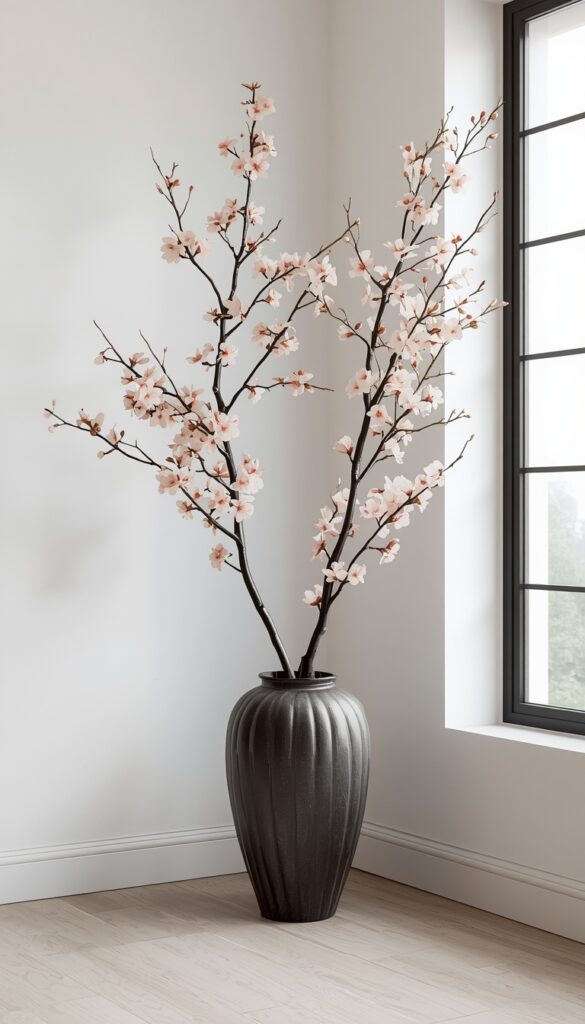
Cherry blossom branches operate on a completely different scale from bouquet style flowers. They bring height, movement, and a sense of natural drama that no compact arrangement can achieve. A single tall branch placed in a large floor vase can genuinely transform a bare corner into a room’s focal point. The magic is in the contrast — delicate clusters of soft pink blooms floating along dark, bare branches creates a composition that feels both minimal and lush simultaneously. This duality is why cherry blossom branches work across so many interior styles, from spare Japandi rooms to romantic maximalist spaces. They are one of the very few faux stems that look better as a solo statement than as part of a mixed arrangement.
Placement matters enormously with cherry blossom branches. They need space to breathe. Do not crowd them into a corner shelf or a busy surface — they belong in open areas where their height and silhouette can read clearly. A large floor vase in a living room corner, an entryway with high ceilings, or beside a staircase are all perfect locations. For best results, use a vase that is heavy enough to anchor the branches securely. Fill it with decorative stones, sand, or floral foam to keep branches upright. If you have two or three branches of slightly different heights, arrange them so they lean away from each other at subtle angles — this creates a more natural, wind caught appearance rather than a stiff, bundled look.
Branch texture and bloom detail are the two quality checkpoints for faux cherry blossoms. The branches themselves should have realistic bark variation — slightly rough, with color shifts from warm brown to cooler gray tones. Uniform, smooth, single color branches look plastic immediately. Each bloom cluster should include a mix of open flowers and small, tight buds, because real cherry trees never bloom in perfect uniformity. The petals should be soft and slightly translucent with a natural five petal shape. Where each bloom connects to the branch, look for a small, realistic calyx rather than a visible plug or attachment point. The best faux cherry blossom branches are also fully flexible and poseable, which means you can reshape them after unboxing into a more organic, asymmetrical form that dramatically increases the overall realism.
6. Faux Anemones — Graphic, Striking, and Underused in Home Decor
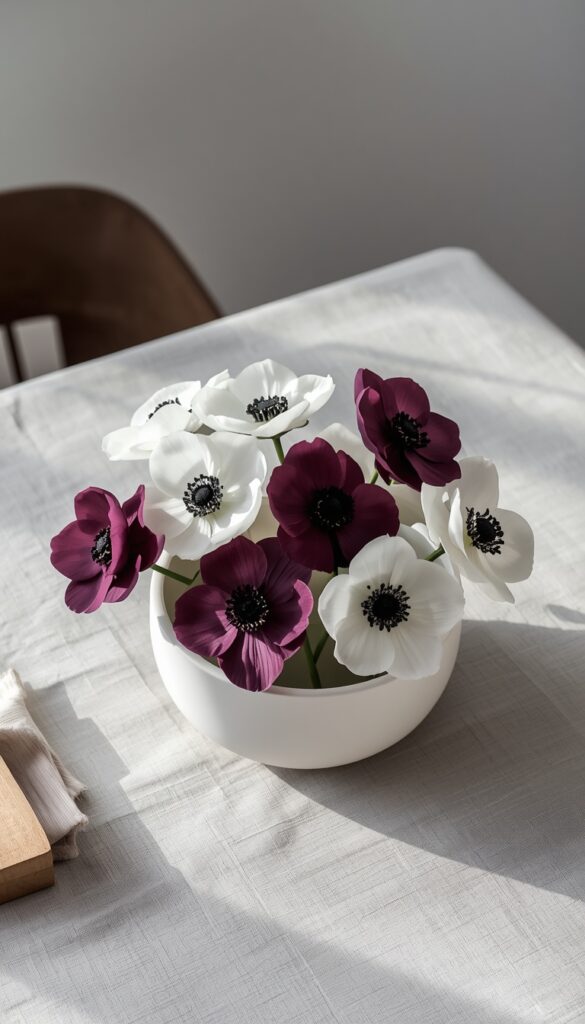
Anemones are one of the most visually striking flowers in existence, yet they remain surprisingly underused in home decor. That wide, flat bloom with its intensely dark center creates a graphic contrast that no other flower replicates. In a room with clean lines and a considered color palette, faux anemones do something genuinely special — they add visual punctuation. White anemones with near black centers in a simple clear vase look more design forward than arrangements that cost ten times as much. Deep purple and rich burgundy varieties work beautifully in moodier, more dramatic rooms. Even a single stem in a small bud vase on a desk or nightstand creates a moment that feels curated and confident.
The flat, open face of anemone blooms makes them behave differently from rounded flowers in an arrangement. They face outward rather than upward, which means they work particularly well in low, wide centerpieces where the blooms are viewed from the side. A shallow bowl or a wide mouthed ceramic vessel filled with seven or eight faux anemones at slightly varying heights creates a centerpiece that looks full and abundant without being tall. Mix white and deep purple anemones together for a high contrast, dramatic effect that suits both modern and maximalist dining tables. For a softer approach, combine blush pink anemones with pale sage greenery and cream colored ranunculus for a romantic, garden inspired arrangement that feels genuinely sophisticated.
Quality faux anemones live or die on the center detail. A real anemone center is one of the most distinctive features in the flower world — densely packed, velvety, and almost jewel-like in its deep dark color, surrounded by a delicate ring of fine stamens. A good faux version replicates this with a textured, slightly raised center that has a matte, almost suede like finish rather than a shiny plastic button. The petals should be slightly crinkled and have a soft, fabric like texture — never smooth or stiff. Color saturation matters here too. Real anemone petals have a slight translucency and depth of color that looks very different from a flat, opaque painted petal. Avoid any version where the center looks like a flat painted circle — that single detail will undermine an otherwise decent stem every single time.
7. Faux Garden Roses — Fuller, Softer, and More Impressive Than Standard Roses
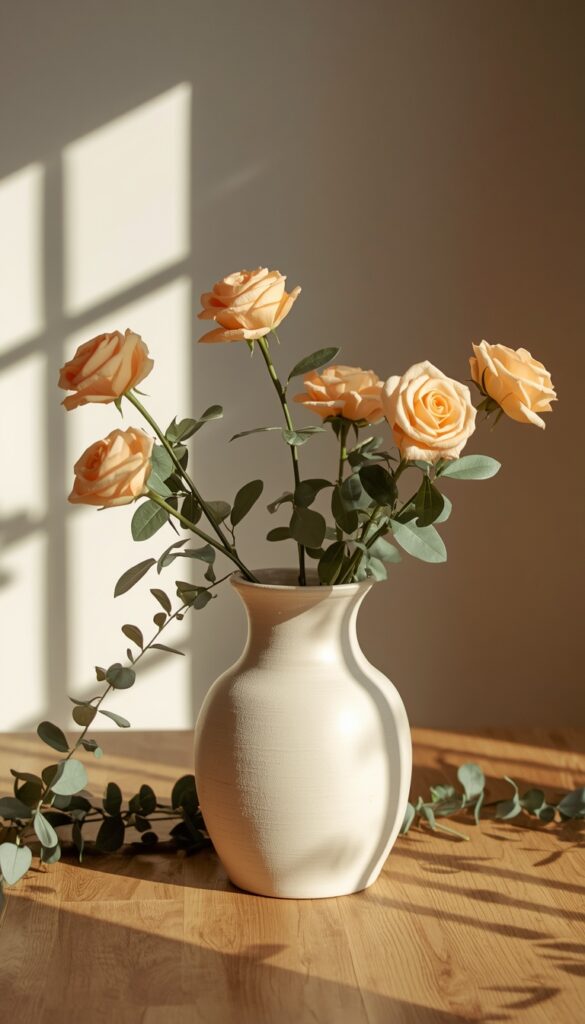
Garden roses and standard roses are not the same flower, and the difference matters enormously in home decor. A classic rose has a tight, high centered bloom with relatively few petals visible at once. A garden rose is an explosion of petals — round, densely packed, overflowing with layers that seem to unfurl endlessly from a soft, spiraling center. The effect is lush, romantic, and almost overwhelmingly beautiful. Three faux garden rose stems in a wide mouthed vase look more abundant than ten standard roses. Soft peach, warm blush, antique cream, and muted coral are the most beautiful and versatile color options for home interiors. They work in bedrooms, living rooms, dining tables, and entry halls with equal elegance.
One styling detail that makes a real difference with faux garden roses is letting some blooms sit lower than others. The natural weight of a full garden rose bloom causes the stem to bow gently, which creates that relaxed, just picked quality. Replicate this intentionally by bending a few stems slightly so their blooms rest closer to the vase rim or even drape over the edge slightly. This one small adjustment transforms a stiff, artificial looking arrangement into something that reads as genuinely organic. Pair garden roses with soft trailing greenery — faux jasmine vine, ivy, or simple eucalyptus — to add movement and fill the spaces between blooms naturally. A textured linen or aged ceramic vase complements the softness of garden roses far better than anything sleek or shiny.
Real touch silicone is the material standard to look for in quality faux garden roses. When you run your finger across a premium petal, it should feel almost indistinguishable from a real rose petal — soft, slightly cool, with a gentle give under pressure. The petal color should show genuine variation: slightly deeper and warmer at the base of each petal, graduating to a softer, cooler tone at the edges. The center of the bloom should be tight and spiral shaped, with the outer petals progressively more open and relaxed as they move away from the center. Realistic thorns on the stem and varied leaf sizes and shapes add to the overall believability. A well made faux garden rose genuinely fools people at conversational distance — and that is exactly the standard worth holding out for.
8. Faux Eucalyptus — The Backbone of Every Beautiful Faux Arrangement
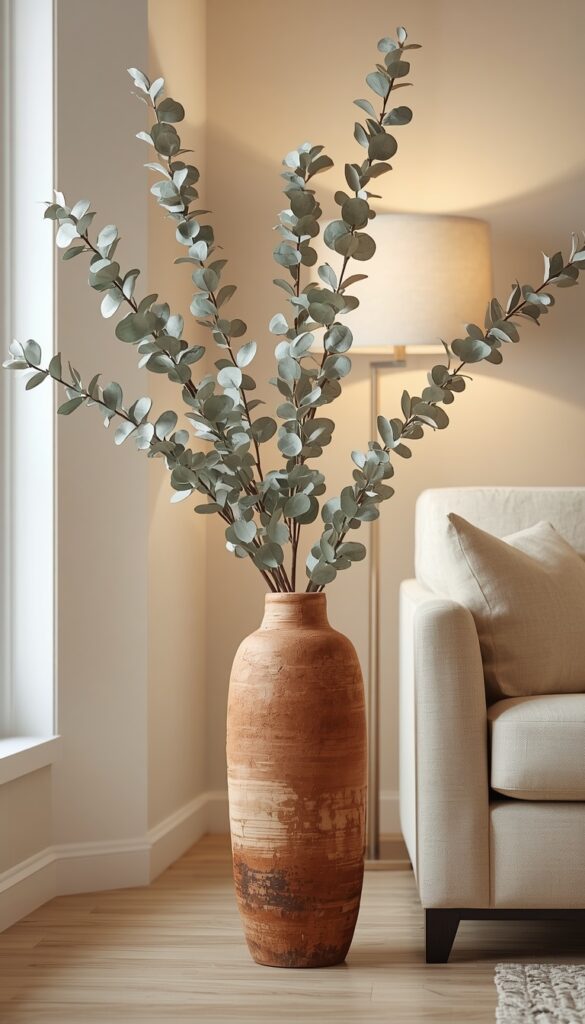
No faux flower collection is complete without eucalyptus, and I say that with complete conviction after years of styling arrangements. Eucalyptus does something that flowers alone cannot do — it creates structure, fills negative space, adds color depth, and makes every flower around it look more realistic and more natural. Silver dollar eucalyptus with its round, stacked leaves is the most popular variety for home decor, but seeded eucalyptus and willow eucalyptus also offer beautiful, distinct textures. Use it alone in a large vessel for a clean, sophisticated green statement. Use it as the foundation layer in a mixed arrangement before adding any blooms. Either way, it earns its place in every room of the house.
The reason eucalyptus makes other flowers look more realistic is simple — real flower arrangements always include foliage. When you place faux flowers alone in a vase without any greenery, the brain registers something slightly off, even if it cannot identify what. Add realistic faux eucalyptus, and suddenly the whole arrangement reads as believable. The gray green tone of eucalyptus is also one of the most universally flattering colors in home decor. It does not compete with warm tones or cool tones — it complements both. This makes it the ideal bridge between different flower colors in a mixed arrangement. Trailing eucalyptus branches in a tall floor vase also add height and movement to a space in a way that feels organic rather than decorative in the obvious sense.
Eucalyptus quality assessment starts with leaf color. Real eucalyptus leaves are never a single uniform green. They show a range from silvery blue green to deeper sage, with a slight powdery bloom on some varieties that gives them a muted, dusty appearance. Any faux version that is uniformly bright green is immediately identifiable as artificial. Good quality stems show genuine color variation across individual leaves and between leaves on the same stem. The leaves themselves should feel soft and slightly pliable, not hard or brittle. Stem bendability is crucial for eucalyptus specifically, because you need to shape trailing branches into natural, organic curves rather than leaving them pointing stiffly in one direction. Sets that include multiple stem lengths give you the most flexibility for different vases and arrangement styles.
9. Faux Cotton Stems — Texture First Styling for Neutral and Farmhouse Spaces
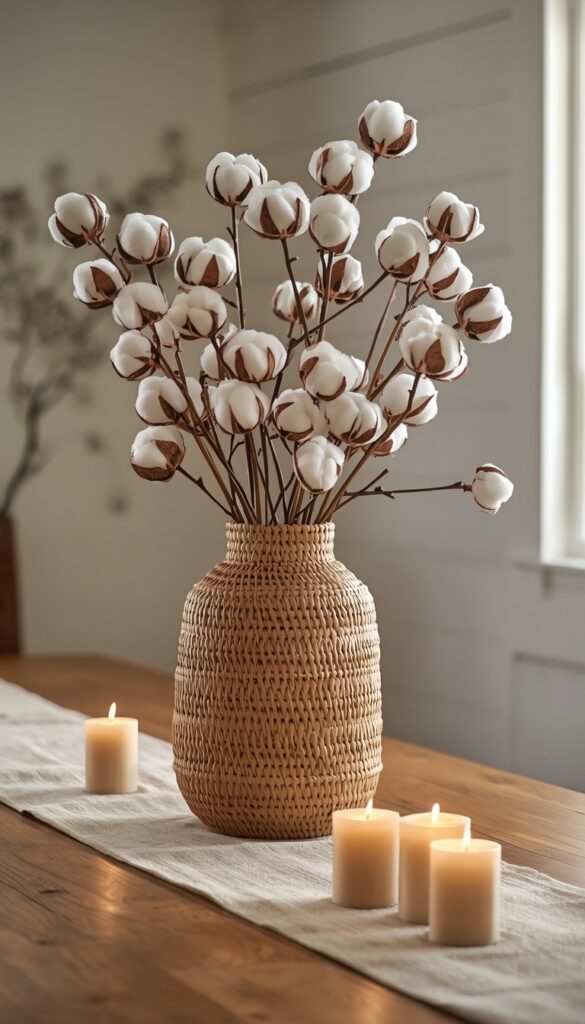
Cotton stems bring something to home decor that almost no other faux stem can offer — pure, tactile texture as the primary design element rather than color or petal shape. Those fluffy white cotton bolls on warm brown stems have a quiet, confident beauty that works in interiors where color is intentionally restrained. Farmhouse, coastal, Scandinavian, and earthy neutral aesthetics all benefit enormously from cotton stems. But here is what most people miss — they also work beautifully in contemporary and transitional spaces as a textural counterpoint to harder, smoother surfaces. A bundle of faux cotton stems in a matte black vase on a white marble surface creates a contrast that feels fresh, intentional, and genuinely stylish. The organic softness against the hard surfaces is the whole point.
Cotton stems are one of the most seasonally flexible faux stems available, which makes them an excellent long term investment for your decor. In summer, a few stems in a clear glass bottle on a window ledge look light and airy. In autumn, bundle them with faux wheat stalks, orange zinnias, and dried style grasses for a harvest inspired centerpiece that suits the season perfectly. In winter, they read as soft and snowy alongside candles and evergreen stems. In spring, pair them with pale blooms and fresh greenery for a clean, nature inspired arrangement. Very few decorative stems transition this seamlessly across the entire year. This versatility alone justifies keeping a good supply of quality faux cotton stems in your decor rotation at all times.
The quality difference in faux cotton stems is immediately obvious once you know what to look for. The cotton ball itself should be soft, fluffy, and irregularly shaped — real cotton balls open unevenly in an organic, imperfect way. Any version with a perfectly round, uniform ball of cotton looks cheap and artificial immediately. The base of the boll — the dried, papery husk that surrounds it where it meets the stem — should be present and realistic, with a slightly ragged, natural edge. The stem color should be a warm, realistic tan or brown, not bright green. Bendable wire stems are essential for this flower type because you need to tilt and position each boll at a natural, slight angle rather than having every one pointing straight up like a row of lollipops.
10. Faux Pampas Grass — Effortless Boho Texture Without the Mess
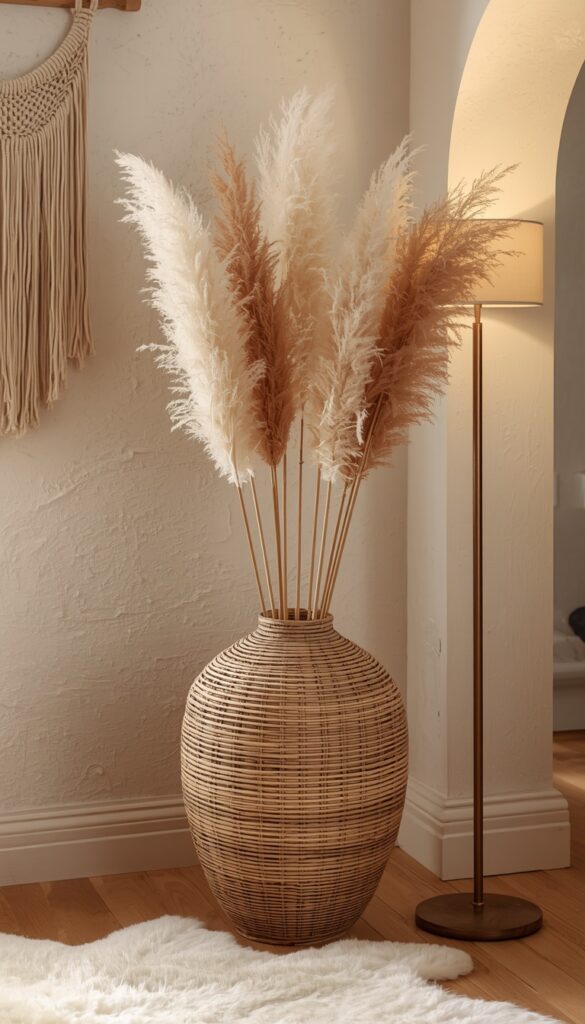
Real dried pampas grass is beautiful, but anyone who has owned it knows the nightmare of those fine fibers shedding across every surface in the room for months. Faux pampas grass solves that problem completely while delivering the same soft, feathery, romantic visual that has made pampas one of the most popular home decor elements of the past several years. The large, plume-like heads in cream, blush, caramel, and warm white add instant warmth and texture to any space. They work in bohemian, coastal, Scandinavian, and modern farmhouse interiors, but honestly, a well placed pampas arrangement suits almost any room that benefits from softness and organic movement — which is most rooms.
Scale is the key to using faux pampas grass effectively. Tall stems in a large floor vase make the biggest impact — three to five stems of varying heights in a round rattan or woven seagrass floor vase create a corner display that reads as a genuine design moment. Place this kind of arrangement in an empty corner of a living room, behind a reading chair, or beside a fireplace and watch how it transforms the feeling of the space. For smaller displays, mini pampas plumes in a medium vase on a sideboard or console work beautifully alongside harder decorative objects like ceramic sculptures, candles, and stacked books. The softness of pampas fibers provides a natural visual counterbalance to rigid objects, which is exactly the kind of intentional tension that makes a styled surface look genuinely designed.
Faux pampas quality comes down to plume density and fiber softness. A full, high quality pampas plume should look abundant and slightly voluminous — the fibers should be fine, lightweight, and numerous enough to create genuine fullness rather than a sparse, thin plume that looks deflated. Real dried pampas move gently in air currents and have an almost luminous quality in natural light. The best faux versions use fine synthetic fibers that behave similarly. Color should be soft and slightly varied — creamy white with warm undertones, not a flat, single tone white that looks painted. Many high quality faux pampas stems can also be gently fluffed by hand after unboxing, which significantly improves the fullness and overall appearance. Always do this before placing them in a vase — the difference it makes is substantial.
11. Faux Sunflowers — Warm, Cheerful, and Endlessly Inviting
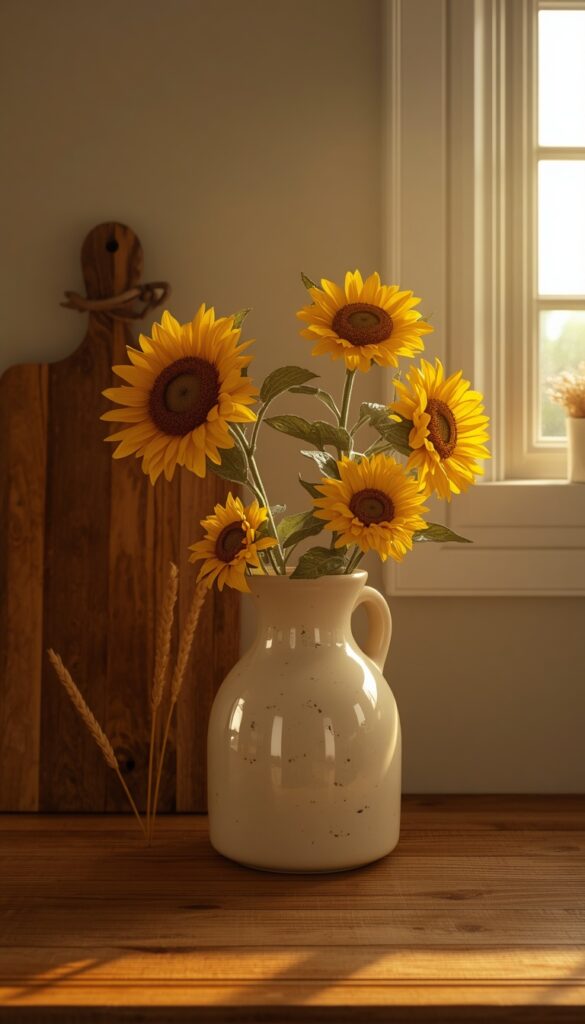
Sunflowers have a personality that no other flower quite matches. They are bold, warm, and openly joyful in a way that immediately lifts the energy of a room. The best spaces for faux sunflowers are the casual, lived-in ones — kitchens, breakfast nooks, family rooms, mudrooms, and covered porches. These are rooms where comfort and warmth matter more than formality, and sunflowers deliver both in abundance. A generous bunch of faux sunflowers in a chunky ceramic jug or a simple galvanized metal bucket on a kitchen counter creates a display that looks completely natural and genuinely welcoming. It is the kind of arrangement that makes a house feel like a home rather than a showroom, and that quality is worth more than most people realize.
Faux sunflowers mix beautifully with other warm toned stems. Combine them with faux wheat stalks, rust orange zinnias, and warm green eucalyptus for a harvest centerpiece that belongs on a farmhouse dining table. For a simpler approach, arrange three sunflower stems at different heights in a clear glass vase and fill the base with smooth river pebbles to anchor the stems — this looks effortlessly styled and costs almost nothing to put together. Sunflowers also work well in outdoor adjacent spaces like sunrooms and covered porches because their bold, sun soaked color creates a visual bridge between inside and outside. One important styling note — sunflowers look better in odd numbers. Three, five, or seven stems always look more natural and visually balanced than even numbers.
Sunflower quality assessment has two clear focal points — the center disc and the petal texture. The center of a real sunflower is one of the most complex textures in the natural world. It has a dense, seed-like surface with a slightly raised, geometric pattern that is very difficult to fake convincingly at low quality levels. Good faux sunflowers replicate this with a granular, slightly rough texture rather than a smooth, painted circle. Petals should be slightly crinkled and matte — real sunflower petals have zero shine, and any glossiness is an immediate quality red flag. The green calyx at the back of the bloom should feel slightly rough and have a subtle hair like texture on its surface. Bendable stems that allow you to vary the angle and direction of each bloom are essential for natural looking sunflower arrangements.
12. Faux Monstera Leaves — Bold, Tropical, and Architecturally Stunning
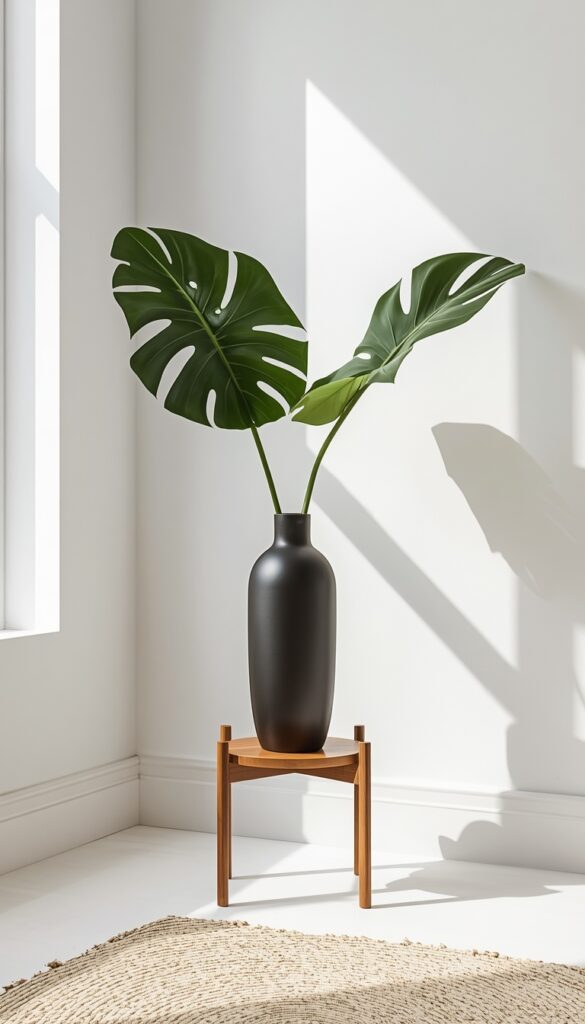
Faux monstera leaves occupy a unique space in home decor because they function more like living sculpture than decorative flowers. Their large, deeply split leaves — those dramatic fenestrations are the defining feature — bring a tropical boldness and structural confidence that no floral bloom can match. A single large faux monstera leaf in a tall, slim vase makes a statement that is both minimal and impactful simultaneously. This is the ideal choice for spaces with high ceilings, bare walls, and minimal furniture where the room needs visual weight and presence without clutter. Contemporary, Japandi, tropical, and maximalist jungle style interiors all benefit from monstera leaves, but they honestly suit any space brave enough to commit to something with genuine scale and presence.
The best way to use faux monstera leaves is to think of them as a design element rather than just a decorative accessory. Use one large leaf as a backdrop behind a cluster of shorter faux blooms in a wide vase — the deep green immediately makes every flower color more vivid and the overall arrangement more complex and layered. Combine two or three monster leaves of different sizes in a floor vase alongside faux bird of paradise stems for a lush, tropical display that fills an entire corner. On a smaller scale, a single medium monstera leaf in a concrete or dark ceramic pot on a console table adds an architectural, considered quality that smaller flowers cannot achieve. The key is always to let the leaf’s natural shape and scale do the work without overcrowding it.
Monstera leaf quality is judged by surface texture, color depth, and the precision of the fenestrations. Real monstera leaves have a glossy surface with clearly visible, slightly raised veins that run from the center stem outward to the leaf edges. The color is a rich, deep green with subtle variation — slightly lighter along the veins and deeper between them. The splits in the leaf should have clean, smooth edges that mirror the organic precision of the real plant. Avoid versions where the cuts look rough, uneven, or too perfectly symmetrical. The stem should be sturdy enough to support the full weight of the large leaf without drooping or collapsing. Premium faux monstera leaves sometimes include the papery brown sheath at the base of the stem that surrounds new growth on real plants — this detail is a genuine mark of exceptional quality.
13. Faux Wisteria Stems — Cascading Drama for Elevated, Romantic Spaces
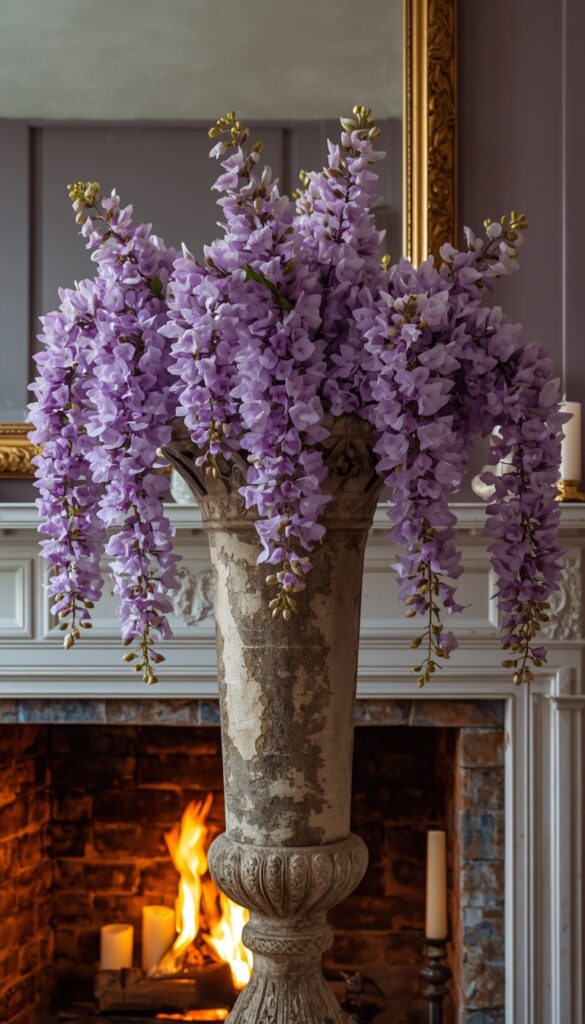
Wisteria is one of the most romantic and visually dramatic flowers in the natural world, and its faux version brings that same cascading, dreamy quality into home decor in a way that very few other stems can replicate. Long, hanging clusters of tiny blooms in soft purple, pale lilac, and creamy white drape naturally from their stems, creating a waterfall effect that is genuinely breathtaking in the right setting. Faux wisteria works beautifully in romantic, maximalist, and cottagecore interiors where abundance and softness are the guiding principles. Display a long stem draped over the edge of a tall vase on a high shelf, wound loosely around a stair railing, or arranged in a wide urn on a fireplace mantel for an effect that stops people in their tracks.
The cascading nature of wisteria makes it uniquely suited to styling situations where height and drape are the design goals. Place a tall, substantial vase on a high shelf or the top of a bookcase and let long wisteria stems drape downward over the edge. This creates a romantic, almost theatrical display that draws the eye upward and fills vertical space in a way that no upright flower arrangement can achieve. Wisteria also works beautifully woven into garlands, wreaths, or floral wall installations. For a dining table centerpiece, lay a long wisteria stem horizontally down the center of the table in a shallow tray with a few pillar candles — this creates an instantly romantic tablescape that looks like genuine effort but takes almost no time at all to put together.
Faux wisteria quality centers on two things — the density of the bloom clusters and the natural drape of the stem. Real wisteria hangs in full, pendulous clusters with dozens of tiny individual florets packed tightly together. Each floret should have a realistic pea flower shape with subtle color variation from the base to the tip of the cluster. Avoid versions where the clusters look sparse, thin, or uniformly colored throughout. The stem itself needs to be flexible enough to drape naturally under the weight of the bloom clusters — a stiff stem that holds an unnatural angle immediately destroys the cascading effect that makes wisteria so distinctive. The best faux wisteria stems use a weighted, flexible wire core that allows the clusters to hang at realistic angles while still holding whatever shape you set them in.
Conclusion
Choosing faux flowers for your home is not about settling for less — it is about making a smarter, longer lasting choice that keeps your space beautiful every single day. The thirteen flowers and stems covered in this guide represent the full range of what high quality faux botanicals can do for a home. From the lush romance of garden roses and ranunculus to the bold architecture of protea and monstera, there is a faux stem here for every room, every style, and every kind of home decorator. The key is always quality first — a few premium stems will always outperform a vase full of cheap ones. Start with two or three of these, style them with intention, and you will quickly understand why so many home decor lovers have made the switch permanently. Your most beautiful home is closer than you think.
Frequently Asked Questions
Q: What are the most realistic faux flowers for home decor? A: Faux peonies, garden roses, and ranunculus made with real touch silicone petals are consistently the most realistic options available. Look for stems with natural color gradients, layered petals, and flexible wire stems. Quality brands that use weighted, poseable stems and botanical accurate leaf details produce results that genuinely fool people at close range.
Q: How do I make faux flowers look real in a vase? A: Start by bending each stem into a natural, slightly curved shape before arranging. Use stems of at least two different heights and let one or two blooms rest lower than others. Mix flowers with realistic faux greenery like eucalyptus, which immediately makes the whole arrangement look more organic. Avoid packing stems too tightly — real arrangements have breathing room between blooms.
Q: Are faux flowers worth the money for home decorating? A: Absolutely, when you buy quality. A set of premium faux stems costs roughly the same as two or three weeks of fresh flowers, but lasts for years with no maintenance. The long term savings are significant. Beyond cost, you get consistent beauty in rooms with low light, high traffic, or pets where real flowers would not survive well anyway.
Q: How do you clean faux flowers without damaging them? A: The easiest method is using a hairdryer on a cool, low setting to blow dust off gently. For light surface dust, a soft makeup brush or a microfiber cloth works well on petals. Avoid water on real touch silicone flowers as it can leave marks. Fabric stems can be lightly misted and air dried if needed. Clean them every few weeks to keep them looking fresh.
Q: What faux flowers work best in a bedroom? A: Soft, romantic blooms work best in bedrooms — dusty pink ranunculus, blush garden roses, white peonies, and lavender all create a calm, restful atmosphere. Keep arrangements small and placed on a nightstand, dresser, or vanity. A single stem in a small bud vase often looks more intentional and elegant in a bedroom than a large, complex arrangement.
Q: Can faux flowers be used in a bathroom? A: Yes, and bathrooms are actually one of the best places for faux flowers because real flowers struggle in humid, low light conditions. Lavender bundles, small eucalyptus stems, and a few ranunculus in a simple vase all work beautifully on bathroom shelves or countertops. Just keep real touch silicone flowers away from direct water splashes to maintain their finish over time.
Q: What vase looks best with faux flowers? A: Textured, matte finish vases almost always look better with faux flowers than shiny or very polished ones. Cream ceramic, rough terracotta, aged stone, and linen textured vessels all complement artificial stems beautifully because they share the same organic, natural quality. Clear glass works well in bright spaces where light plays through the arrangement. Match the vase scale to the flower type — tall slim vases for branches, wide mouths for full round blooms.