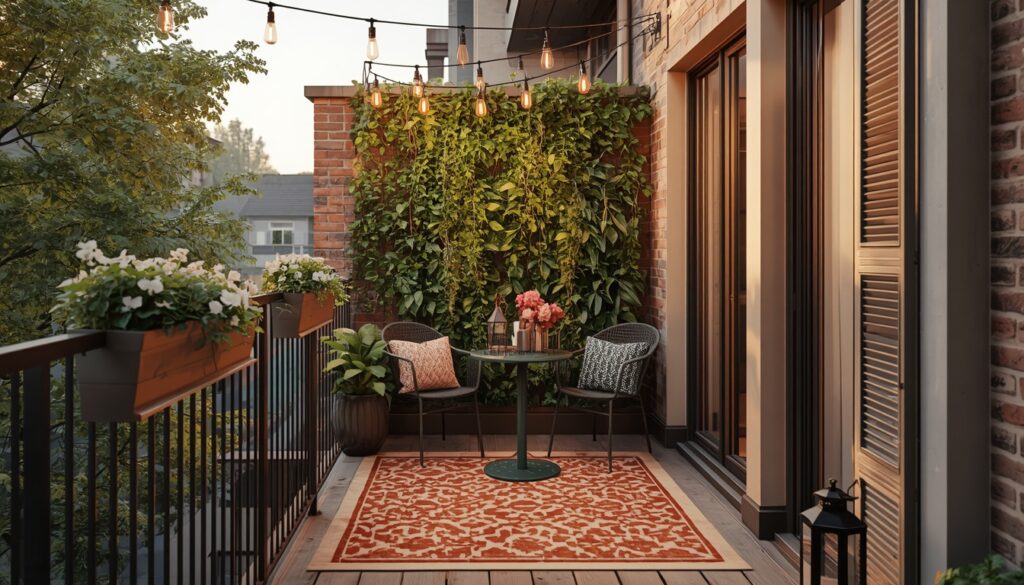
A narrow balcony is not a problem. It is an untapped opportunity. Most people look at a slim outdoor strip and see limitations. Experienced decorators look at the same space and see a private retreat waiting to happen. The truth is, narrow balconies often end up more beautiful and more functional than wider ones — because every single inch gets intentional treatment. Nothing is wasted. Nothing is random. When you work within tight constraints, every chair, every plant, every light string earns its place. That focused approach creates spaces with genuine personality and purpose.
The ideas in this guide are not theoretical. They work in real apartments, real climates, and real life. Whether your balcony fits one person or two, whether it faces a busy street or a quiet courtyard, these solutions will transform how you think about and use your outdoor space. Some ideas cost almost nothing. Others are worth a small investment that pays off every single day you step outside. Read through all fourteen — because even one great idea can completely change what your narrow balcony becomes.
1. Folding Wall Mounted Table — Eat Outside Without Losing Floor Space
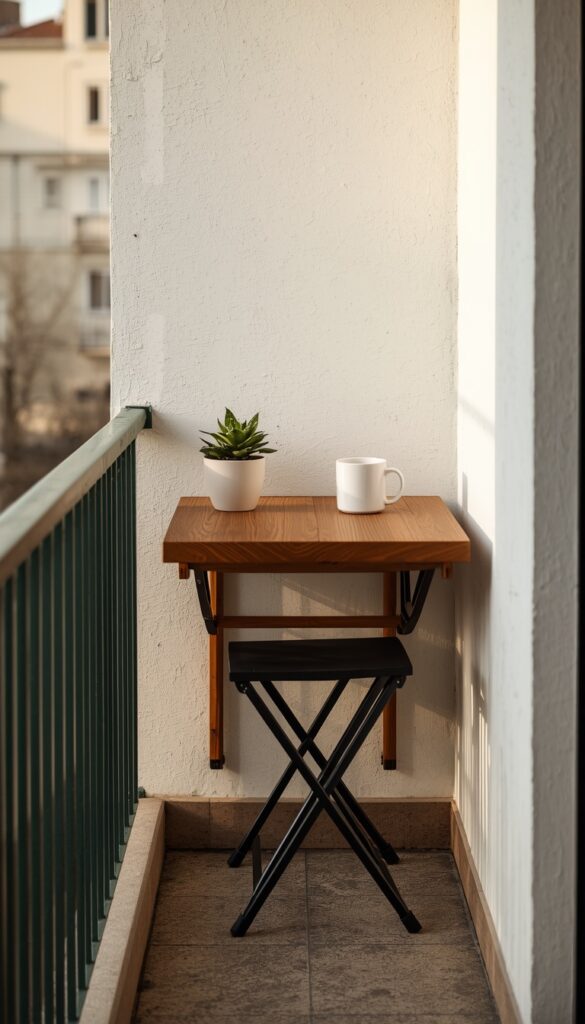
A wall mounted folding table is the single smartest furniture investment for a narrow balcony. When it folds down, it gives you a full surface for morning coffee, outdoor meals, or laptop work. When you fold it back up, it sits flush against the wall and disappears completely — returning every inch of floor space to you. These tables come in wood, metal, and powder coated steel finishes. Teak and bamboo versions weather beautifully outdoors. The best ones mount securely into wall studs or masonry with hardware rated for outdoor use. A table that wobbles under your coffee cup defeats the entire purpose, so installation quality matters as much as the table itself.
Pair your wall mounted table with one or two folding stools that hang on wall hooks when not in use. This setup creates a complete outdoor dining or working station that stores itself in under thirty seconds. For renters who cannot drill into walls, several brands now make freestanding folding tables with a narrow footprint — under 40 centimeters deep — that tuck flat against a railing or wall when folded. Style the table surface with a small potted succulent, a weather resistant candle, and a simple placemat. This turns a functional surface into a genuinely inviting outdoor spot that feels designed rather than improvised. The difference between a folding table that looks like a camping accessory and one that looks intentional is entirely in how you style the surrounding space.
Choosing the right size matters enormously. A table that is too large dominates the balcony and blocks movement. For balconies under one meter wide, look for tables in the 60 to 80 centimeter width range. This gives you enough surface for two place settings or a laptop and a drink without overwhelming the space. Height matters too — standard dining height works if you use stools, but counter height or bar height can actually feel more natural on a narrow balcony because it keeps your sightline open and creates a less enclosed feeling. Matte finishes in warm wood tones or dark charcoal integrate far more naturally into outdoor spaces than bright, shiny surfaces that reflect harsh sunlight.
2. Vertical Garden Wall — Lush Greenery That Grows Up Instead of Out
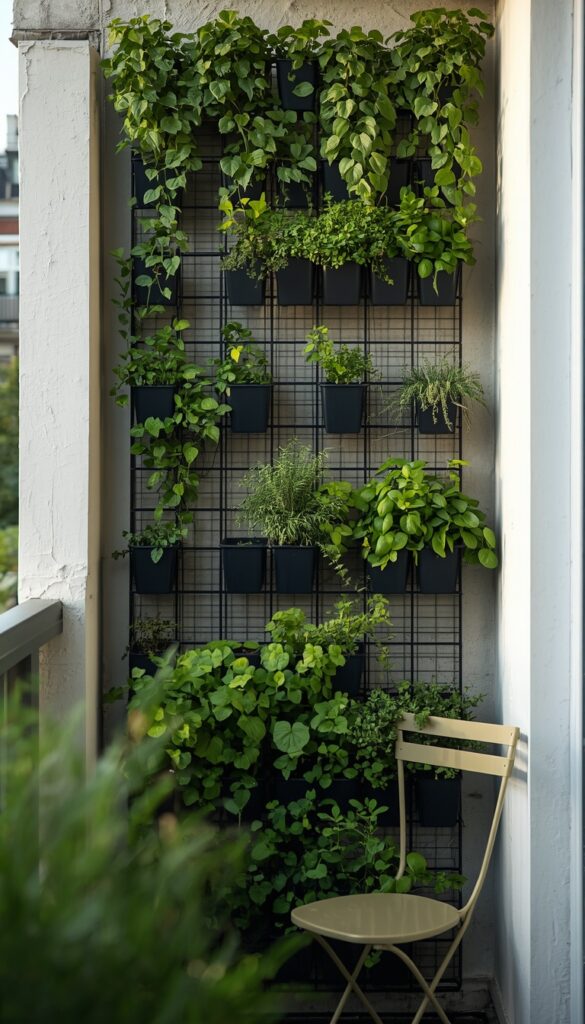
On a narrow balcony, floor space is precious. Every pot on the floor is floor space you cannot stand, sit, or move through. A vertical garden wall solves this completely. It takes your plant collection off the floor and moves it onto the wall, where it creates a living backdrop of greenery that makes the entire balcony feel like a private garden. Wall mounted planter systems, pocket planters, modular grid panels with clip-on pots, and wooden pallet planters all work beautifully for this purpose. The visual impact is immediate and dramatic — a bare wall covered in trailing plants, herbs, and ferns transforms the entire atmosphere of a narrow outdoor space.
The plants you choose for a vertical garden wall make a significant difference in long term success. Trailing varieties like string of pearls, ivy, and creeping jenny spill downward beautifully and create that lush, layered look. Compact herbs like basil, mint, thyme, and parsley grow well in small pockets and give you a functional kitchen garden at the same time. Ferns and peace lilies suit shaded balconies where direct sunlight is limited. For sunny balconies, succulents and lavender thrive in vertical planters without demanding constant watering. Mixing plant heights and textures intentionally — tall upright plants at the top, mid level bushy plants in the center, and trailing varieties at the bottom creates a composition that looks genuinely designed.
Watering a vertical garden requires a slightly different approach than floor pots. Water tends to run down from upper pockets to lower ones, which means upper plants can dry out faster while lower plants may stay wetter. Check moisture levels individually rather than watering everything at once on a fixed schedule. A simple drip irrigation system connected to a timer eliminates this problem entirely and keeps every plant consistently watered without daily effort. Self watering vertical planter systems with built in reservoirs are also worth the investment for busy people. The wall itself needs protection — mount planters on a frame that holds them slightly away from the wall surface to allow air circulation and prevent moisture damage to the wall behind.
3. Narrow Bistro Set — The Classic Two Seat Solution That Always Delivers
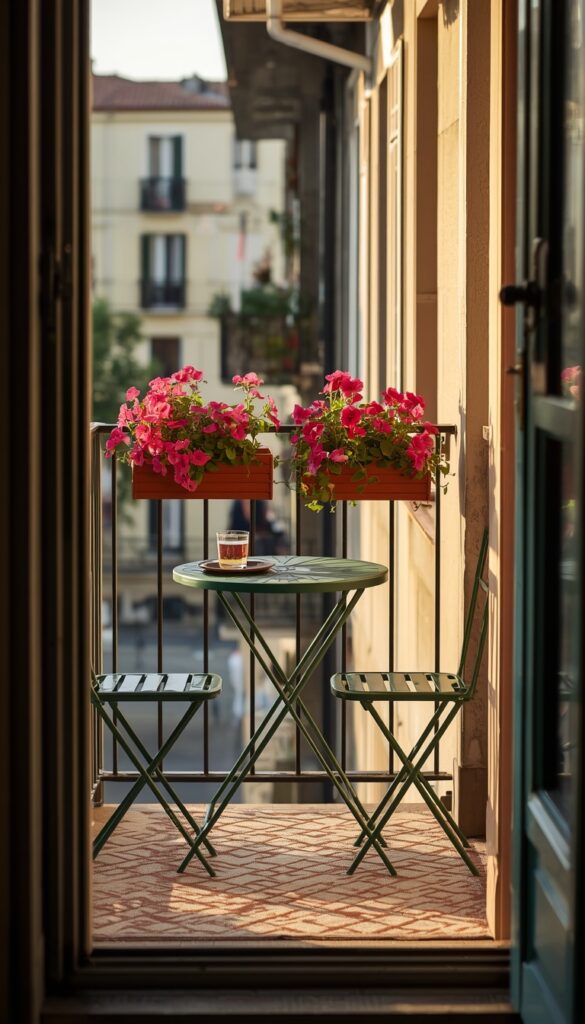
A well chosen bistro set does more for a narrow balcony than almost any other single purchase. Two slim chairs and a small round table create an instantly complete outdoor living moment — a place to sit, a surface to rest things on, and a clear sense of purpose for the space. The key word is slim. Standard outdoor furniture is designed for patios and gardens with generous space. Bistro sets are specifically designed for small, tight spaces — their proportions are scaled down without sacrificing comfort or style. Wrought iron bistro sets have been the classic choice for over a century because they are genuinely durable, lightweight enough to move easily, and visually open enough not to make a small space feel cramped.
Folding bistro sets offer an additional layer of flexibility that fixed furniture cannot match. On days when you want to use the balcony for something other than sitting — morning yoga, container gardening, or simply standing and enjoying the view — a folding set moves aside in seconds. Several contemporary brands now produce bistro sets in powder coated aluminum that weighs almost nothing, resists rust completely, and comes in beautiful matte colors including forest green, terracotta, navy, and warm black. These modern versions have shed the fussy ornate details of traditional wrought iron in favor of cleaner lines that suit contemporary apartments perfectly. A bistro set in a strong color also acts as a design anchor for the entire balcony — everything else you add relates back to it.
Placement on a narrow balcony matters more than most people realize. Pushing the bistro set into a corner — especially the corner with the best view or the most shelter — creates a sense of destination. It makes the balcony feel like a room with a specific sitting area rather than a corridor with furniture in it. Add a small outdoor rug under the table and chairs to define the zone further. Even a rug that extends just 20 to 30 centimeters beyond the chair legs creates a visual boundary that makes the seating area feel intentional and complete. Weather resistant flatweave rugs in natural tones or simple geometric patterns work best in small outdoor spaces where a busy pattern would feel overwhelming.
4. String Lights Overhead — Instant Atmosphere That Costs Almost Nothing
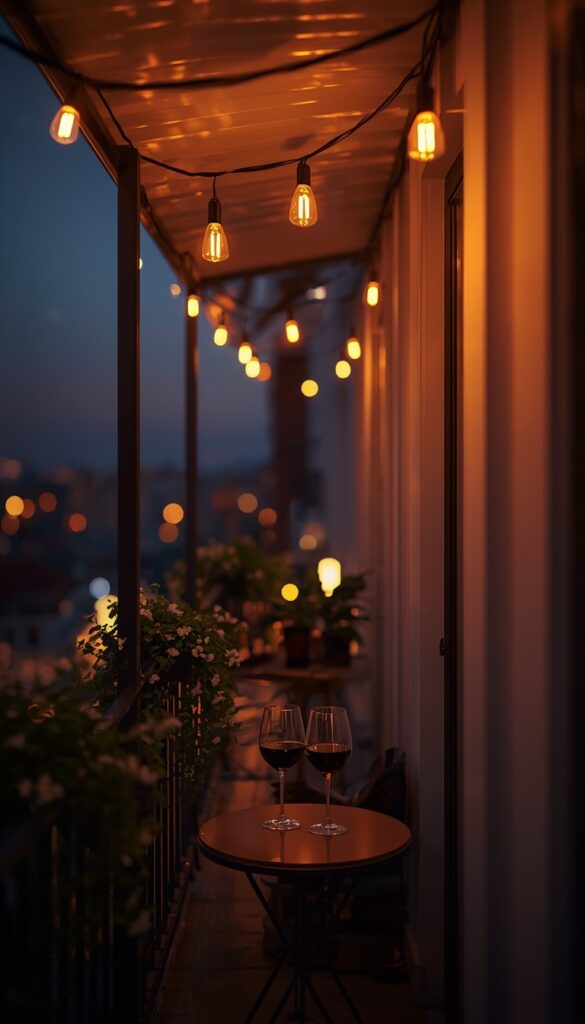
String lights are the most affordable, most impactful transformation you can make to a narrow balcony. A single strand of warm white Edison bulbs strung overhead turns an ordinary outdoor strip into a space that feels genuinely magical after dark. The warm amber glow of good quality string lights does something to the atmosphere of an outdoor space that no other lighting source replicates. It slows everything down. It makes the space feel intimate and separate from the busy world beyond the railing. For apartment dwellers especially, this kind of evening atmosphere on a private balcony is genuinely valuable — it creates a reason to be outside after sundown rather than retreating indoors.
The way you hang string lights matters enormously for the final effect. A single straight line from one end of the balcony to the other looks functional but not particularly beautiful. Instead, hang lights in a gentle zigzag pattern between two walls, or drape them in soft curves from hooks placed at varying heights. This creates depth and movement in the light pattern that a straight line simply cannot achieve. For balconies with only one wall to work with, attach the far end of the string to a tall outdoor planter or a bamboo pole secured in a heavy pot. Waterproof string lights rated for outdoor use are essential — interior string lights degrade quickly in outdoor conditions and become a safety concern.
Bulb choice shapes the entire mood of the space. Large vintage Edison bulbs with visible filaments create a warm, nostalgic atmosphere that suits bohemian and rustic balcony styles beautifully. Smaller globe bulbs in a tighter string give a more contemporary, refined look that suits modern and Scandinavian inspired spaces. Cool white string lights work in very specific design contexts — minimalist, industrial, or coastal spaces where a crisper light suits the aesthetic. For most residential balconies, warm white in the 2700K to 3000K color temperature range creates the most flattering, most inviting atmosphere. Solar powered string lights eliminate the need for an outdoor power outlet entirely and work well in balconies that receive at least five to six hours of direct sunlight daily.
5. Railing Planters — Color and Life Without Using Any Floor Space
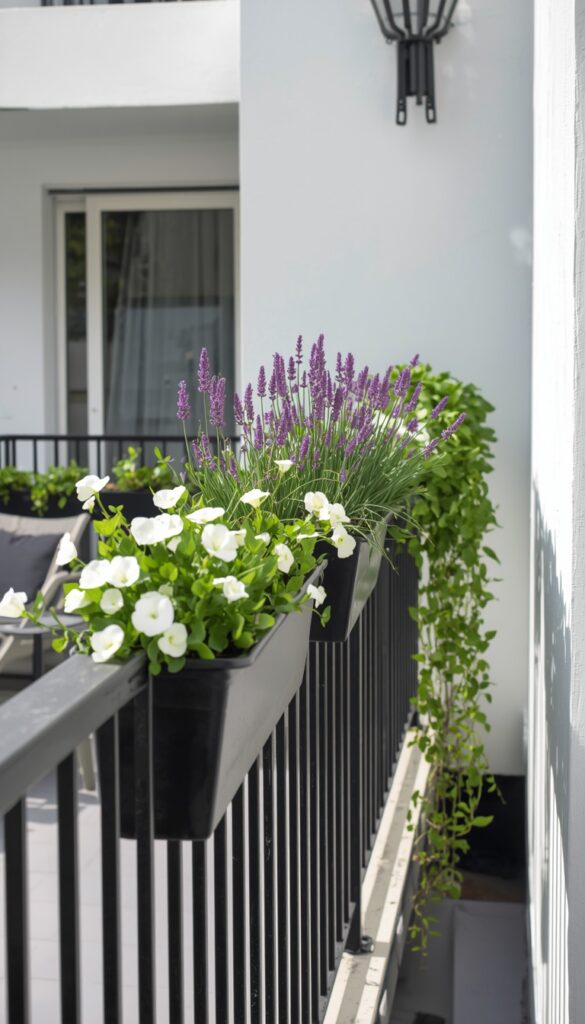
Railing planters are specifically designed for one purpose — turning your balcony railing into a garden. They clip, hook, or strap onto the railing and hold plants at eye level or just above it, which creates a natural privacy screen while adding color, texture, and life to the space. Because they attach to the railing rather than sitting on the floor, they use zero floor space. This makes them the ideal plant solution for the narrowest balconies where even a row of floor pots would create an obstacle. Railing planters come in metal, plastic, and fabric versions. Metal versions in powder coated steel or galvanized iron last the longest and look the most refined. Fabric versions are lighter and better suited to railings that cannot support heavy loads.
Plant selection for railing planters should consider two things — sun exposure and weight. Trailing plants like petunias, lobelia, bacopa, and million bells create a cascading curtain of flowers that spills down the outside of the railing beautifully from the street view below. Upright plants like dwarf lavender, salvia, and ornamental grasses create a hedge like effect that adds privacy from neighboring balconies. For maximum visual impact, mix trailing and upright varieties in alternating planters along the railing length. This creates a layered, full look that a single plant type alone cannot achieve. Keep weight in mind — most balcony railings have load limits, and saturated soil is significantly heavier than dry soil. Lightweight perlite mixed potting soil reduces weight considerably without affecting plant health.
Maintenance for railing planters is straightforward but needs consistency. Plants at railing height are exposed to more wind and direct sun than floor level plants, which means they dry out faster. In summer, daily watering may be necessary during hot spells. Self watering railing planters with built in water reservoirs solve this problem for stretches of hot weather or when you travel. Deadheading spent flowers every few days keeps trailing annual plants blooming vigorously throughout the season rather than going to seed early. At the end of the growing season, railing planters store flat or stacked compactly — they take up almost no storage space compared to floor pots. This practical advantage makes them a genuinely smart long term investment for any small balcony.
6. Floor to Ceiling Outdoor Curtains — Privacy, Shade, and Instant Style
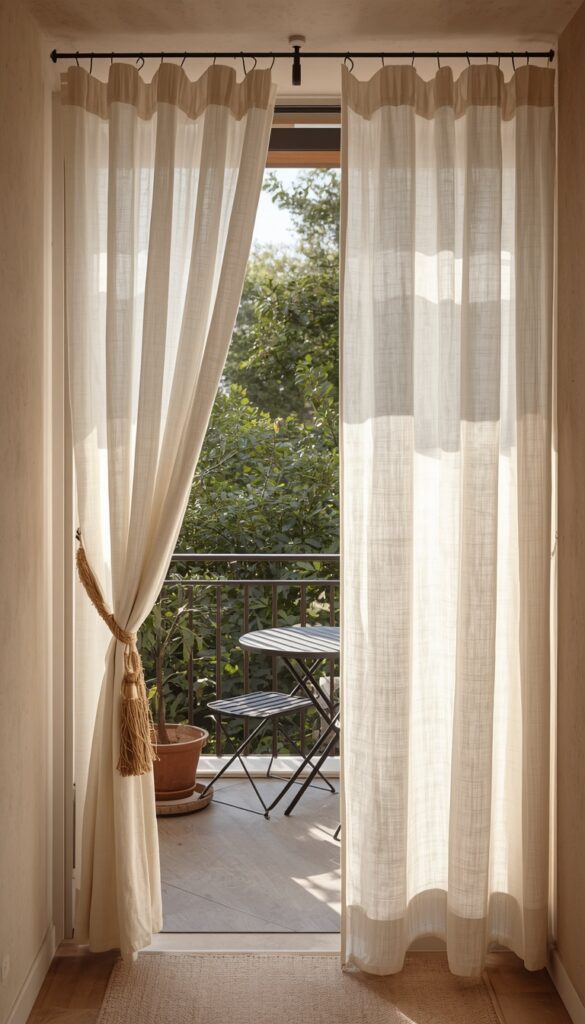
Outdoor curtains transform a narrow balcony from an exposed strip into a genuinely private, sheltered retreat. Floor to ceiling panels hung from a ceiling mounted rod or a tension wire create soft walls of fabric that block sightlines from neighboring buildings, filter harsh afternoon sunlight, and add a dramatic, resort-like quality to even the most basic balcony. When you pull them open, the view returns completely. When you draw them closed, the balcony becomes a private cocoon. This flexibility is exactly what small outdoor spaces need — the ability to shift the feeling of the space depending on your mood and your need for privacy at any given moment.
Fabric choice is critical for outdoor curtains. Indoor curtain fabric deteriorates rapidly in outdoor conditions — it fades, mildews, and weakens within one season. Look specifically for solution dyed acrylic fabrics like Sunbrella, or outdoor rated polyester with UV inhibitors woven into the fiber. These materials resist fading, repel water, and handle temperature swings without breaking down. White and natural linen look fabrics create the most airy, Mediterranean feel in outdoor spaces. Striped fabrics in navy and white or green and white add a classic coastal character. Solid deep tones like forest green, terracotta, or charcoal create a more enclosed, dramatic atmosphere that suits moody, intimate balcony setups. The weight of the fabric also matters — lightweight panels billow beautifully in a breeze while heavier ones hang straighter and provide more wind protection.
The hardware you use to hang outdoor curtains determines how the whole installation looks and functions. Tension wire systems create a clean, architectural line that suits modern balconies perfectly. Traditional curtain rods in matte black or brushed brass suit more traditional and transitional outdoor aesthetics. Always use rustproof hardware — even stainless looking finishes can corrode outdoors in humid climates. For renters, freestanding curtain rod frames that anchor with weighted bases offer a drill free alternative that works surprisingly well. Add curtain tiebacks — simple rope, leather, or natural jute versions — so you can hold panels open elegantly rather than having them blow into the space on windy days. This one detail elevates the whole installation from practical to genuinely designed.
7. Slim Outdoor Daybed or Lounger — Make Your Narrow Balcony a Real Rest Spot
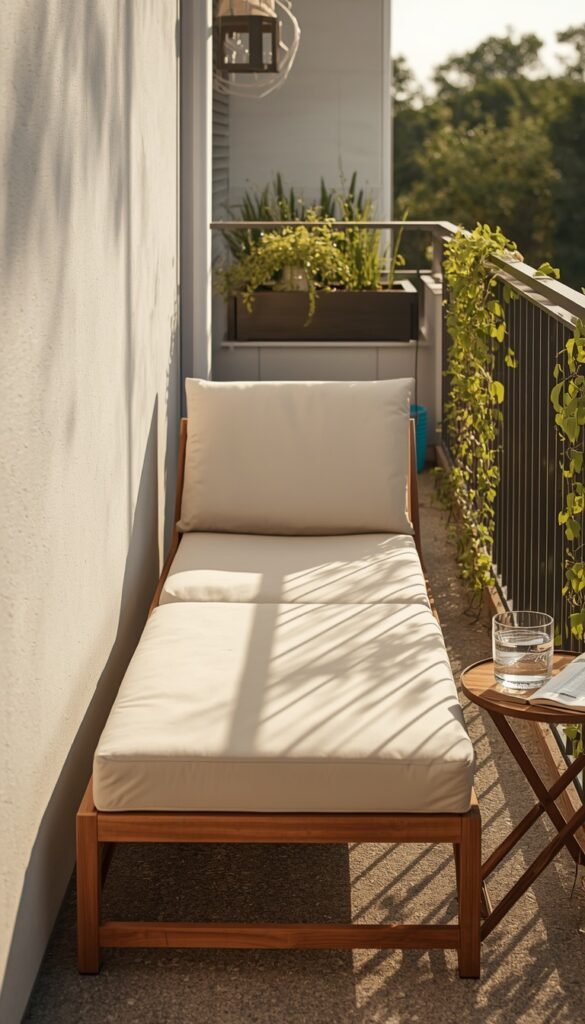
Most people assume a lounger is impossible on a narrow balcony. That assumption is wrong. Several furniture brands now produce slim outdoor loungers specifically designed for tight spaces — models as narrow as 60 centimeters wide and under 180 centimeters long that fit comfortably on balconies where a standard lounger would be completely impractical. These slim designs do not sacrifice comfort for proportion — they simply scale the dimensions appropriately for smaller spaces. A narrow balcony with a well chosen lounger, a small side table, and a string of lights overhead becomes something genuinely special. It becomes the kind of outdoor space that makes waking up in the morning feel like a small luxury.
Positioning a slim lounger on a narrow balcony requires thinking about traffic flow. On a balcony under 90 centimeters wide, a lounge placed lengthwise along one wall leaves just enough space to walk alongside it. A folding side table that tucks under the lounger when not in use keeps the pathway clear. On slightly wider balconies of 100 to 120 centimeters, placing the lounger at a slight diagonal can open up more usable floor space at each end while still fitting the full length of the furniture. Outdoor cushions in weather resistant fabric — Olefin or solution dyed acrylic — add comfort and color. Choose cushion colors that complement your railing planter choices and outdoor curtain tones for a cohesive, finished look.
A slim outdoor lounger works hardest when you treat the surrounding space as a complete zone rather than just furniture on a balcony. Add a small weather resistant basket beside the lounger to hold a book, sunscreen, and a water bottle. Hang a simple hook on the wall within reach for a sun hat. Place a low planter with a trailing plant at one end of the lounger so greenery frames the furniture naturally. These small additions create a sense of intention that transforms a lounger from a piece of furniture into a genuine relaxation destination. That distinction matters because a space that feels designed gets used. A space that just has furniture in it gets ignored, and a narrow balcony that goes unused is a missed opportunity every single day.
8. Vertical Bike Storage — Reclaim Your Balcony From Bicycle Chaos
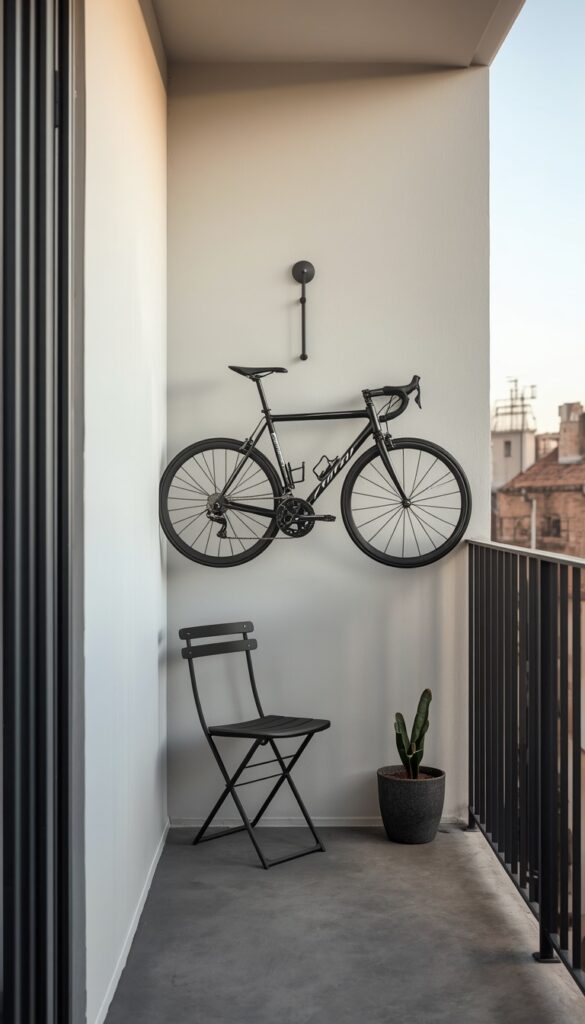
A bicycle on a narrow balcony is the fastest way to make an already tight space feel completely unusable. Most bikes stored horizontally take up 180 centimeters of floor length and 60 centimeters of width — which on a narrow balcony means the bike essentially IS the balcony. Vertical bike storage solves this completely. Wall mounted hooks that hold a bike vertically — front wheel up — reduce the bike’s floor footprint from 180 centimeters down to roughly 40 centimeters. That reclaimed space is transformative. Suddenly there is room for a chair, a plant, a table. The balcony becomes usable again instead of being a glorified bike shed with a view.
Several types of vertical bike storage work well for balconies. Simple J hooks mounted directly into a wall stud or masonry hold the bike by one wheel and require minimal hardware. Freestanding vertical bike stands that grip the wheel between two padded rails work for renters who cannot drill into walls — these anchor with their own weight and remain stable even in wind. Ceiling mounted pulley systems hoist the bike completely off the floor and up toward the ceiling, which reclaims even more usable space below. For balconies with enough ceiling height, typically 250 centimeters or more — a ceiling hoist is the most space efficient solution available. The bike hangs overhead and the entire floor below remains completely open for other uses.
Beyond the practical benefit, vertical bike storage also protects the bike itself. Bikes stored on the floor of a balcony accumulate moisture underneath the frame and in contact points with the floor surface. This accelerates rust on steel frames and degrades rubber components faster than bikes stored with airflow around them. A vertically mounted bike has better air circulation around the entire frame, which extends its lifespan in outdoor conditions. Cover a vertically stored balcony bike with a fitted waterproof bike cover during extended rainy periods to protect components fully. This combination of smart storage and basic weather protection keeps a bike in genuinely good condition for years longer than floor storage in an exposed outdoor environment.
9. Outdoor Mirror — The Visual Trick That Doubles Your Balcony Space
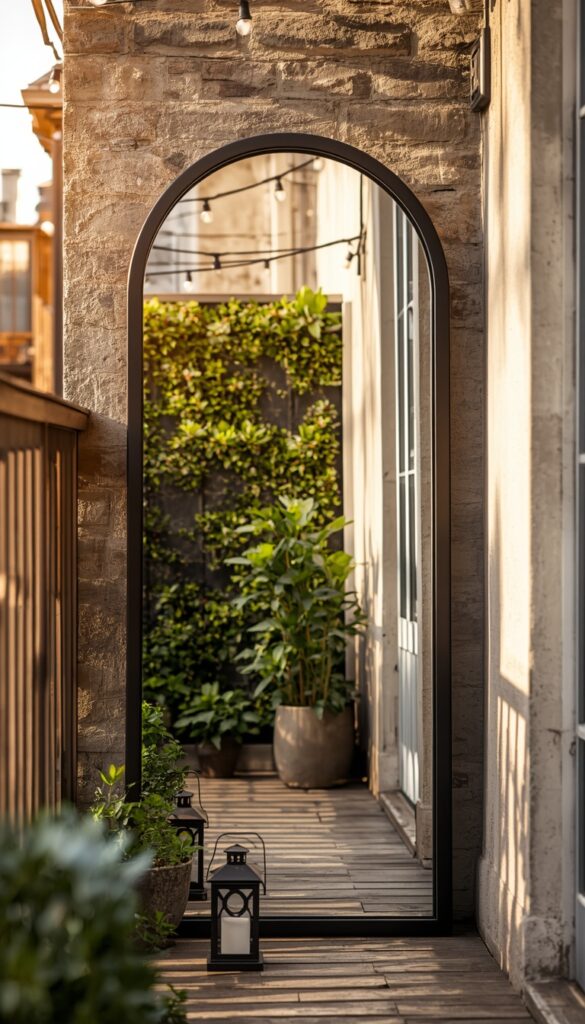
Mirrors are one of the most powerful tools in interior design for making small spaces feel larger. Outdoor spaces benefit from exactly the same principle — and yet almost nobody uses mirrors on their balcony. A large weather resistant mirror mounted on the back wall of a narrow balcony creates an immediate visual doubling effect. The reflection of plants, lights, furniture, and sky makes the space feel twice its actual size. It also bounces light into shadier corners of the balcony, which helps plants grow better and makes the space feel brighter and more open throughout the day. This is one of the simplest, most affordable transformations available for a narrow outdoor space.
Not every mirror works outdoors. Standard interior mirrors are made with silver backed glass that deteriorates rapidly in outdoor humidity — the silver backing oxidizes and creates dark spots and blotching within months of outdoor exposure. Look specifically for mirrors made with aluminum backed glass or acrylic mirror panels, both of which resist outdoor moisture without degrading. Galvanized steel frames, powder coated aluminum frames, and solid teak frames all handle outdoor conditions well. Avoid frames with MDF cores or any wood that has not been properly sealed for exterior use — these swell, crack, and delaminate in wet weather. Lean a large mirror against the back wall rather than mounting it if you rent — a leaned mirror still creates the full visual effect without requiring wall fixings.
Mirror placement on a narrow balcony requires one important consideration — reflection angle. A mirror placed directly opposite a seating area reflects the person sitting there, which can feel uncomfortable and self conscious. Instead, angle the mirror slightly so it reflects the plants, the sky, or the view rather than the people in the space. This creates a much more pleasant visual experience and makes the reflected image look like an extension of the garden rather than a portrait of the occupants. Decorative mirrors with interesting frame shapes — arched, hexagonal, or oval — add a design element beyond the functional benefit. A large arched outdoor mirror against a bare wall is genuinely one of the most striking things you can do to a small balcony with minimal effort and expense.
10. Tiered Plant Stand — Maximum Plants, Minimum Footprint
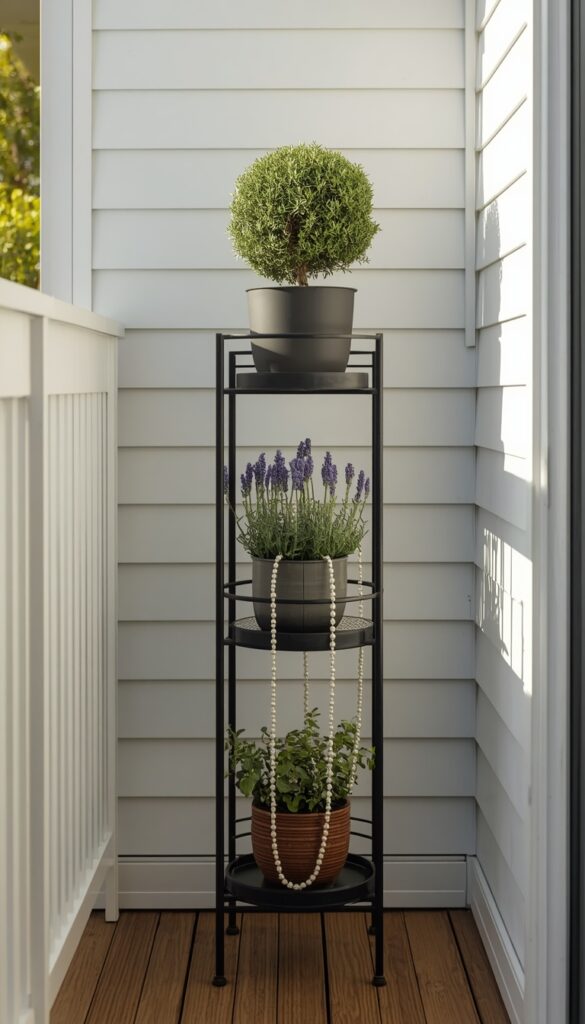
A tiered plant stand concentrates vertical growing space into a small floor area in a way that individual floor pots simply cannot match. A three tier stand that occupies 40 by 40 centimeters of floor space can hold six to nine plants at three different heights — the equivalent of six to nine individual floor pots that would collectively occupy three to four times the floor area. This mathematical efficiency is why tiered plant stands are one of the most popular solutions for narrow balcony gardening. They also create a composed, gallery-like plant display rather than a scattered collection of individual pots, which automatically makes the balcony look more intentional and designed.
Material choice for a tiered plant stand depends on the balcony’s style and climate. Powder coated steel stands in matte black or forest green are the most durable and suit contemporary and industrial aesthetics beautifully. Teak and bamboo stands bring warmth and natural character to more organic, bohemian, or Japandi inspired balcony styles. Wrought iron stands with decorative detailing suit traditional and Mediterranean style outdoor spaces. Whatever material you choose, make sure the stand is rated for outdoor use and that joints and welds are sealed against moisture. Cheaper stands develop rust at poorly finished joints within one season. A quality outdoor rated stand, properly maintained, lasts for many years and looks better with age rather than worse.
Plant selection for a tiered stand should follow a simple visual principle — tallest at the top, most trailing at the bottom. Place an upright plant like a small olive tree, a rosemary topiary, or a tall ornamental grass on the top tier. Mid height bushy plants — compact lavender, dwarf basil, or small succulents — work well on the middle tier. Trailing plants like strings of pearls, ivy, or calibrachoa on the bottom tier spill downward and soften the base of the stand beautifully. This top to bottom composition creates a natural, layered look that feels like a section of a real garden compressed into a single, organized structure. Water top tier plants more frequently as they dry out faster in their elevated, more exposed position.
11. Built In Bench With Storage — Seating and Organization in One Smart Piece
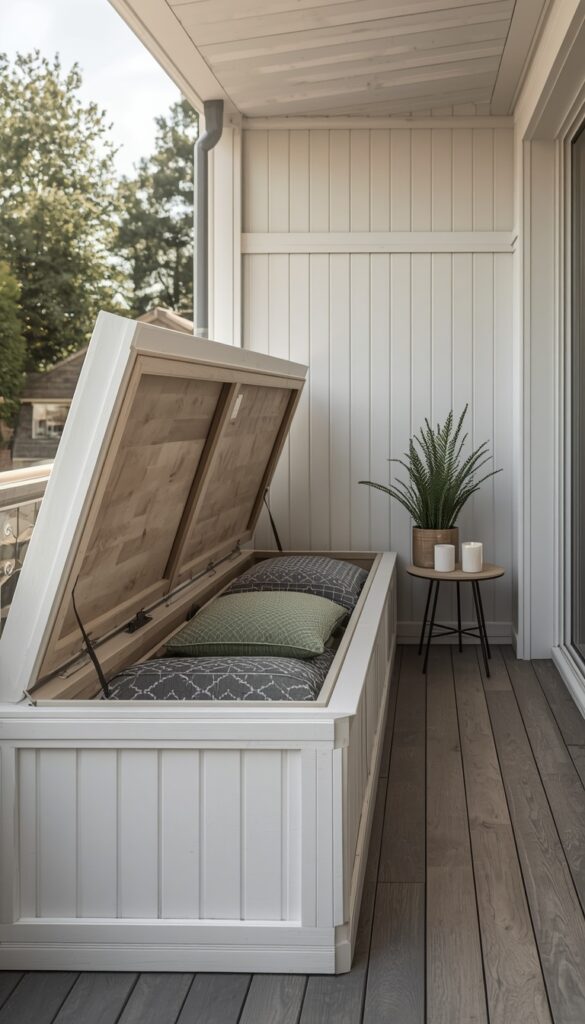
A built-in bench along one wall of a narrow balcony solves two problems simultaneously — it provides comfortable seating without the visual bulk of freestanding chairs, and it hides outdoor storage inside a weatherproof box below the seat. Cushions, plant tools, extra pots, outdoor candles, and seasonal items all disappear inside the bench base while the top surface becomes a comfortable place to sit. The bench runs the length of the wall, which means it uses wall space rather than floor space. The floor in front remains clear for movement, a small table, or additional plants. This integrated approach to seating and storage is the defining feature of genuinely well designed small outdoor spaces.
Building a simple outdoor bench is more achievable than most people assume. The basic structure is a rectangular box made from pressure treated timber or exterior grade plywood, sealed with outdoor paint or decking oil. The seat lid attaches with piano hinges that allow it to lift fully and stay open while you access the storage below. Gas struts — the same mechanism used in car boot lids — make the seat lid stay open hands free, which is far more practical than a lid that closes on your fingers. The front and sides of the bench can be finished with cladding boards, tongue and groove timber panels, or painted plywood depending on your preferred aesthetic. A bench cushion made from outdoor foam covered in weather resistant fabric completes the transformation from storage box to genuine seating.
For renters or people who prefer not to build, several flat pack outdoor storage benches are available in teak, eucalyptus, and powder coated aluminum that require no construction beyond basic assembly. These freestanding versions offer the same combined seating and storage function without any permanent installation. Look for models with a seat opening large enough to be genuinely useful — at least 40 centimeters deep and 30 centimeters tall inside the storage cavity. Smaller storage openings look good but hold almost nothing useful. A bench 120 to 150 centimeters long suits most narrow balconies well — long enough to lie on with a cushion for reading, short enough to leave adequate floor space in front for comfortable movement and a small side table.
12. Outdoor Rug — The Fastest Way to Make a Balcony Feel Like a Room
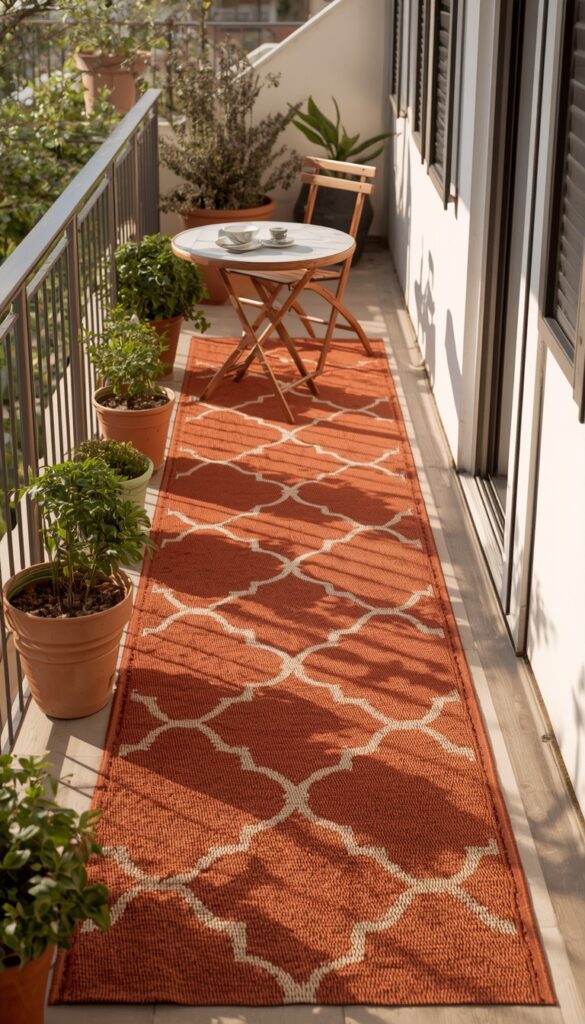
An outdoor rug is the single fastest transformation for a narrow balcony. It costs very little, takes five minutes to lay down, and immediately changes the feeling of the space from utilitarian to genuinely livable. A rug defines the balcony as a room rather than a corridor. It adds color, pattern, and warmth underfoot that bare concrete or tile simply cannot provide. It also softens the visual hardness of outdoor surfaces, which makes the entire space feel more inviting and comfortable. In terms of impact per dollar spent, an outdoor rug competes with any other single purchase you can make for a small balcony — and it requires zero installation, zero tools, and zero commitment.
Choosing the right outdoor rug for a narrow balcony requires thinking about proportion carefully. A rug that is too small looks like an afterthought — a bath mat dropped in the middle of the space. A rug that fills most of the floor area creates a genuine room-like feeling. For narrow balconies, a runner style rug that runs the full length of the space works exceptionally well. It draws the eye lengthwise, which makes the balcony feel longer and more spacious. Geometric patterns with linear elements — stripes, chevron, simple grid patterns — reinforce this lengthening effect. Flatweave polypropylene rugs handle outdoor conditions the best — they dry quickly after rain, resist fading in UV light, and can be hosed clean in minutes when they get dirty.
Color and pattern choice for an outdoor rug should relate to the overall palette of the balcony. A rug in a neutral tone — warm sand, natural jute look, or soft gray works with any plant colors, furniture tones, or accessory choices without clashing. A rug with a bold pattern or strong color becomes the anchor of the entire balcony design — everything else you add should relate back to it. Terracotta and cream geometric rugs suit Mediterranean and earthy balcony styles beautifully. Navy and white stripes suit coastal and Scandinavian aesthetics. Black and natural tones suit minimalist and contemporary outdoor spaces. Whatever you choose, make sure the rug extends at least 20 centimeters beyond the legs of any furniture sitting on it — this is the proportion rule that separates a well styled balcony from one that just has a rug on it.
13. Hanging Chair or Hammock Chair — Suspended Comfort for Small Spaces
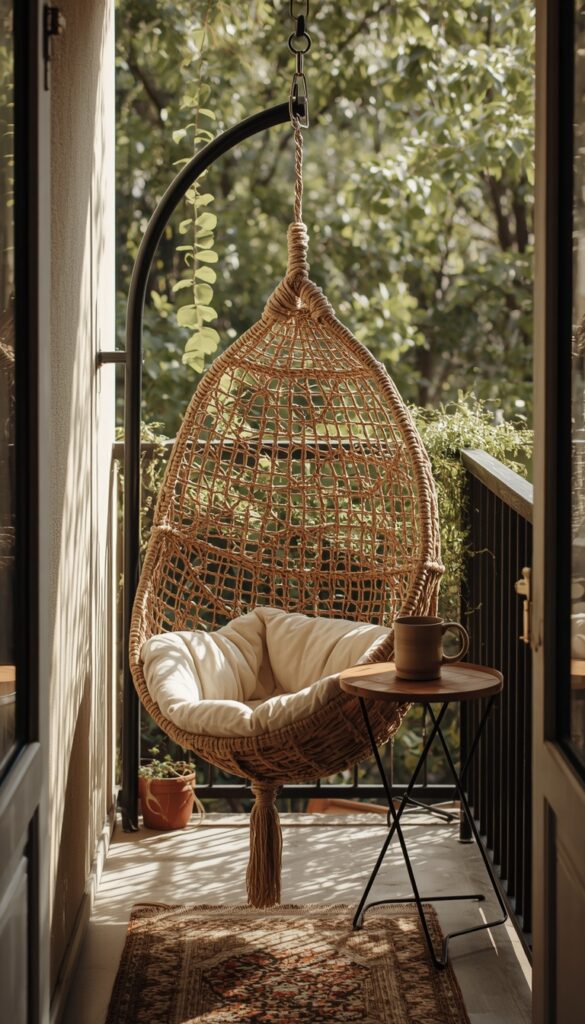
A hanging chair takes seating completely off the floor. This is its genius. Where a floor chair requires a footprint of roughly 60 by 60 centimeters, a hanging chair needs only the single point where it attaches to the ceiling — its floor presence is essentially zero. On a narrow balcony where floor space determines everything, this distinction is transformative. A quality hammock chair or hanging egg chair suspended from a ceiling beam or a wall mounted swing arm bracket creates a seating option that is not only space efficient but genuinely more comfortable and more characterful than any floor chair could be. It moves gently. It cocoons the sitter. It turns the act of sitting on the balcony into an experience rather than just a location.
Installation requires a structurally sound ceiling or wall anchor point that can support at least 150 kilograms — the weight of an average person plus a safety margin. Concrete balcony ceilings typically anchor well with a properly sized expansion bolt and a swivel hook rated for dynamic loads. Timber ceiling joists support hanging chairs with a structural hook screwed directly into the joist. Always check the load capacity of both the mounting hardware and the chair itself before installation. For renters, several brands now produce freestanding hanging chair frames that require no ceiling attachment — these work well on balconies with enough floor depth to accommodate the frame base, typically around 90 centimeters front to back.
Hammock chairs and hanging egg chairs suit different aesthetics and different uses. A woven cotton or macrame hammock chair has a bohemian, organic character that suits plant filled, textural balcony setups beautifully. It is also lighter and packs away easily when not in use. A hanging egg chair with a weather resistant cushion has a more contemporary, lounge like quality that suits cleaner, more minimal balcony styles. Both work equally well for the purpose. Add a small wall mounted folding side table within arm’s reach of the hanging chair so you have a surface for a drink or a book without needing to stand up. A small footrest stool or a stack of outdoor cushions at the base completes the setup and makes extended sitting genuinely comfortable.
14. Lanterns and Candles — Layered Lighting That Creates Real Evening Magic
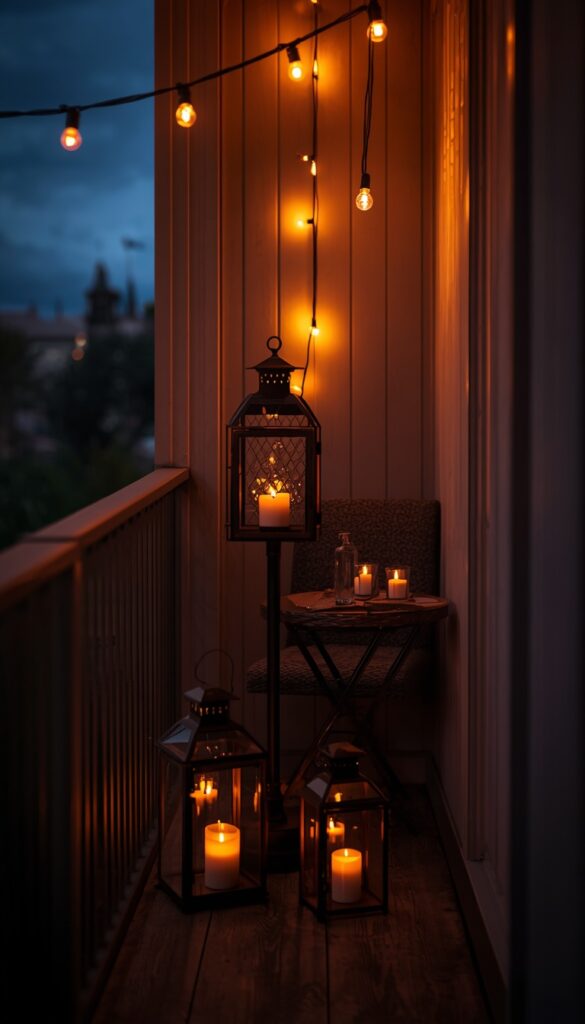
String lights handle the overhead ambient lighting on a narrow balcony brilliantly. But ambient light alone, however warm, creates a flat, one dimensional atmosphere after dark. Lanterns and candles add a second and third layer of light at lower heights — on the floor, on the table, on the bench — that creates the kind of depth and warmth that makes an outdoor space genuinely beautiful in the evening hours. Flickering candlelight at tabletop and floor level, combined with warm string lights above, creates a layered glow that feels atmospheric and intimate in a way that a single light source simply cannot achieve. This combination is the difference between a balcony that is lit and a balcony that feels magical.
Lantern choice for a narrow balcony should balance proportion with presence. Large floor lanterns — 40 to 60 centimeters tall — placed at the ends or corners of the balcony anchor the space and create visual weight at floor level without taking up useful surface area. Smaller tabletop lanterns on the bistro table or bench surface add intimacy to seating zones. Moroccan style pierced metal lanterns cast beautiful geometric light patterns on walls and floors. Simple glass hurricane lanterns with thick pillar candles inside have a clean, elegant quality that suits more refined outdoor aesthetics. Cluster three lanterns of varying heights together rather than spacing them individually across the balcony — grouped lanterns create a stronger visual statement and a more concentrated pool of warm light.
Wind is the practical challenge of using candles outdoors. On a balcony, even a gentle evening breeze extinguishes an unprotected flame within minutes. Always use lanterns with glass or metal sides that shelter the flame on at least three sides. Pillar candles inside hurricane glass are the most wind resistant option for outdoor use. Battery operated flickering candles have improved dramatically in realism over recent years — the best versions use a genuine irregular flicker algorithm and a warm amber LED that looks convincingly like a real flame from normal viewing distance. These work beautifully inside lanterns where the glass diffuses the light naturally. For a low maintenance, weather proof alternative to wax candles, rechargeable LED candles with a dimmer function give you complete control over the intensity of the light at any point in the evening.
Conclusion
A narrow balcony is one of those spaces that rewards creativity more than almost any other in the home. Every idea in this guide proves that limited dimensions do not mean limited potential. From vertical gardens and wall mounted tables to hanging chairs and layered evening lighting, the solutions that work best in small outdoor spaces share one quality — they think upward, not outward. They use walls, railings, and ceilings as actively as they use the floor. That shift in thinking is what transforms a narrow balcony from a forgotten strip of outdoor space into a genuine daily destination. Pick two or three ideas from this list that fit your space and your lifestyle, implement them with intention, and watch how quickly your narrow balcony becomes the part of your home you love the most.
Frequently Asked Questions
Q: How do I make a narrow balcony feel bigger? A: Use vertical space aggressively — wall mounted planters, hanging chairs, and tall shelving draw the eye upward and free the floor. Add an outdoor mirror to visually double the depth of the space. Choose slim furniture with open frames rather than bulky solid pieces. Light colors and a well proportioned runner rug also make narrow outdoor spaces feel significantly more spacious.
Q: What furniture works best on a narrow balcony? A: Wall mounted folding tables, slim bistro sets, built in benches with storage, and hanging chairs are the four best furniture choices for narrow balconies. They either mount to walls, fold away, or hang from the ceiling — all of which minimize the floor footprint while maximizing function and comfort. Avoid deep sofas or wide armchairs that eat into the limited floor width.
Q: Can I put a garden on a narrow balcony? A: Absolutely. Vertical wall planters, railing mounted planters, and tiered plant stands all create a lush garden without using significant floor space. Focus on trailing plants for railings, compact herbs for wall pockets, and a statement plant on a tiered stand. With thoughtful plant selection and a simple watering routine, even a very narrow balcony supports a genuinely thriving outdoor garden.
Q: How do I add privacy to a narrow balcony without losing light? A: Outdoor curtains in lightweight fabric filter sightlines while allowing diffused light through. Tall railing planters with upright plants create a natural green screen at eye level. Bamboo or reed screening panels attached to railings block direct sightlines without fully enclosing the space. These options give you meaningful privacy without making the balcony feel dark or enclosed.
Q: What plants grow well on a narrow balcony? A: Trailing plants like petunias, ivy, and calibrachoa thrive in railing planters. Compact herbs including basil, thyme, and mint grow well in vertical wall pockets. Succulents and lavender suit sunny narrow balconies with limited watering. For shaded balconies, ferns, peace lilies, and trailing pothos handle low light well. Choose plants based on your specific sun exposure for the best long term results.
Q: How do I light a narrow balcony on a budget? A: Solar powered string lights are the most affordable starting point — they require no wiring, no outdoor power outlet, and cost very little. Add two or three battery operated lanterns with LED candles for floor and table level warmth. This combination of overhead string light and lower lantern glow creates genuinely beautiful layered lighting for under the cost of a single outdoor light fixture.
Q: Is it worth decorating a very small balcony? A: Without question. Even a balcony that fits only one chair and a few plants becomes a genuinely valuable daily space when treated with intention. Fresh air, natural light, and a personal outdoor moment, however small — significantly improve daily wellbeing. The return on a small decorating investment in a narrow balcony is disproportionately high compared to the actual cost and effort involved.