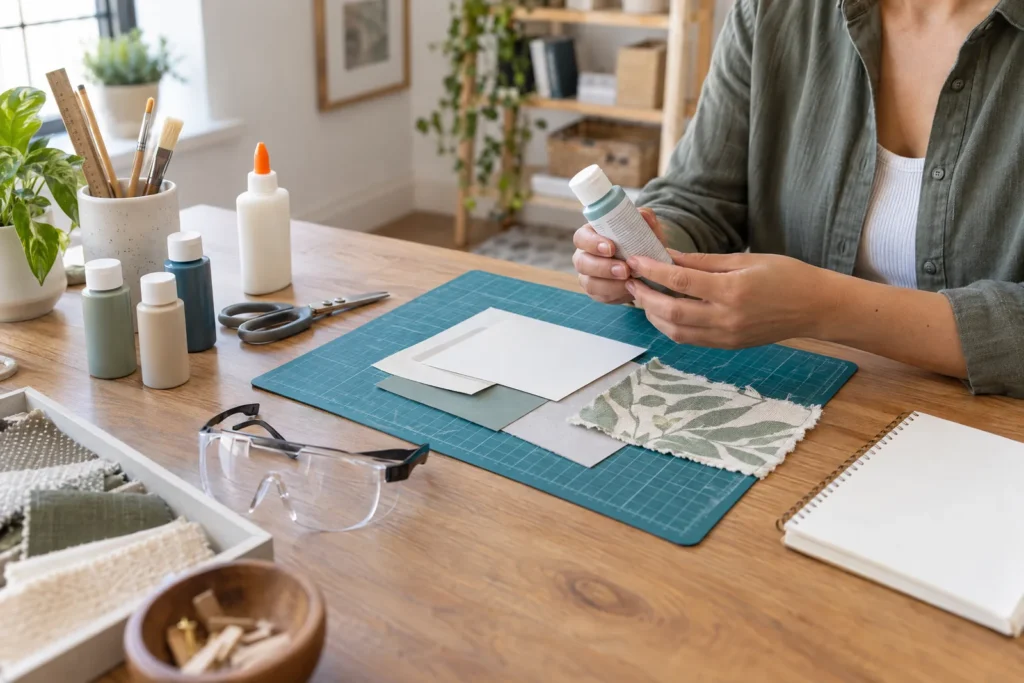
Before you cut, glue, paint, or hang a home-decor craft, pause for a quick screen. This beginner craft safety checklist helps you identify material, tool, workspace, exposure, and finished-piece risks before they become surprises.
This U.S.-focused guide covers low-risk, non-construction decor crafts. It does not teach wiring, structural work, load-bearing mounting, hazardous sprays or solvents, epoxy or resin, candles or open flame, or untrained power-tool use. Product labels, SDSs, tool manuals, and current emergency guidance take priority. This is advice, not a safety guarantee.
For inspiration, browse 14 Simple DIY Room Decor Ideas only after screening the particular project. It is not an endorsement that every idea shown is beginner-safe.
The 60-second start, stop, switch, or escalate decision tree
- What kind of project is it? Wiring, structural construction, load-bearing mounting, open flame, hazardous spray or solvent, epoxy or resin, unknown old paint, or unfamiliar power tools means stop. Switch to a pre-cut, lightweight, no-power-tool alternative, or ask a qualified professional.
- Is every product in its original labeled container? If not, do not use it. Never transfer craft material to a food or drink container.
- Can you meet every label and SDS control? Check ventilation, PPE, surface protection, temperature, cure time, ignition, storage, and disposal. If not, switch materials or projects. Do not improvise.
- Can you control every tool? A damaged cord, unstable stand, dull blade, or unfamiliar tool is a stop signal. Replace it or get instruction. Never force a cut or hold material in its path.
- Can children, pets, and visitors stay out? If not, postpone or relocate. Supervision is not access control around hot, sharp, wet, curing, toxic, or small-part materials.
- Could the finished piece fall, tip, expose a sharp edge, shed parts, contact food, or sit near heat? Do not use it as planned. Modify it or seek qualified advice.
- Do you know what to do for an exposure or serious injury? Keep the label available. Follow it and contact HRSA Poison Help, Poison Control, or 911 as appropriate.
If you are not sure, pause and choose the simpler project.
Read the product label before choosing a material
A label is a project-control document, not just marketing copy. The CPSC Art and Craft Safety Guide explains why intended use, exposure, and directions matter. Check:
- intended surface and use, including skin or food contact
- signal words such as POISON, DANGER, WARNING, and CAUTION
- label or SDS ventilation, PPE, temperature, and humidity requirements
- dry versus full cure time, plus heat, ignition, storage, spill, and disposal directions
- age, supervision, small-part, manufacturer, and recall information
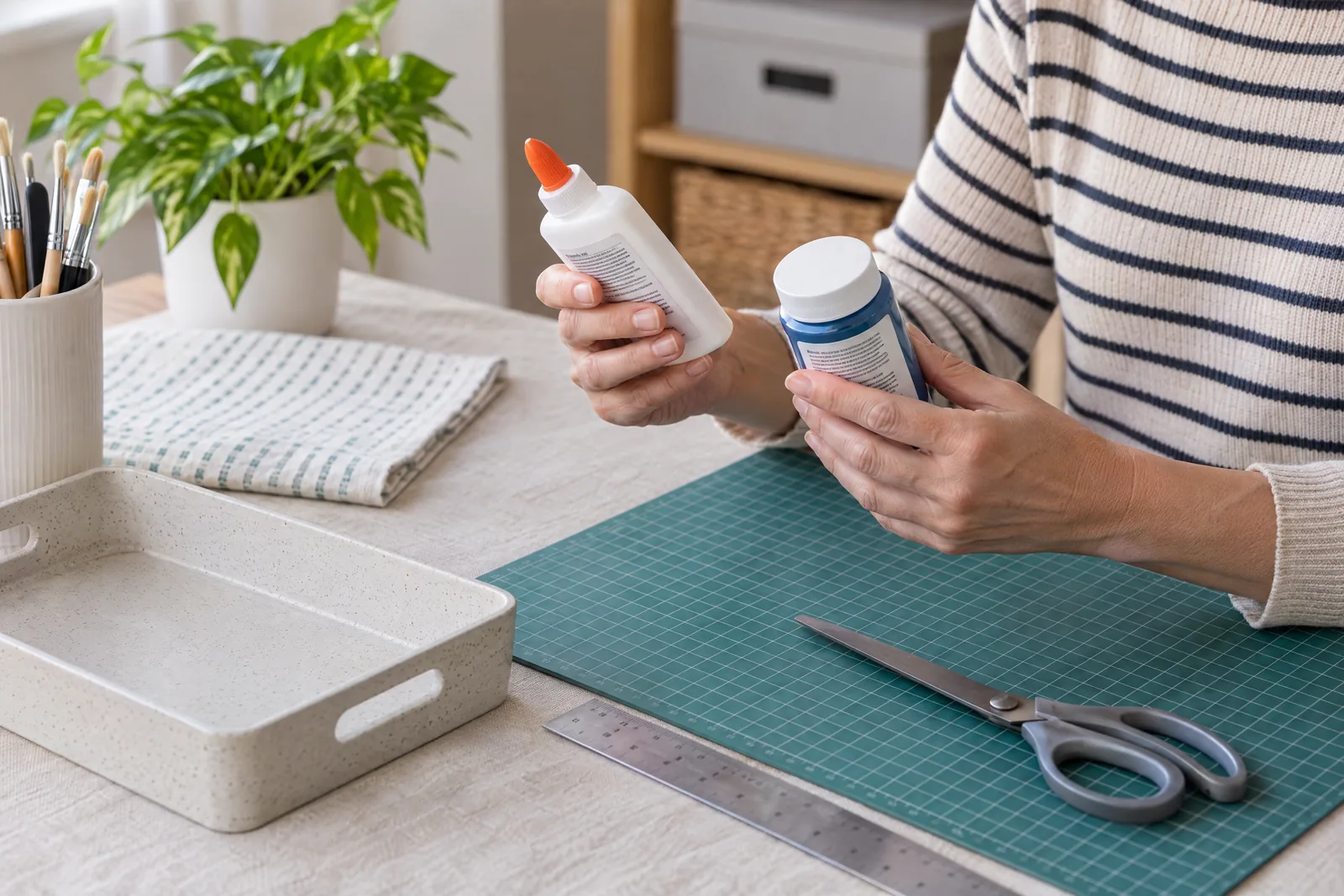
“Non-toxic” does not mean risk-free. An ACMI seal is not a promise that every use or exposure route is risk-free. CPSC art-material labeling guidance explains that ASTM D-4236 concerns chronic hazard labeling, not all-purpose safety certification. ACMI materials-safety guidance explains the limited, directed-use scope of AP and CL marks. Read the exact product directions.
Product-label matrix
| Material or product | Verify before use | Beginner control | Stop or switch trigger |
|---|---|---|---|
| Water-based paint or marker | Surface, warnings, ventilation, skin and food-contact limits, dry and cure time | Protect the surface, close the container, avoid eating or drinking, wash hands after cleanup | Unlabeled product, a warning you cannot meet, unapproved skin or food use, or child or pet access |
| Glue, decoupage medium, or adhesive | Materials, exposure warnings, ventilation, PPE, cure, storage, cleanup | Use only what is needed, cap promptly, keep hands away from eyes and mouth | No original label, fumes you cannot control, or a higher-risk use you cannot manage |
| Hot-glue gun | Temperature setting, stand and nozzle directions, cord, unplug and cool directions | Stable heat-safe zone, keep tip and molten glue away from skin, unplug and cool | Damaged cord, unstable gun, no safe set-down area, child or pet access, or a cooler adhesive would work |
| Sealer or finish | Indoor or outdoor use, fumes, PPE, ventilation, cure, ignition, storage, disposal | Follow the label, protect the surface, isolate wet or curing pieces | Solvent or spray hazard outside this guide, controls you cannot meet, or use before full cure |
| Polymer clay or bake or cure material | Manufacturer temperature, time, ventilation, oven directions, use limits | Follow the manufacturer in a controlled setup; separate food preparation unless explicitly permitted | Missing directions, uncertain setup, food-contact plan, or an instruction you cannot follow |
| Spray, resin, epoxy, solvent, candle or wax, or unknown chemical | Full label and SDS, exposure, ignition, PPE, ventilation, cure, disposal | Do not learn or perform the process from this guide. Choose a labeled lower-risk alternative or seek qualified instruction | Automatic stop, switch, or escalate category for this article |
Choose tools by task, not by a generic starter kit
Choose the intended tool in good condition and avoid excessive force. Pre-cut materials and simple hand tools are often the best starting point.
Cutting tools and hand tools
Use the intended scissors, cutter, needle, or hand tool. Stabilize material on a suitable mat, keep the non-cutting hand out of the path, and cut away from your body and other people. Stop if material shifts, a blade binds, visibility is poor, or the surface is unstable. Store blades, needles, pins, wire ends, and cutters closed or in a designated container, not loose. Eye protection is task-specific, not universal.
Hot glue and heat awareness
Create a separate hot zone on a stable stand or heat-safe surface. Treat the nozzle, molten glue, and recently glued material as burn hazards. Never test temperature with skin. Keep cords away from walkways, never leave a plugged-in gun unattended, unplug when finished, and let it cool before storage.
Instructions vary by model. The Gorilla Dual Temp Mini Hot Glue Gun has model-specific hot-nozzle, molten-adhesive, unplugging, and cooling warnings. It is not a universal rule for every glue gun. Your manual controls. Choose dry knots or room-temperature adhesive when they fit. For an injury, follow current emergency guidance rather than improvising treatment here.
Power-tool boundary
If the plan requires drilling, sawing, sanding, a nail gun, a ladder, or another power tool, stop this craft tutorial. Read the manual, use specified guards and PPE, obtain appropriate instruction, and reconsider the project. An unscreened video is not training.
Screen the workspace before opening a container
| Workspace check | Ready when | Pause or change the setup when |
|---|---|---|
| Surface and lighting | Stable, level, protected, and bright enough | Material slides, shadows hide the cutting path, or heat or liquid could damage it |
| Tools and cords | Correct, intact, and safely placed | A tool is damaged, a walkway is blocked, or a cord crosses a door or window route |
| Containers | Labeled and closed when not in use | Unlabeled, leaking, open, or in a food container |
| Air and exposure | Matches the label and SDS | You rely on a universal window or fan rule or cannot meet the control |
| Access | Children, pets, and visitors cannot reach materials | Supervision is the only barrier |
| Readiness | Hair, clothing, footwear, and attention suit the task | You are rushed, tired, distracted, or working near food |
Keep doors, windows, and walkways clear. The U.S. Fire Administration home fire escape guidance recommends unblocked escape routes.
Match PPE to the label and task
PPE is not a costume or universal checklist. Start with the label, SDS, and tool manual.
| Potential hazard | Control to verify | Do not assume |
|---|---|---|
| Fragments or splashes | Appropriate eye protection when called for | Every craft needs goggles |
| Skin contact | Compatible gloves only when recommended | Any glove protects against every chemical |
| Dust or particulate | Source control, suitable cleanup, and specifically selected protection when needed | A generic mask makes powders or sanding safe |
| Fumes or vapors | Label-directed ventilation, substitution, or isolation | “Just open a window” is always sufficient |
| Heat or sharp edges | Stable setup and task-appropriate clothing | Gloves automatically make blades or hot glue safe |
Keep children and pets out of the exposure zone
Access control is not the same as supervision. Store sharp and hot tools, small parts, adhesives, wet paint, and curing pieces in closed, secure storage and keep products in original containers. “Non-toxic” is not permission for licking, ingestion, skin painting, or food preparation. Clean hands and the surface, collect scraps, and check the floor before allowing a child or pet back.
Inspect finished decor before use
| Finished-piece check | Ask before use |
|---|---|
| Edges and attachments | Any sharp corners, wire ends, staples, pins, brittle edges, or scratchy fibers? |
| Small parts and shedding | Could parts detach or shed fibers, glitter, or dust? |
| Hanging and placement | Is it lightweight and within the manufacturer’s method and weight limit? Could it fall, swing, or tip? |
| Heat and ignition | Is it near a heater, stovetop, candle, fireplace, or other heat source? If yes, relocate or stop. |
| Intended use and cure | Does use stay within the label, and is the piece fully dry or cured? |
| Access | Could a child or pet reach it, or could it land in a walkway? |
Do not improvise structural mounting or assume an adhesive holds a particular load. Follow hardware or adhesive limits. Water-based paint does not automatically make a tray food-safe.
Clean up, store, and document
- Replace caps and keep labels readable. Follow cleanup and disposal directions. Do not pour unknown material into a sink or contaminated waste into a regular bin unless the label allows it.
- Collect blades, pins, needles, wire, and scraps before wiping the surface. Wash hands and clean reusable tools as directed.
- Keep wet or curing pieces controlled and inaccessible. Record product name, finish, date opened, and cure date.
- Keep the container available for an exposure question. Use HRSA Poison Help prevention tips and the product label. For urgent breathing difficulty, serious injury, or another emergency, call 911.
Three low-risk examples
These examples demonstrate screening, not hazardous-use instruction.
1. Pre-cut paper and fabric wall panel
Use pre-cut cardstock or a lightweight backing, fabric, paper scissors, a mat, and labeled water-based adhesive. Confirm surfaces, warnings, ventilation, cure, and hanging limits. If backing is sharp or hanging requires drilling, switch or stop. Work on a stable surface, keep scissors closed when idle, cap adhesive, cut away from the body, and let the panel cure. Cover corners and check that embellishments cannot detach. If warnings cannot be met indoors, use a labeled alternative or dry assembly.
2. Decorative-use-only painted new tray
Start with a clean, intact, pre-made tray and water-based paint labeled for that surface. If old paint or finish is unknown, flaking, moldy, or damaged, do not sand or strip it as a beginner step. Protect the surface, keep food and drink away, follow label-directed PPE, ventilation, and cure time, and use a brush rather than a power tool. Do not add a spray finish or treat “water-based” or “non-toxic” as food-contact approval. Treat the result as decorative only. If the old finish must be sanded, stripped, or heated, stop and choose a clean blank or qualified help.
3. Pre-cut yarn hanging with a dry-knot preference
Use pre-cut yarn, a lightweight pre-cut form, scissors, and a lightweight hanging method. Prefer dry knots. If hot glue is considered, verify the gun, stand, cord, model directions, and child and pet exclusion. Cut on a stable surface with fingers clear of the scissor path. If a hot zone and unplug-and-cool plan cannot be maintained, stop and omit the glue. Use knots or a labeled room-temperature adhesive instead. Inspect for loose strings, scratchy ends, detachable parts, and exposed sharp ends or wire.
Printable beginner craft safety checklist
Before opening a package
- [ ] It is low-risk decor, not construction, wiring, structural work, hazardous spray or solvent use, resin or epoxy, open flame, or untrained power-tool work.
- [ ] Products are in original labeled containers, and I read intended use, warnings, PPE, ventilation, cure, storage, and disposal directions.
- [ ] I can meet every label and tool instruction.
Before starting
- [ ] Surface is stable, protected, level, and well lit; walkways, doors, windows, and cords are clear.
- [ ] Children, pets, and visitors cannot access the work zone.
- [ ] Tools are correct and in good condition; PPE is selected for this task.
- [ ] Phone, label, and emergency information are accessible.
Before using or hanging the finished piece
- [ ] It is dry or cured, with no sharp edges, loose wires, detachable parts, or shedding material.
- [ ] Use stays within the label’s limits and away from heat, flame, food preparation, and dampness unless designed for it.
- [ ] Placement method and weight limits are appropriate.
- [ ] If uncertain, I paused and switched plans or sought qualified help.
Make the safer choice before the craft begins
A useful beginner DIY materials and tool safety checklist is about matching a project to controls you can actually maintain. Choose labeled products, use the intended tool, control the workspace, keep children and pets out, and inspect the finished decor as carefully as the work in progress.
When a plan crosses into unknown old finishes, sprays or solvents, resin, flame, wiring, structural mounting, or unfamiliar power tools, stop learning through a craft tutorial. Switch to a simpler pre-cut, lightweight design or get qualified help. A small creative project is still successful when it ends with a clear label, a clean workspace, a fully cured piece, and no unanswered safety question.