
“Renter-friendly” describes a design approach, not the result of a lease or property review. Before starting renter friendly apartment upgrades, identify the exact item, location, lease clause, building rule, surface, attachment, load, safety concerns, product instructions, approval record, and removal plan. If a critical fact is unknown, hold the project and ask rather than treating uncertainty as silent approval.
A low-intervention idea may be a portable candidate, but still check your lease, property rules, furnished-unit terms, building policies, and applicable local requirements. A change touching a wall, floor, cabinet, window, fixture, or other property feature deserves specific written property-manager clarification before alteration. Fixed lighting, hardwiring, plumbing, ventilation, structural attachment, safety-critical anchoring, or another building system means stop for property-authorized qualified work.
These are next actions, not legal categories, and can change as facts change. This is general U.S. planning information, not legal advice. Lease terms, property rules, local law, product instructions, and your circumstances control.
Start with the three next actions
1. Portable low-intervention candidate, still check the rules
Use this starting point only for an item that remains movable and does not require drilling, anchoring, hardwiring, plumbing, building-system changes, blocking a door or window, or creating an unsafe condition. An area rug, freestanding lamp, movable side table, or portable decor may fit this initial screen.
“Candidate” does not mean approved. Check the exact lease clause, house rules, furnished-unit provisions, flooring restrictions, fire and egress rules, and building policy. Consider floor protection, water, trip paths, cords, heat, ventilation, outlets, and stability.
2. Obtain specific written property-manager confirmation before altering
Use this next action when the proposal changes a wall, floor, cabinet, fixture, window treatment, or another property surface or feature. It also fits a product whose reversibility depends on the exact substrate, finish, adhesive, load, duration, or removal method. Examples include peel-and-stick wall covering, adhesive shelving, temporary floor covering, curtain hardware, a fixture swap, or replacement cabinet handles.
Ask about the specific product and installation method, not only “Can I decorate?” Request the location, quantity or area, dates, attachment, load, conditions, installer, payer, removal method, restoration standard, and move-out timing. Wait for a clear response, then save it with the lease and product instructions. Written confirmation clarifies scope, but does not guarantee acceptance of poor workmanship, damage, repair charges, or restoration.
3. Stop for property-authorized qualified work
Stop and contact the owner, property manager, or designated maintenance channel when the proposal involves a fixed light or hardwiring, plumbing or water connection, ventilation, structural attachment, major floor or cabinet alteration, safety-critical anchoring, or a condition you cannot safely verify.
Ask whether the property requires a qualified trade, permit, inspection, insurance, or approved contractor. Do not proceed based on a blog, product label, or no-drill workaround. If furniture is tip-prone, do not leave it unanchored to avoid holes. Ask for an approved safe attachment or safer alternative.
What to collect before choosing a project
Create one record for each proposal. “Wallpaper” or “shelf” is too broad to evaluate:
- The exact lease clause, move-in packet language, house or building rule, or “not found,” plus city and state and any HOA, co-op, or condo policy.
- Product brand, model, dimensions, quantity, finish, manufacturer preparation, surface exclusions, load, duration, and removal directions.
- Actual surface and condition, including texture, peeling, cracks, dampness, stains, recent paint, and existing marks.
- Attachment method, weight, contents, tip risk, cord route, heat, outlet, water, humidity, ventilation, access, and egress concerns.
- Dated wide and close before photos, plus a removal and restoration plan covering the worker, timing, original parts, repair standard, payer, and move-out record.
This table is a screening record, not a legal-permission determination. Mark each field Known, Unknown, Confirmed, or Not applicable. An Unknown in a high-risk field is a question or stop signal, not a green light.
Screening matrix for a specific proposal
| Field | Record for [item] | Status or question | Screening next action |
|---|---|---|---|
| Proposed item | Exact item, brand or model, location, quantity or area: [details] | Known / Unknown | Portable candidate, written confirmation, or stop based on the full record |
| Intended benefit | What should improve: [benefit] | Known / Unknown | Use a lower-intervention alternative if the proposed change is declined |
| Change type | Portable / surface-attached / fixture or system / structural or safety | Confirmed / Unknown | Do not treat this as a legal classification |
| Lease or property rule | Exact clause, house rule, move-in packet language, or “not found”: [quote] | Known / Unknown | Hold and ask if the rule is missing, unclear, or restrictive |
| Jurisdiction and building context | City and state: [location]; building, HOA, co-op, or known code or permit question: [details] | Known / Unknown / Not applicable | Research or ask the appropriate authority; do not infer permission |
| Approval record | Not asked / asked / pending / approved / denied / unclear; date and sender: [record] | Confirmed / Unknown | Request item-specific written clarification before altering when needed |
| Actual surface and condition | Surface: [surface]; condition, age, texture, peeling, dampness, or marks: [details] | Known / Unknown | Do not use a product on an unknown or unsuitable surface |
| Adhesive or attachment | Freestanding / tension / adhesive / hook or strip / nail or screw / anchor / other: [method] | Known / Unknown | Preserve the exact method and instructions; reassess if attachment changes |
| Load, weight, and tip risk | Item weight, contents, shelf load, center of gravity, or tip concern: [details] | Known / Unknown | Ask about an approved safe method; stop if stability cannot be verified |
| Heat, electric, water, and ventilation | Outlet, lamp, fixture wiring, heat, water, humidity, plumbing, vent, or blocked access: [details] | None / Known / Unknown | Stop for property-authorized qualified work when systems or safety are involved |
| Product instructions | Manufacturer preparation, exclusions, load, duration, use, removal, and warranty: [version or link] | Saved / Unknown | Do not rely on “removable” marketing alone |
| Test or inspection | Patch test, fit check, stability check, dwell observation, or property inspection: [result] | Complete / Pending / Not applicable | Treat a test as limited evidence, not approval or a guarantee |
| Before photos | Dated wide and close photos saved at [location] | Complete / Missing | Photograph existing condition before installation |
| Installation plan | Installer, date, tools, protection, access, and egress plan: [details] | Complete / Unknown | Revise or ask before work starts |
| Removal and restoration | Who removes it, method, timing, disposal, original parts, patch, paint, cleaning, or replacement: [plan] | Complete / Unknown | Hold if removal is only described as “easy” or “removable” |
| Repair and payer | Possible repair, labor, qualified trade, inspection, and payer: [details] | Confirmed / Unknown | Put conditions in the request; do not assume a refund or reimbursement |
| Completion and move-out record | After photos, receipts, response, inspection, restored originals, and move-out date: [record] | Planned / Missing | Keep the record through removal and any property sign-off |
Worksheet 1: make a one-item proposal card
Copy this card into your notes. The goal is a specific question, not a general request to “make improvements.”
| Proposal card prompt | Your record for [item] |
|---|---|
| What exactly is changing? Include brand or model, dimensions, location, quantity or area, and dates. | [item, model, location, quantity, area, dates] |
| What stays portable, and what touches the property? Include fastener, adhesive, water, heat, wiring, ventilation, and weight. | [portable part and property contact] |
| What does the lease or property rule say? Paste the exact words or write “not found.” | [exact clause or not found] |
| What surface and condition are involved? | [surface, finish, texture, age, marks, cracks, dampness] |
| What is unknown? Consider approval, product instruction, load, code, restoration, cost, and jurisdiction. | [unknowns to resolve] |
| What evidence will be saved? | [before photos, product instructions, request, response, test, receipts, after photos] |
| What next action applies, and why? | [portable candidate, written confirmation, or stop for qualified work] |
For approval, attach the product sheet, a photo or measured sketch, exact attachment, expected load, dates, and removal plan. Record who has authority to respond, the sender, and the scope.
Worksheet 2: surface, attachment, and safety screen
Use these prompts before approval and again before installation:
- Surface and condition: painted drywall, plaster, tile, laminate, wood, flooring, cabinet, window, ceiling, or unknown; smooth, textured, peeling, cracked, damp, stained, recently painted, or unknown.
- Attachment and load: freestanding, tension, adhesive, hook or strip, nail or screw, anchor, hardwired, plumbing, or other; empty, light, moderate, heavy, tip-prone, or unknown. Check exact manufacturer directions and never infer a safe load from appearance.
- Heat, electrical, water, and ventilation: lamp, outlet, fixture wiring, heat, cord route, splash, humidity, plumbing, blocked vent, or unknown.
- Egress and access: could a door, window, escape route, detector, extinguisher, service panel, or required access be obstructed? If yes or unknown, stop and resolve it.
- Qualification: manufacturer direction, patch or fit test, approved anchor, property inspection, or qualified trade? Never improvise wiring, plumbing, or safety-critical anchoring.
For furniture with drawers, doors, shelves, or a television, use CPSC Anchor It for tip-over safety. A no-drill rule does not make an unsafe top-heavy arrangement safe. Ask for an approved attachment or another arrangement, and stop using it if no safe option exists.
Keep exits usable. U.S. Fire Administration home fire escape plan guidance supports unobstructed doors and windows. Do not let furniture, curtains, decor, cables, or storage block a door, route, detector, or required access.
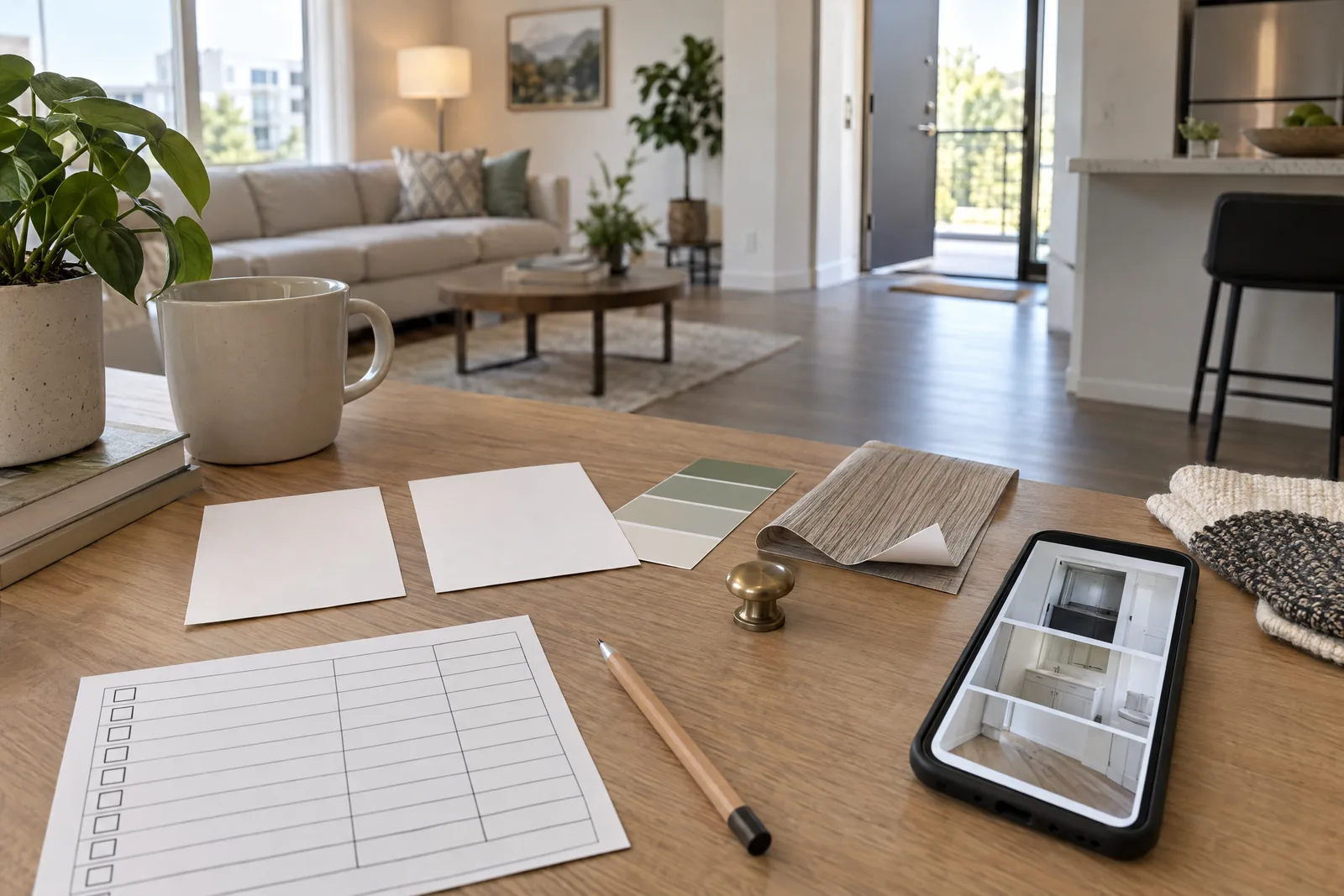
Worksheet 3: keep an approval record
Written confirmation reduces ambiguity about scope and restoration, but this does not claim every approval must legally be written. If a response is oral, summarize it and ask for confirmation, especially when work changes a surface, fixture, or building feature. “Decorating is fine” may not cover a particular product or method.
| Approval record prompt | Record for [item] | Check before proceeding |
|---|---|---|
| Date and channel of request | [date, email, portal, letter, conversation summary] | Sender and recipient are identified |
| Decision authority | [owner, manager, agent, maintenance, HOA or other] | Authority for this exact work is clear |
| Exact scope | [item, brand or model, location, dimensions, area, quantity] | Response covers this item, not only a general idea |
| Method and risk details | [adhesive, fastener, load, heat, electric, water, vent, installer] | Method matches the request and product instructions |
| Dates and access | [installation date, removal timing, inspection access] | Property conditions and access are understood |
| Response | Pending / approved / approved with conditions / denied / unclear | Do not alter while pending or unclear |
| Conditions | [color, product, quantity, professional installer, no drilling, approved anchor, inspection] | Every condition is saved and feasible |
| Removal and restoration | [method, patch, paint, clean, replace, originals, move-out deadline] | Standard is specific enough to follow |
| Repair responsibility and payer | [tenant, owner, other; labor, materials, repair, inspection] | No assumed refund, reimbursement, or deposit result |
| Saved copy | [file, email folder, portal location] | Copy is preserved with lease and instructions |
If “yes” omits the product, location, load, installer, removal timing, or restoration standard, ask a narrower follow-up. Approval for one change does not imply approval for another. A saved response records scope, not a guarantee against damage.
Two conditional comparisons
Area rug versus peel-and-stick wall covering
Choice 1: area rug. Suppose a renter proposes a properly sized, unattached living-room rug. It can initially screen as a portable low-intervention candidate, subject to lease, property rules, and a physical check. Compare it with door swings, walking paths, vents, windows, and furniture. Check floor protection, pad compatibility, plant leaks, curled edges, sliding, trapped moisture, and transitions. A rug pad is not a safety guarantee. If the rug blocks an opening, slides, curls, stains the floor, or creates a trip risk, revise or reject it.
For measured sizing, use She Is Modern’s rug sizing guide for living rooms. It helps with scale, not lease, safety, or restoration. Save product information and dated floor photos.
Choice 2: removable wall covering. Peel-and-stick wallpaper on painted drywall is not automatically permission-free or damage-free. Screen it as obtain specific written property-manager confirmation before altering because the outcome depends on lease, product, paint age and condition, texture, preparation, humidity, dwell time, installation, and removal. Request the exact product, wall, area, dates, instructions, any proposed test, dated before photos, and restoration plan. If the wall is damp, peeling, textured or unknown, or the property prohibits it, do not proceed. The two ideas share a marketing label but trigger different next actions.
Compatible cabinet handles versus fixed light or plumbing work
Choice 1: replacement cabinet handles. A renter wants to replace existing pulls with compatible hardware. Even when the new handles appear to match the existing hole spacing, screen this as obtain specific written property-manager confirmation before altering if the hardware, holes, finish, or property fixture is affected. Record the exact hole spacing, handle dimensions, finish, cabinet material, existing condition, and whether the original handles and screws will be labeled and stored. Ask who may install and reinstall them, what happens if the finish chips or holes do not match, who pays for repair, and what must be restored at move-out. “Renter-friendly” does not decide whether a handle swap is reversible for this cabinet.
Choice 2: fixed light or plumbing change. Replacing a hardwired light fixture or changing a faucet or bidet connection affects electrical or water systems. This is stop for property-authorized qualified work. Contact the property manager and ask who may perform it, whether a qualified or licensed professional, permit, inspection, insurance, or property-approved contractor is required, and whether the owner supplies or retains the fixture. Do not use a plug-in, adhesive, or reversible-looking workaround to bypass an authorization or safety issue. This article does not provide wiring, plumbing, code, leak, or repair instructions.
Removal, restoration, and move-out record
Plan removal before installation. “Removable” is not a complete plan. Adhesive can pull paint; fasteners can enlarge holes; floor coverings can move, leave residue, trap moisture, or affect a finish; and a fixture may need qualified reconnection. Record the remover, method, timing, disposal, patching, repainting, cleaning, replacement, inspection, and payer. Store original hardware, packaging, and instructions in a labeled place.
| Removal and restoration prompt | Record for [item] | Completion check |
|---|---|---|
| Who removes the item and when? | [person or contractor, date or move-out timing] | Removal timing matches the written condition |
| What method and product directions apply? | [manufacturer steps, tools, qualified work, disposal] | Instructions saved and followed by the appropriate person |
| What could go wrong? | [pulled paint, enlarged hole, residue, moisture, damaged finish, missing part] | Risks were discussed before installation |
| What must be restored? | [original hardware, patch, paint, clean, replace, inspection] | Restoration standard is specific, not “good enough” |
| Who pays? | [tenant, owner, other; materials, labor, repair, inspection] | Payer and repair responsibility are recorded |
| Where are originals stored? | [labeled storage location] | Originals and screws or hardware are complete |
| What is the move-out record? | [dated photos, receipts, approval, repair invoices, sign-off] | Record is ready for the move-out file |
| Final condition | [after photos, remaining issue, property response] | Unresolved work is identified and addressed |
At completion, confirm the approved scope, unobstructed access, and stability. Save photos, receipts, instructions, approval, inspection notes, and property acceptance. Approval does not promise a deposit refund, reimbursement, rent credit, or exemption from restoration.
A separate note about disability-related modifications
A disability-related request is not an ordinary cosmetic question or one of this worksheet’s outcomes. HUD and DOJ guidance on reasonable modifications under the Fair Housing Act describes a distinct protected process. Requests may be oral or written, although a written record is useful. Do not assume its process, cost allocation, approval path, or documentation matches decoration. Seek appropriate jurisdiction-specific guidance.
If the answer is unclear or the project is declined
Do not “ask forgiveness” after changing the apartment. Hold the project and ask a narrower question covering item, method, location, surface, load, dates, installer, removal, and payer. If declined, ask about an owner-approved product, installer, alternative, or location. If still unclear, choose a movable option that passes the safety screen or defer the project.
The fewest holes do not necessarily mean the safest alternative. A no-drill method can create a tip, fall, heat, water, ventilation, surface, or egress problem. Recheck conditions rather than relying on a label.
Final decision
Use the record, not the marketing label. If the item is movable and low intervention, screen it as a portable candidate and still check the lease and property rules. If it changes a surface or feature, obtain specific written clarification before altering and save the conditions. If it involves fixed lighting, plumbing, ventilation, structural attachment, safety-critical anchoring, or an unresolved system or safety concern, stop for property-authorized qualified work.
Before installing, identify the exact clause or question, actual surface and condition, adhesive or load, heat, electric, water, ventilation, product instructions, dated before photos, repair payer, removal timing, and move-out record. If a critical field is unknown, hold and ask. That pause is more useful than a broad “renter-friendly” promise.