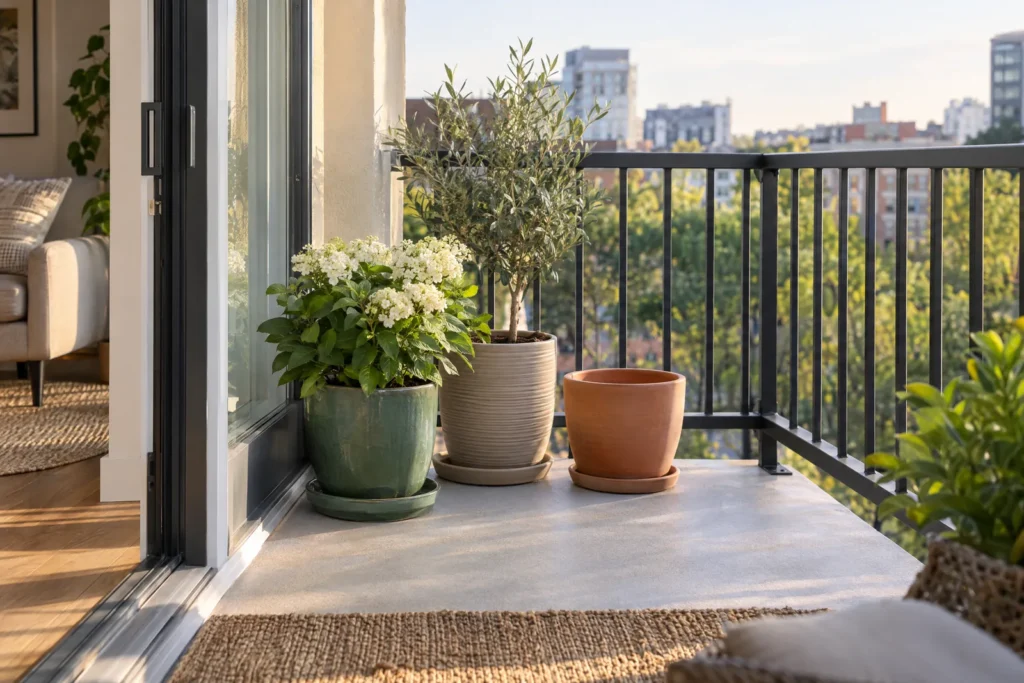
A balcony planter can create two problems that are easy to miss while shopping: it can become much heavier after watering, and its excess water can travel to a wall, lower balcony, walkway, or neighbor’s belongings. There is no universal balcony weight number for every apartment or condo. The useful question is whether you documented the real setup, its support path, its water path, and the property-specific instructions that control it.
This worksheet is a practical screening tool, not a structural inspection, engineering calculation, building-code interpretation, or approval. It cannot certify a balcony, railing, wall, ceiling, shelf, or planter arrangement. Use it to collect facts, identify gaps, and choose whether to ask for property review, pause, or stop.
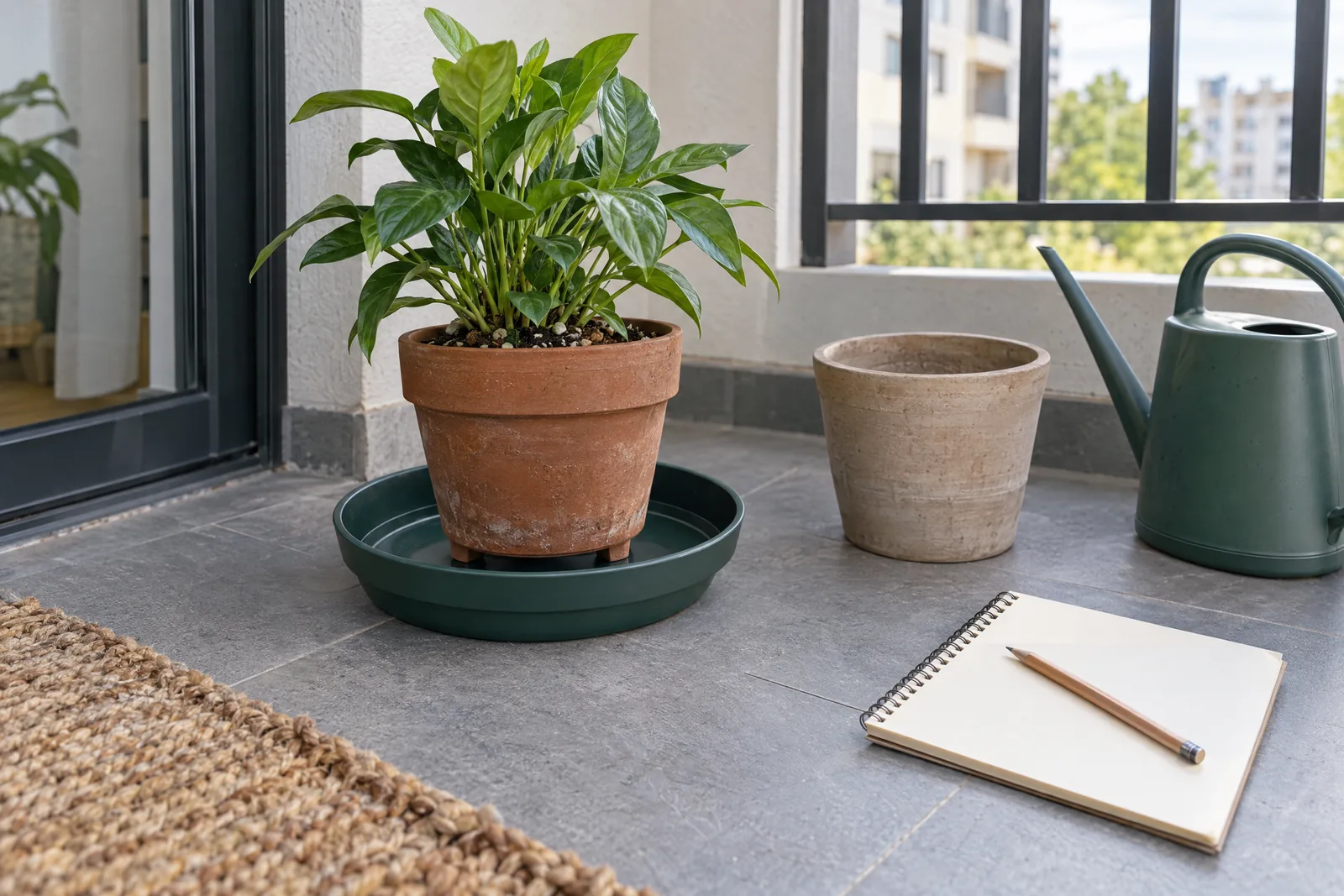
Start with the actual condition, not the store-shelf condition
Before buying a pot or mounting anything, make a list of every part that will be present when the setup is watered. A dry container, an empty reservoir, and a bag of mix describe only part of the situation. The fully wet condition is the condition you need to document for review.
Fill in the worksheet below using product labels, manufacturer instructions, measurements, and information from the property authority. If you do not know an item, write “unknown” instead of filling the space with a general assumption.
| Item | Actual condition to record | Source for the entry | Unknown or next check |
|---|---|---|---|
| Container and count | Type, material, dimensions, quantity, and empty weight for each pot, box, basket, or bin | Product label, manual, seller documentation, or a careful measurement | Exact model, empty weight, or total count |
| Growing medium | Mix type, fill amount, and its watered-and-drained weight if reliably known | Bag label, proposed fill amount, and a safely manageable sample if needed | Actual wet-medium weight or how much mix the container holds |
| Plant and root ball | Plant type, size, root ball or nursery pot included, and any decorative top layer | Plant tag, seller information, or a visual inventory | Mature size, hidden root mass, or retained material |
| Separate water or reservoir | Water held in a tray or filled reservoir, apart from water already counted in the wet medium | Manufacturer instructions and the proposed watering method | Overflow behavior, reservoir volume, or separately retained water |
| Saucer, tray, stand, and hardware | Empty weights, dimensions, feet, caddy, shelf, brackets, hooks, ties, or ballast | Product instructions and a physical inventory | Loaded instructions, attachment rating, or hardware weight |
| Placement and surface | Floor, shelf, railing, wall, ceiling, or hanging point; note location and contact points | Lease, property rules, manufacturer instructions, and visual inspection | Support path, surface condition, or permission |
| Drainage destination | Tray, saucer, approved drain, contained surface, or other planned route | Your first-watering observation and property guidance | Where overflow goes, what is below, and whether staining is possible |
How to document weight without pretending to approve the balcony
Add the parts together as an inventory: the container, wet medium, plant, any separately retained water, saucer, stand, and hardware. Water already held in the measured wet medium must not be counted a second time. Keep separate notes so a manager, building representative, manufacturer, or qualified professional can understand the setup.
If the medium is unknown, you may weigh a sample only when it is a small, safely manageable item. Put the same mix into a known-size vessel, wet it thoroughly, allow excess water to drain, weigh the filled vessel, and subtract the empty vessel. Do not lift or handle a heavy pot to obtain a measurement. A sample gives you a better description of the proposed contents. It does not certify the balcony or turn your total into a safe load.
Do not substitute a generic wet-soil density, a product marketing phrase, or an online “balcony limit” for actual property information. Ask the authority responsible for the building or support, and follow the exact instructions for the product you want to use.
Choose a placement before you choose a planter
A freestanding floor pot, an over-railing box, and a hanging basket are different arrangements because their support paths and failure consequences differ. A light container is not automatically acceptable when it is elevated, attached, exposed to wind, or positioned where water can reach another unit.
Use the table as a decision aid, not as a capacity table. “Ready to ask for approval” means you have a reasonably complete inventory and a controlled drainage plan to submit for property review. It does not mean the arrangement is approved.
| Proposed placement | Working status before installation | What must be checked | Lower-risk direction to discuss |
|---|---|---|---|
| Freestanding pot on the balcony floor | Ready to ask for approval only if rules allow it and the surface is sound | Fully wet inventory, stable footprint, access path, surface damage, pooling, drainage destination, and property rules | A smaller, movable floor container with contained runoff, if permitted |
| Shelf, tier, or plant stand | Hold when the shelf is narrow, tall, added by the resident, or top-heavy | Manufacturer loaded instructions, footprint, anti-tip method, wet contents, surface, and permission | A low, wide floor arrangement without an added shelf |
| Over-railing or clamp-on planter | Hold until the exact installation is verified | Railing dimensions and construction, product fit and loaded instructions, wind exposure, runoff, and written property guidance | A freestanding planter that does not touch or load the railing |
| Hanging basket from a wall or ceiling | Hold until the support point and attachment are verified | Approved support point, attachment instructions, inspection, wet load, falling-object risk, wind, and permission | A freestanding basket stand or floor pot, if allowed and stable |
| Drilled, tied, or permanently attached planter or trellis | Hold until permission and support details are documented | Lease or HOA terms, building approval, anchor or attachment information, wet inventory, and access | A reversible, freestanding alternative that the property authority permits |
| Visible crack, corrosion, deflection, water infiltration, unknown support, or uncontrolled runoff | Stop | Do not add test weight or install the proposed load. Contact the property authority or a qualified professional | Remove the proposed load and wait for site-specific direction |
Avoid treating a preferred location as proof of capacity. For an authorized installation, the reviewer may have a placement preference, but a location near a wall or toward the building side is not a substitute for approval. Do not move a heavy pot to a different spot as a DIY structural solution.
Ask the right property and product questions
Check the lease, tenant handbook, resident portal, condo documents, and written instructions from the landlord, manager, building office, or HOA. A silent document is not confirmation that an installation is accepted. Ask in writing about floor containers, railing or hanging products, shelves, hooks, wall anchors, permanent attachments, drainage, and product or inspection requirements. Include the exact container, location, wet inventory, and runoff route.
Ask the planter manufacturer for the exact model’s fit, mounting, filled-use, overflow, and wind-related instructions. Manufacturer guidance describes the product, not permission for a particular building. Property permission does not by itself confirm structural suitability.
Build a drainage path that ends somewhere controlled
Pot drainage and balcony runoff are related but separate. A drainage hole helps excess water leave the pot. It does not tell you where that water will go after it leaves the pot. A saucer catches some water, but it is not a guarantee against leaks, overflow, staining, or a neighbor complaint.
For the plant itself, use a container with a functional drainage opening, keep that opening clear, and empty retained saucer water when the plant does not require a reservoir. These steps help manage container moisture and staining, but they do not approve a balcony load, attachment, or property drainage arrangement.
Trace the complete path before planting:
| Point in the path | Check in the proposed setup | Record the result |
|---|---|---|
| Container base | Is the drainage hole or manufacturer-described overflow present and clear? Can the saucer, liner, or surface block it? | Clear, blocked, or needs a permitted spacer or change |
| Tray or saucer | Does it catch the expected discharge without becoming an unintended reservoir? Can it be emptied safely? | Contained, uncertain, or not suitable |
| Balcony surface | Could water run under the pot, across the floor, toward a wall, or to an edge? | Observed route and any pooling or staining concern |
| Edge and lower areas | Could water reach a lower unit, shared walkway, façade, furniture, or belongings? | Below-area check and property instruction |
| Self-watering feature | What happens when the reservoir is full, and where does overflow leave the container? | Manufacturer-described route or unknown |
| First watering | Can you observe a slow watering test without sending water over an edge? | Controlled, needs correction, or stop |
Do not add a bottom layer of gravel, rocks, or broken pottery as a universal drainage fix. In ordinary containers, that layer takes up root space and can worsen drainage. Instead, use a suitable container medium, keep the drainage opening clear, and manage the water that exits.
Water slowly during the first test and watch the entire route. If the water escapes toward a neighbor, wall, walkway, or uncontrolled edge, stop and correct the plan before regular watering. Empty retained saucer water when the plant does not require a reservoir, following the instructions for a genuine self-watering design. Recheck after a move, heavy storm, strong wind, larger plant, or different watering routine.
Three decisions for the finished screen
The screening outcome is Ready to ask for approval, Hold, or Stop. Use these labels rather than “pass.” They describe the next action, not a structural result.
Ready to ask for approval. The setup is itemized, the proposed placement is clear, the drainage destination is observable and controlled, and no damage or support uncertainty is present. Send the inventory and product information to the landlord, manager, HOA, building office, or other responsible authority. Wait for the response before installing anything that requires approval.
Hold. A key detail is missing or the proposed placement involves a railing, shelf, hanging point, wall, ceiling, permanent attachment, unclear reservoir, or incomplete runoff path. Do not add test weight or install while waiting. Gather the missing information and request written guidance. A permitted freestanding alternative can be discussed, but it is not automatically acceptable.
Stop. There is a crack, corrosion, visible movement, deflection, water infiltration, unknown support, disputed rule, falling-object concern, or uncontrolled runoff. Do not test the arrangement. Remove a proposed load if it can be done without lifting or creating a new hazard, then contact the property authority or a qualified professional for site-specific advice.
Hypothetical example: two pots plus a railing planter
Imagine a renter proposes two 18-inch ceramic pots near the outer edge and one over-railing planter. The renter knows the ceramic pots are heavy when empty, but has not documented wet medium, plant mass, retained water, saucers, railing construction, exact product fit, or where runoff will go. The lease and resident portal do not answer the question, and the first watering could reach the balcony below.
| Proposed part | Known | Unknown or concern | Decision |
|---|---|---|---|
| Two ceramic pots | Two pots, ceramic material, outer-edge location | Empty and fully wet inventory, surface condition, saucers, plant mass, and drainage route | Hold |
| Over-railing planter | A railing-mounted product is proposed | Exact railing fit, construction, loaded instructions, permission, wind, and runoff | Hold |
| Property review | Lease and portal appear silent | Written answer from landlord, manager, HOA, or building office | Hold |
| Water path | Water may leave the containers during watering | Whether water can be contained without reaching the lower balcony | Hold, and stop if it cannot be controlled |
The correct status is Hold, not safe, unsafe, or approved. The renter should not install the plan or add test weight. Next, record each empty container and stand, document wet contents and any reservoir, obtain the railing product instructions, ask the property authority about floor and railing placements, and demonstrate a contained drainage path. If support remains unknown, damage is found, or runoff cannot be controlled, the status changes to Stop and qualified site-specific advice is needed.
What to do after the review
If the property authority allows the setup and manufacturer instructions are satisfied, start with the smallest reversible arrangement that matches the documented plan. Keep access routes clear, monitor wind and tipping, and inspect trays, attachments, surfaces, and drainage after weather or changes to the plants. A lightweight container can still tip, leak, stain, or fall.
Only then choose plants and exposure ideas. Browse 10 Small Balcony Garden Ideas for plant and layout inspiration, not structural authority. Once the property decision is clear, 14 Narrow Balcony Ideas That Work can help with design inspiration and traffic flow. Neither replaces property instructions, manufacturer documentation, or qualified review.
The goal is not to produce a guessed balcony weight limit. It is to know what will be present when the plan is wet, where the load and water will travel, who must approve the arrangement, and when uncertainty means you should wait or stop.