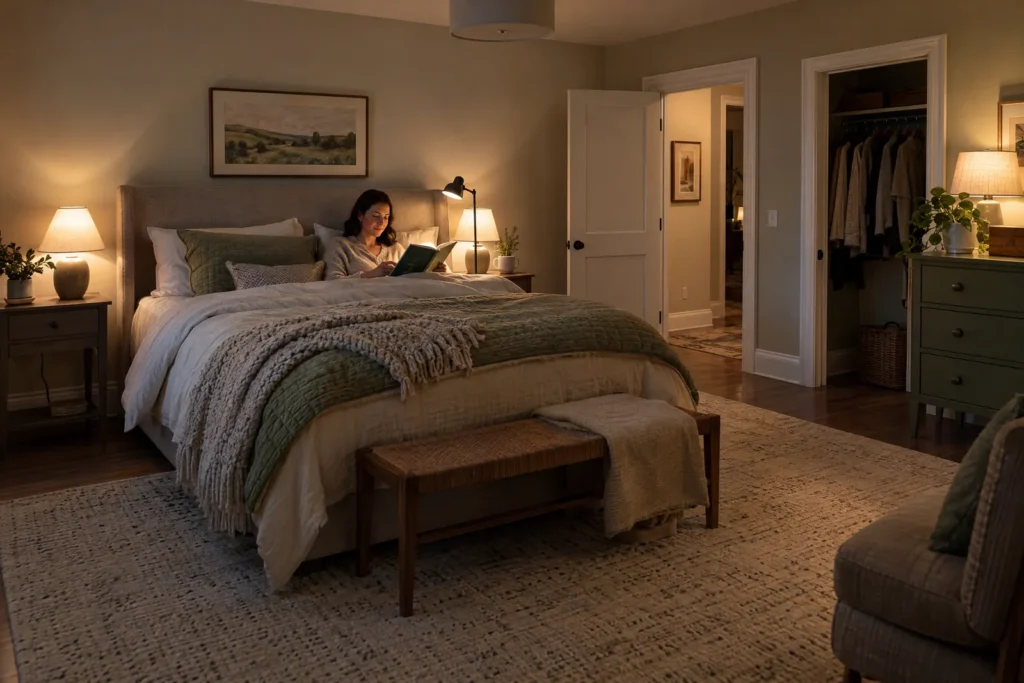
Good bedroom lighting starts with what you do in the room, not with a fixture you happen to like. Reading in bed, finding a shirt in a dark closet, checking a mirror, working at a desk, and walking to the bathroom all place your eyes, hands, feet, and attention in different locations. They also create different needs for control, glare, shadows, and power.
This bedroom lighting plan is a calm room audit you can complete before shopping. It works for a homeowner, renter, guest-room host, couple, or anyone trying to make a small bedroom useful without relying on one bright source. The goal is not to prescribe one perfect bulb or a showroom arrangement. It is to help you test the actual positions and moments that matter in your room.
The central sequence is simple:
- Name the activity.
- Mark where the user will be.
- Choose a source to try.
- Put the control where it can be reached at that moment.
- Check glare from the real eye position.
- Confirm the outlet and cord path.
Only after those checks should you buy a fixture or ask for electrical work.
Start with what happens in your bedroom
A room can look beautifully lit in a photograph and still be frustrating at bedtime. A central light may illuminate the floor while putting a bright source in your eyes. A decorative bedside lamp may look right on a dresser but leave the book in shadow. A closet light may turn on only after the open door blocks it. A desk lamp may make a monitor or mirror hard to see.
Begin by listing the moments you actually have. Include routine moments that are easy to overlook:
- Reading paper or a screen in bed
- Getting dressed and comparing clothing
- Looking into a mirror, applying makeup, or doing hair
- Opening the closet, searching shelves, and putting clothes away
- Working at a desk, writing, crafting, or handling a hobby
- Making the bed or picking something up from the floor
- Walking from the pillow to the bedroom door or bathroom
- Returning to bed without waking a sleeping partner
- Relaxing when you do not want the full room illuminated
For each activity, note the user position. Write down where the reader’s eyes are, where a book or screen rests, where feet need a clear view, and whether another person is sleeping nearby. Daylight matters too. A window, shade, or seasonal change can alter reflections and shadows, so test the room under its usual evening conditions as well as during the day.
If you are planning a broader bedroom refresh, the complete bedroom design guide can help with the furniture and layout decisions that surround this lighting audit. Keep the lighting decisions tied to the activities you identified rather than adding sources simply to fill empty ceiling or wall space.
Use this bedroom lighting plan worksheet
Print this table, copy it into a note, or use it as a conversation starter with the person who shares the room. The prompts are intentionally open. Your room, furniture, sightlines, and electrical situation determine the useful answer.
| Activity or moment | Where the reader is | Light source to try | Control the reader can reach | Glare or shadow check | Outlet, cord, or power note |
|---|---|---|---|---|---|
| Reading in bed | [blank prompt] | [blank prompt] | [blank prompt] | Can I see the page or screen without seeing a bare source or bright reflection? [blank prompt] | Nearest usable outlet: [blank prompt]. Is the cord clear of pillow, rug, doorway, and furniture legs? [blank prompt] |
| Getting dressed | [blank prompt] | [blank prompt] | [blank prompt] | Does the light reveal clothing and the mirror without putting the reader between the source and the subject? [blank prompt] | Existing outlet or approved hardwired point: [blank prompt]. Cord route: [blank prompt] |
| Closet or wardrobe | [blank prompt] | [blank prompt] | [blank prompt] | Are shelves, hanging clothes, the door opening, and floor visible? Where does the user cast a shadow? [blank prompt] | Power source: [blank prompt]. Door movement or cord pinch concern: [blank prompt] |
| Desk, makeup, or focused task | [blank prompt] | [blank prompt] | [blank prompt] | Does the source reflect on a screen, mirror, glossy surface, or glasses? [blank prompt] | Outlet and charging needs: [blank prompt]. Is a power strip truly needed and within its rating? [blank prompt] |
| Night route to bathroom or door | [blank prompt] | [blank prompt] | [blank prompt] | Does the light guide feet without shining into a sleeper’s face or making a trip-shadow? [blank prompt] | Route crosses a doorway, rug, or furniture leg: [blank prompt]. Safer alternate route: [blank prompt] |
| Shared sleep or one person wakes | [blank prompt] | [blank prompt] | [blank prompt] | Can one person read or move without flooding the other side of the bed? [blank prompt] | Separate source and control from partner’s side: [blank prompt]. Charging location: [blank prompt] |
How to complete the worksheet without buying anything
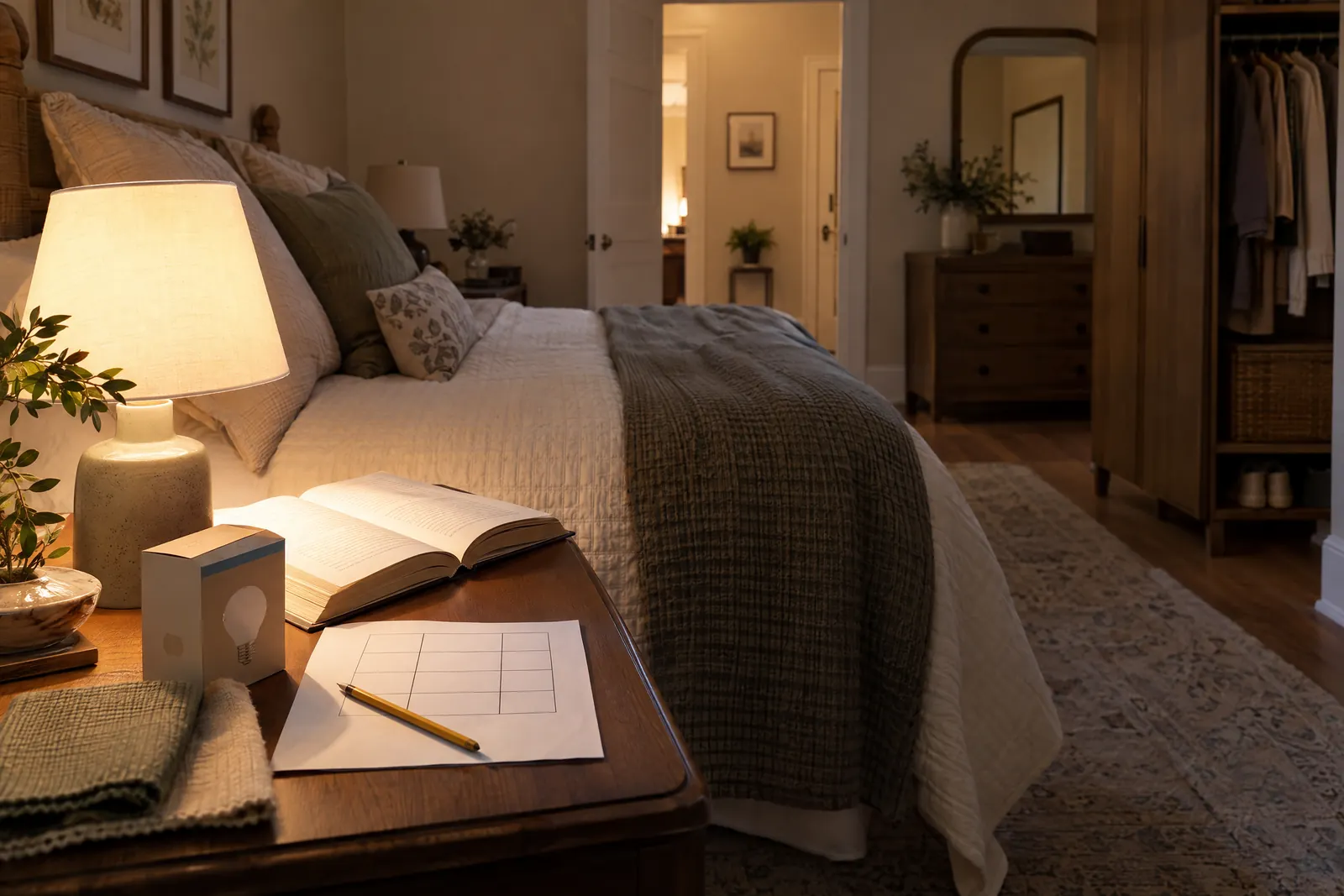
Use an existing lamp, a portable light, or a temporary shaded source as a test object. You can also use a phone flashlight briefly to understand direction, but do not treat a bare phone beam as a final fixture test. Move a chair or stack of books to represent a bedside table. Use a piece of paper to represent a book, a blank monitor screen to represent desk work, and an open closet door in its normal position.
Sit where you read. Stand where you dress. Open the closet and reach for the shelf you use most. Sit at the desk with the monitor or mirror in place. Lie down on each side of the bed. Then walk the route in both directions. A plan that works only from the center of the room has not been tested yet.
For each position, ask four questions:
- Can I see the task comfortably without squinting or leaning into a shadow?
- Is the source itself, or its reflection, in my ordinary sightline?
- Can I reach the control without crossing the room or disturbing someone?
- Can power reach the source without an unsafe or annoying cord path?
Record what changes when a shade is turned, a source is moved, or a control is placed closer. This gives you a more reliable basis for shopping than a fixture photograph or a single output number.
Plan light for the moments that are easy to miss
Reading in bed without lighting your partner’s face
Reading light should serve the page, screen, or craft in your hands. Try a shaded bedside lamp, an adjustable wall fixture, a swing-arm source, or a portable light that can be aimed and controlled from the reader’s position. The category matters less than the sightline. A source that looks gentle while you are standing may be glaring when you are lying down.
Test both sitting and reclining. Turn the page, adjust the screen, and look toward the headboard as well as toward the room. Check paper, screen glass, and eyeglasses for reflected glare. If one person reads while the other sleeps, test the reader’s side with the other person’s eyes closed and then open. A directional or shielded source may be less disruptive than lighting the whole room, but only your room positions can confirm that.
Give each bedside user an independent control when possible. It can be a fixture switch, an inline control, a reachable wall control, or another option permitted by the product instructions and your home. Convenience should not require stretching across a sleeping person, reaching behind a headboard, or leaving the bed to turn the source off.
Getting dressed and using a mirror
Dressing is a front-facing activity. You need to see clothing, body position, and the mirror without putting yourself between the source and the thing you are trying to see. A light directly behind the user can create a silhouette or put the mirror into shadow. A source that hits the mirror at the wrong angle can produce a bright reflection instead of useful visibility.
Test your normal stance with the closet open and the window coverings in their usual evening position. Look at a dark garment, a light garment, and a textured fabric if those are part of your routine. Then step to the side and repeat the test. Notice whether the source creates a hard shadow under the brow, chin, or arms, and whether a nearby glossy surface sends light back into your eyes.
The right answer might be an existing room source combined with a nearby adjustable task source. It might be a portable lamp that can be moved when the furniture changes. It might be an independently controlled mirror-area source installed only after a qualified professional confirms the requirements. Do not assume that one overhead fixture will show every detail or color equally well in every room.
Treat the closet as its own lighting problem
A closet can be bright at the doorway and dark where the clothes are. Test with the door fully open, partly open, and in the position it normally occupies. Look at the rear of shelves, the lower floor, hanging garments, and corners where a person may cast a shadow. Reach for a shirt with your body in the space rather than evaluating from outside. For an optional fixture example after the visibility test, see the closet-lighting section of our bedroom lighting ideas. Test any option against the actual door, shadows, power, and controls.
Possible source types include a door-activated wardrobe light, a separately controlled fixture, a nearby adjustable source, or an existing light that reaches the shelves. The choice depends on available power, door movement, heat and clearance requirements stated by the manufacturer, and whether the source can be serviced safely. A motion sensor may be convenient, but check whether it triggers reliably, reacts to pets or other movement, and starts at a level that is comfortable in a dark room.
Keep cords away from hinges and moving doors. Never wedge a cord where a door, drawer, or furniture edge can pinch it. Do not add or relocate wiring by following an online shortcut. For a new, hardwired, relocated, or uncertain electrical point, follow local requirements and use a qualified, property-approved electrician.
Make a bedroom desk work for screens and paper
A bedroom desk may serve several jobs. Screen work, writing, drawing, makeup, sewing, and reading each place the source differently. Start with the most demanding task and test the other tasks afterward. A nearby task lamp is often easier to aim than a central source, but the table surface and screen still determine whether the result is comfortable.
Sit in your actual chair. Open a document on the monitor, place paper where you write, and look through your glasses if you wear them. Move the temporary source until you can identify reflections on the screen, shadows from your writing hand, and bright patches on a glossy tabletop. A source can be bright enough for the task and still be poorly placed if it bounces into your eyes.
Plan charging at the same time. Note the laptop, phone, lamp, and other equipment you actually use. Do not assume that adding a power strip solves every outlet problem. Check the strip’s rating and condition, keep plugs accessible, and avoid a chain of strips or cords routed across a walkway. If the desk must move to make the cord path safe, adjust the furniture plan before buying a new light.
Find the bathroom without turning on the room
Define the night route as pillow to floor to door or bathroom and back again. A small source near the floor, route edge, or bathroom entrance may help, provided it is independently controlled and does not shine directly toward the bed. The test is not whether the source looks subtle from across the room. Lie on the pillow and look toward it. Then stand and check whether feet, thresholds, furniture corners, and floor-level objects are recognizable.
Use the lowest comfortable setting that allows you to identify the route. A dimmable or motion-activated option may suit one household and annoy another. Consider false triggers, pets, guests, accessibility needs, and whether the source comes on more brightly than expected. A switch, remote, or fixture control may be more reliable than an automated feature if the control remains reachable and predictable.
Keep the route clear instead of trying to compensate for obstacles with more light. The bedroom door and any window used for escape should remain unblocked. Plan an accessible way out with clear doors and windows. Lighting can help you see a path, but it cannot make a blocked exit safe.
Build layers around activities, not a formula
People often describe bedroom lighting as ambient, task, and accent lighting. Those labels can be useful, but they are source types, not a complete plan. Start with the worksheet and let each activity decide which source is necessary.
An ambient source helps with orientation, making the bed, cleaning, and entering the room. It may be a ceiling fixture, a floor source, or another broad light that can be controlled when the room needs general visibility. Test whether the source is comfortable from the bed and whether its shadows make the floor harder to read.
A task source serves a specific activity such as reading, dressing, screen work, or applying makeup. It should be positioned or aimed for that activity, with the control close to the person using it. If the activity moves, a portable or adjustable source may be more useful than a fixed decorative choice.
An accent or low-level source can support relaxation and wayfinding. It may highlight an architectural feature or provide a gentle route marker, but it should not create a new glare source or a cord hazard. Use it because it solves a real moment in the room, not because every wall needs a light.
A small room without an overhead light can still have a workable plan. Start with one source that lets you enter and move safely, then test separate task sources at the bed, closet, mirror, or desk. A floor lamp, table lamp, portable source, or plug-in fixture may be practical categories, but none is automatically landlord-approved. Confirm permission, mounting rules, outlet access, and product instructions before using a plug-in sconce or other wall-mounted option.
Run a glare and shadow check from the real user position
Glare is a relationship between the source, the eye, the task, and reflective surfaces. It cannot be dismissed by choosing a particular light appearance or by relying on a product label. Sit, stand, and lie down where the activity takes place, then deliberately look in the directions you normally look.
Use this sequence for each proposed source:
- Start at the task. Read a page, view a screen, inspect clothing, or look into the mirror.
- Turn your head toward the source without forcing an unusual pose. Is the bulb or bright opening directly visible?
- Look at nearby reflective surfaces. Check screens, mirrors, framed glass, polished furniture, and eyeglasses.
- Move one step or change posture. Notice whether the useful area disappears into a shadow.
- Ask another household member to repeat the test from their position.
- Test the control from the place where it will be used, including in the dark.
A shade, diffuser, direction change, or source relocation may solve the issue. So may moving the task rather than adding another fixture. Keep any changes temporary until you have repeated the test at the time of day when the room is most difficult to use.
Make controls and outlets part of the plan
A beautiful source that cannot be turned on at the right time is not a successful bedroom lighting plan. Mark the control for entry, the control for each bedside user, the control for the night route, and the control for any desk or closet source. Ask who needs each one and whether the person can reach it without standing, stretching, waking a partner, or crossing a dark floor.
Controls may include a fixture switch, wall control, inline switch, remote, app, timer, or motion sensor. Each introduces tradeoffs. A remote can be misplaced. An app may be inconvenient when a phone is charging. A timer may not fit a changing routine. A motion sensor may trigger unexpectedly or be too bright for a sleeping person. Choose reliability and reach before novelty.
If you plan to dim an LED, verify the exact bulb or integrated fixture against the control maker’s current compatibility information. A dimmable label alone does not guarantee a quiet, flicker-free pairing. Dimmers and timers require compatible lamps and bulbs, so check the current fixture, bulb, and control instructions rather than assuming products will work together.
Map the power path with painter’s tape before committing to furniture placement. Identify the nearest usable outlet, the plug orientation, the cord length stated by the product, and the path around legs and doors. Keep cords out from under rugs, away from doorways, and out of furniture pinch points. Do not overload an outlet or power strip. If the practical power path is not safe, change the layout or get qualified help rather than hiding the problem.
Bedroom lamp and cord safety in the U.S.
Follow the lamp or fixture’s own label and current instructions for the permitted bulb type and wattage. Do not use a bulb that exceeds the stated requirement because it appears to fit. Keep curtains, bedding, clothing, paper, and other burnable materials away from lamps, fixtures, and bulbs.
Match a lamp’s recommended bulb wattage, keep burnable material away from lamps and bulbs, replace damaged or loose cords, and avoid overloaded outlets and power strips. Follow the fixture and product instructions for any additional requirements.
Inspect a cord before use. A cracked, loose, frayed, or otherwise damaged cord is a reason to stop using the item and follow the manufacturer’s replacement or service guidance. Never route a lamp cord under a rug, across a doorway, or where furniture can pinch or damage it. Do not use an extension cord as a hidden permanent route through a walking path.
Do not provide yourself with a wiring project by removing a receptacle, adding a junction box, tapping a circuit, running cable, or hardwiring a sconce. New, relocated, hardwired, or uncertain electrical work belongs with a qualified electrician who follows local requirements. Renters should also confirm property approval before mounting or altering anything. A plug-in fixture may reduce installation complexity, but it is not automatically landlord-approved or safe in every location.
Make a second pass before you shop
After the first test, leave the temporary arrangement in place through one normal evening. Use the room while tired, with the door closed, shades drawn, and the bed made. Write down only the changes that affect comfort, visibility, control reach, or safety.
| What to retest | Failure you notice | Adjustment to try | Retest from |
|---|---|---|---|
| Bedside or desk source | Bulb or reflection appears in your normal sightline | Change direction or try a shaded source | Actual pillow, chair, mirror, and desk positions |
| Task source | Your hands, page, clothing, or face fall into shadow | Move the source or change its angle | Normal working position |
| Bedside or entry control | You must cross a dark room or lean over a partner | Relocate a portable source or choose an approved reachable control | In the dark, from entry and bed |
| Cord path | Cord crosses a doorway, rug, or furniture pinch point | Move furniture or choose another power location; never conceal the hazard | Full walking route in both directions |
| Night route | Light wakes a partner or misses floor obstacles | Aim or shield the source and test a different location | Both sides of the bed and floor route |
| Closet source | Open door or your body shades the shelves | Change source position while following fixture instructions | Closet open, user inside, and floor visible |
If an adjustment changes another activity, update the worksheet rather than forcing the first idea to work. The goal is a coordinated room, not a collection of individually attractive fixtures.
Fixture purchase checklist
Bring the worksheet and this checklist when comparing products. Shop by the problem the fixture solves, not by a universal number or a photograph.
- [ ] I can name the activity this fixture supports.
- [ ] I have tested the user’s real eye, hand, foot, screen, book, or mirror position.
- [ ] The source can be shielded, aimed, or placed so it is not an uncomfortable direct or reflected glare source.
- [ ] The control is reachable at the moment it is needed.
- [ ] The bulb, integrated light, fixture, and control instructions are available and current.
- [ ] If dimming or timing is planned, the exact lamp or bulb is listed as compatible by the control manufacturer.
- [ ] The fixture’s stated bulb requirements match the bulb I plan to use.
- [ ] The outlet is usable without overloading an outlet or power strip.
- [ ] The cord can remain clear of rugs, doorways, moving doors, furniture legs, and pinch points.
- [ ] Curtains, bedding, clothing, and other burnable materials can stay away from the lamp or bulb.
- [ ] A portable or plug-in option has the required property permission if I rent.
- [ ] Any new, hardwired, relocated, or uncertain electrical work will be handled by a qualified, property-approved electrician under local requirements.
Frequently asked questions
How many light sources should a bedroom have?
There is no useful universal count. Start with the activities you need to perform and add only the sources that solve a visibility, control, glare, or route problem. A small room may need fewer sources than a large room, while a room used for reading, dressing, desk work, and nighttime movement may need more independent options. Test the room before buying another fixture.
Can I use an LED bulb with any dimmer?
No. Compatibility depends on the exact bulb or integrated fixture and control. Check the manufacturers’ current instructions and compatibility information before pairing them. A label that says dimmable is not a guarantee of a quiet or flicker-free result with every control.
How can I add bedroom lighting without wiring?
Consider portable and plug-in categories, but still verify the product instructions, cord route, outlet condition, and property rules. A plug-in sconce is not automatically landlord-approved. Do not hide its cord under a rug, across a doorway, or behind furniture where it can be pinched. If the room needs a new or relocated electrical point, use a qualified, property-approved electrician and follow local requirements.
A functional bedroom lighting plan is complete when the room supports real activities without asking you to tolerate glare, hunt for switches, or make an unsafe cord path. Test first, adjust from the user’s position, verify compatibility and instructions, and bring in qualified help whenever the electrical work is new or uncertain.