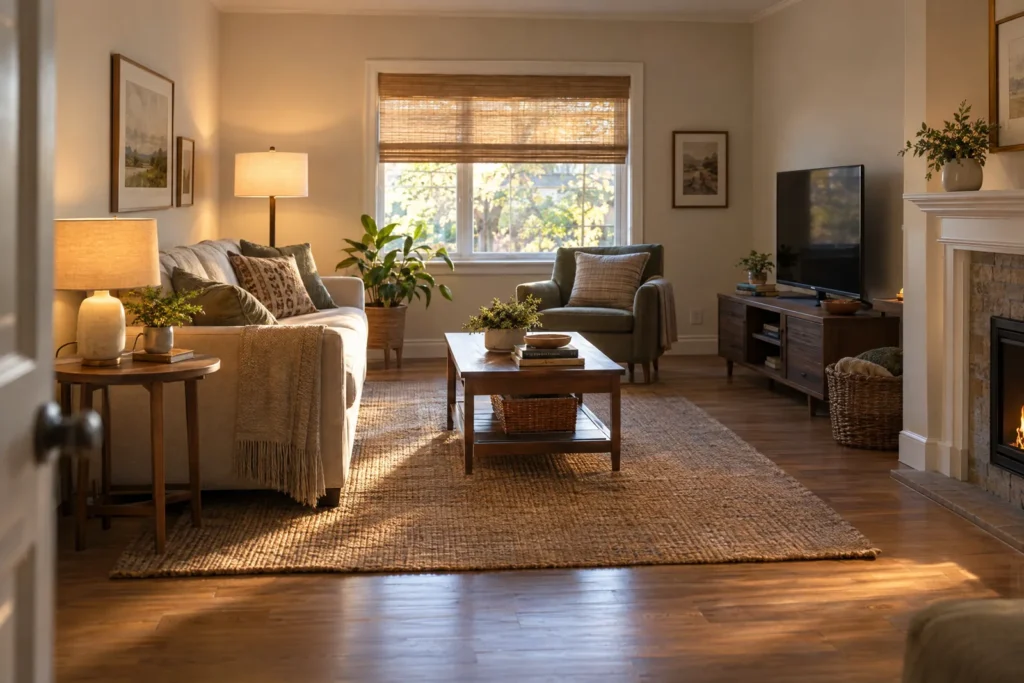
A living room changes from a conversation space to a cinema, reading corner, homework station, or path to the kitchen over the course of an evening. A useful lighting plan has to change with it. The goal is not to fill the room with the most fixtures or to copy a showroom arrangement. It is to map light to real seats, real tasks, reachable controls, and the routes people use when the room is not fully lit.
This guide uses a simple sequence: map, test, control. Mark the furniture, screen, windows, outlets, existing sources, and important seats. Test the page, screen, faces, hands, and walking route from the positions where they will actually be used. Then decide which sources can be moved, dimmed, isolated, or replaced before buying anything or changing wiring.
Start with the room as people use it
Begin with a quick sketch on paper. It does not need to be to scale, but it should show the TV or other screen, windows, doors, seating, coffee table, reading chair, side tables, existing lamps, switches, receptacles, and the route to the entrance, kitchen, bathroom, or drink table. Add glossy furniture, framed glass, mirrors, and pale walls that may bounce a bright source into the screen or a person’s eyes.
Mark every meaningful position, not only the center of the sofa. An end seat may face a different angle from the TV. A chair may be used for reading while the sofa is used for movies. Someone may stand at the doorway while another person is watching. These positions become separate test rows.
Next, list what already exists:
- Which fixtures are hardwired, plugged in, movable, shaded, directional, or controlled remotely?
- Which switches can be reached from a seat, and which require crossing the room?
- Which outlets are hidden behind furniture or likely to be used by another device?
- Where would a cord be visible, pinched, stepped on, or pulled across a walking route?
- Which sources are comfortable at full output, and which are only useful when reduced?
- Does anyone in the household need lower glare, stronger contrast, a quiet route, or a control that works while seated?
This inventory prevents a common mistake: choosing a fixture category before checking whether the room can support its location and control. Furniture and sightlines often matter more than the geometric center of the room.
Name the scenes before choosing fixtures
A living room lighting plan should describe what the room must do. Start with the scenes below, then add the activities that are specific to the household.
- Everyday and conversation: Faces, the coffee table, and the route to the door should be readable without a harsh source dominating the room.
- TV or movie: The screen should remain comfortable from each important seat, with enough background or route light to prevent a completely disorienting dark room.
- Reading: The actual page, e-reader, or magazine should be visible at the chair, with the source out of the reader’s direct eye line.
- Gaming, laptop, craft, or homework: Hands, controls, paper, and the work surface should be visible without a reflected source obscuring a screen.
- Entertaining: The room should support faces and movement, while decorative or display light can be adjusted without forcing every other source on.
- Night circulation: The path to a door, drink, or nearby room should remain legible without creating a bright point that is uncomfortable after the room has been dimmed.
- Two activities at once: One person may read while another watches television. This is the test that exposes whether sources and controls are genuinely independent.
For every scene, write down what must be visible and what must not happen. For TV viewing, the problem may be a window reflection or a lamp shade appearing in the screen. For reading, it may be a hand shadow or a bright bulb in the reader’s eye line. For conversation, it may be faces disappearing into shadow. For night movement, it may be a bright source that makes the rest of the room harder to see.
Assign lighting jobs, not a fixture count
Think of each source as having a job. A soft background source can give the room context. A task source can serve a page, hands, or a tabletop. An accent source can draw attention to artwork or a plant. A media background source can reduce the visual jump between a bright screen and a dark room. One source may serve more than one job, but only if the seat-by-seat test confirms that it does not create a new problem.
A shaded, wall-directed, or indirect source may be comfortable for conversation but too weak or poorly placed for a page. A directional floor lamp may help a reader but appear in the TV reflection. A ceiling fixture may be useful for cleaning and setup but too exposed for a movie scene. The label on a lamp does not prove that it works for your chair, screen, or route.
A practical plan often has separate ways to adjust the room rather than one all-or-nothing switch. That could mean a lamp control beside a reading chair, an independently controlled background source for TV, or a social setting that leaves a low route light on. The right arrangement depends on the room and household, so record the result instead of applying a universal number of lamps, brightness, color temperature, or fixture spacing.
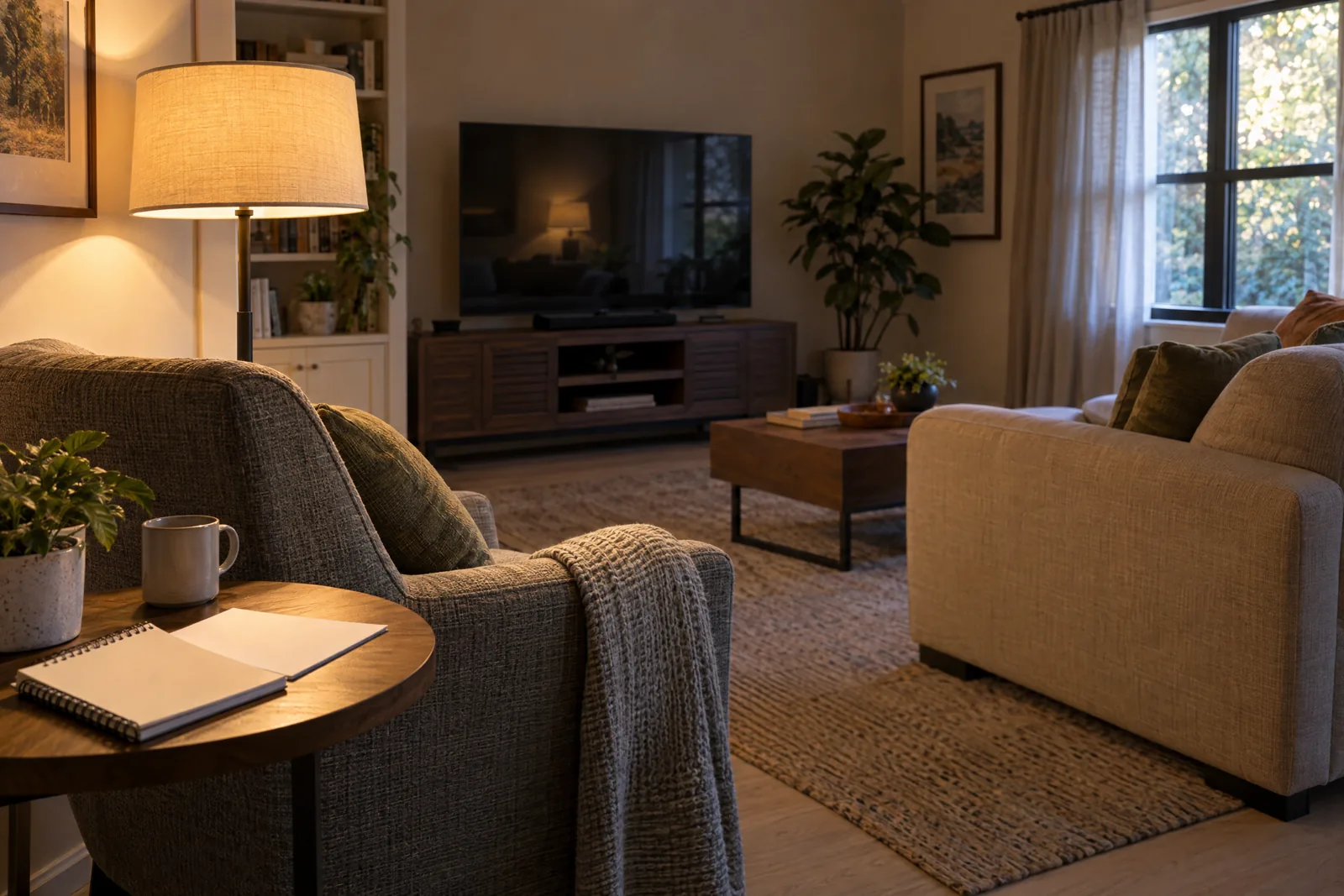
The activity-by-seat worksheet
Copy a row for every important seat and standing position. Include the least favorable seat, such as the end of the sofa with the widest view of a window or the chair nearest a reflective table. Use the worksheet while sources are in their proposed locations, not only while browsing pictures.
| Seat or position | Activity and time | Current source | Screen or glare observation | Reachable switch | Outlet and cord route | Proposed test | Retest result and decision |
|---|---|---|---|---|---|---|---|
| Sofa seat A | TV, evening | ||||||
| Sofa seat B | Conversation, evening | ||||||
| Reading chair | Page, evening | ||||||
| End seat or laptop spot | Work, gaming, or craft | ||||||
| Standing route | Night movement |
For the current source column, write something specific, such as “overhead fixture,” “table lamp behind right shoulder,” or “daylight from window opposite screen.” In the glare column, record what is actually visible: a shade, bulb, window, glossy table, framed glass, or bright patch on the wall. In the proposed test column, write one change only, such as “move lamp beyond screen reflection,” “turn shade away from chair,” or “add a low background source and switch off ceiling fixture.” This makes the retest meaningful.
A detailed glare and comfort test
Use the room in ordinary conditions. Test once with typical daylight, once after sunset, and once with the room as dark as it normally becomes during a movie. Do not judge a light only at its brightest setting.
- Sit in every important position and face the screen, page, table, and other people as usual. Include the seat that looks least convenient on the sketch.
- Look at the screen from each seat. Note every lamp shade, bare bulb, window, bright wall patch, glossy tabletop, mirror, or framed surface that appears in it.
- Look away from the screen toward each source. Notice squinting, a bright point in the natural eye line, or a source that becomes distracting when talking.
- For reading, open the actual book or e-reader at the normal angle. Check whether the page is clear, whether a hand or body casts a shadow, and whether the source is visible above or beside the shade.
- For a laptop, tablet, game, or craft, place hands and materials as they will be used. Check both the work surface and the screen. Change the user’s position if more than one person will use the spot.
- Reduce, redirect, shade, or isolate one source at a time. Record the lowest setting that still supports the activity, but do not treat that observation as a universal brightness target.
- Walk the usual route from the sofa to the entry, kitchen, bathroom, and drink table. Look for a dark change in floor level, a cord, furniture edge, pet item, or blocked switch.
- Repeat the test with curtains, furniture, or screen angle in their normal positions. A change that fixes one reflection may create a new shadow or route problem.
The plan is ready for the next buying decision when the important rows pass under normal conditions. If a row fails, change the source position or control before assuming that a brighter bulb will solve it.
Controls and power belong on the plan
A source that works beautifully but cannot be operated from the intended seat may not support the scene. Record who needs to control it, where that control is located, and what happens if a remote, app, or rechargeable unit is unavailable. A guest should be able to understand the basic social or TV setting without a scavenger hunt.
| Source or group | Job and scenes | Control type and location | Reachable from | Can it be isolated from TV? | Minimum useful setting | Failure fallback | Ownership note |
|---|---|---|---|---|---|---|---|
| Background source | Everyday, social, night route | Cleaning and replacement access | |||||
| Reading source | Reading, craft | Shade and control access | |||||
| Media background | TV, movie | Screen reflection check | |||||
| Accent or display source | Social, display | Optional, not a route dependency |
Keep power planning separate from style decisions. For each plugged-in source, draw the cord path before deciding that the lamp belongs there. If the cord crosses a route, is pinched by furniture, is damaged or would overload a connection, move the source or ask a qualified electrician about a suitable solution. Follow the lamp, plug, dimmer and control instructions.
For a new junction box, hardwired sconce, recessed source, ceiling work, or uncertain existing wiring, stop at the layout stage and obtain qualified electrical advice. A decorating sketch cannot determine whether a particular installation is permitted or suitable. Check the product instructions, mounting surface, local requirements, and, for a rental, written landlord permission before changing the room.
TV and movie lighting: test the screen from every seat
Television changes the test because the screen is both a task surface and a reflective surface. A source that looks pleasant from the doorway can become an obvious bright shape from the end of the sofa. Windows, lamps, glossy tables, framed art with glass, and pale wall areas can all contribute to the distraction.
Start with the screen off and inspect the room from each seat. Then turn on the proposed background sources and repeat the inspection. Finally, use the screen in a normal scene, because a dark scene can reveal a reflection that a bright image hides. Move or shade the source, lower its setting, or place it outside the reflection path. Test again from the least favorable seat.
A comfortable TV scene usually needs two separate checks:
- Screen comfort: No source is an avoidable bright reflection or an irritating point in the viewer’s eye line.
- Orientation: The room still offers enough visual information to find a drink, door, switch, or route without turning on the harshest source.
A dim or indirect background idea can be useful. Treat any approach as a starting point, not as a performance specification. The screen, window, seating angle, and wall finish in the actual room decide the result.
Reading, laptop, and craft zones: judge the task
Move the actual chair and side table into position before judging a reading source. Open the material used most often. Check the page while sitting back, leaning forward, and holding the book at the usual angle. If two people use the chair, test both handedness and seating positions where they change the shadow or control reach.
Look for four issues:
- Page or surface visibility: Text, hands, tools, and materials should be easy to inspect at the normal working position.
- Body and hand shadows: A source behind the wrong shoulder can put the reader’s hand or arm across the page.
- Direct glare: The shade or beam should not become a bright source in the eye line when the reader looks up.
- Control access: The reader should be able to adjust or switch the source without crossing the room or disturbing the TV viewer.
For a laptop or tablet, add a screen reflection check. A source that performs well on paper may be a poor choice when the user alternates between the page and a glossy display. Test with the screen at its normal tilt, not flat on a table for convenience.
Conversation and entertaining: light faces and routes
Conversation is a multi-seat scene, so inspect faces from the actual arrangement rather than from the room entrance. Ask whether one person is sitting in a shadow cast by a shade, tall furniture, or another person. Check the coffee table, drink table, and route to the door without turning the room into a uniformly bright box.
A useful social scene can combine a comfortable background layer with a task or display source that can be reduced separately. Direct light may make a surface clear but feel exposed from the sofa. Indirect light may soften the room but leave faces or hands too dim. A shaded source may be calm from one seat and visible in another. The decision is made by looking from each position and recording the tradeoff.
If the room is used for entertaining, test the control sequence before guests arrive. Can the main source be lowered without losing the route? Can a display source be turned off without darkening the reading chair? Can someone sitting at the far end understand which control changes the scene? These small details often matter more than matching every fixture.
One person reads while another watches
This simultaneous-use test should be a separate worksheet row pair. First, set the TV scene at its normal viewing level. Then operate the reading source at its normal page setting. Return to the TV seat and inspect the screen again. The reader’s source may be comfortable at the chair but visible across the room or reflected in the screen.
Try moving the reading source slightly, changing its direction, using its shade, or isolating it from the media background. Then repeat the page test. Keep the change only if both seats pass. Also check whether the reader can operate the source while seated and whether the TV viewer can lower the background light without switching off the reader.
The point is not to make the two activities identical. It is to give each person a useful, controllable zone without solving one task by making the other unpleasant.
Rooms without overhead wiring and renter constraints
No ceiling junction box does not mean that the first available lamp is the answer. Choose a path based on the job, cord route, permission, and control needs.
- Movable floor or table source: Flexible and easy to retest, but it needs a stable location, a sensible cord route, and enough floor or table space.
- Plug-in wall or ceiling option: Can keep floor space clear, but mounting, visible cord treatment, switch reach, and landlord permission become part of the plan.
- Rechargeable source: Useful where wiring or visible cords are impractical, but charging, replacement, control access, and a fallback scene must be considered.
- Surface-mounted or hardwired work: May create a neat, integrated result, but it is no longer only a furniture decision. Verify the mounting surface, product instructions, local requirements, and qualified electrical scope.
Portable and plug-in approaches can preserve flexibility when there is no ceiling junction box, but they still need a stable location, a safe cord route, reachable control, and any required permission. Sketch the cord route first, then decide whether the source still works visually and safely in the room.
Choose fixture categories by job and constraint
Use this table to narrow the type of source. It is not a shopping list and does not make one category correct for every room.
| Option | Useful when | Tradeoff to test | Questions before buying |
|---|---|---|---|
| Floor lamp | A movable or higher source is needed | Footprint, shade in eye line, cord route, stability | Can it aim at the task or wall without reflecting in the screen? |
| Table lamp | A side table is already placed well | Small working area, table clutter, control reach | Does it help the seat, or only decorate the table? |
| Wall or plug-in sconce | Floor and table space are limited | Mounting, cord cover, permission, switch reach | Can the intended user control it from the seat? |
| Pendant or ceiling fixture | A room-level source or focal point is wanted | Direct glare, mounting, wiring scope, control | Does it serve the activity arrangement rather than an empty-room center? |
| Recessed or directional source | Planned ceiling work is appropriate | Installation scope, aiming, glare, maintenance | Who will verify the installation and local requirements? |
| Uplight or indirect source | A darker wall or corner needs soft fill | Wall or ceiling bounce, source visibility, cord path | Does it improve comfort without appearing in the screen? |
| Rechargeable or battery source | Wiring is impractical or temporary | Charging, replacement, runtime, fallback | What happens when it needs charging or is unavailable? |
Validate bulbs and controls in the actual room
Light appearance changes with daylight, wall color, flooring, shade material, and nearby sources. Instead of choosing a color-temperature number as a universal answer, compare the actual bulb and fixture in the room. Look at faces, wood, upholstery, the page, and the screen under the proposed scene. Note whether the result feels too stark, too dim for the task, or visually mismatched with the sources that remain on.
Change one variable at a time. If a bulb is replaced, leave the source position unchanged. If a dimmer or smart control is added, verify that the bulb, fixture, and control are listed as compatible in their product instructions. Product compatibility does not promise a particular appearance or illumination level in an individual living room.
Record the setting that supports the task with the least glare. Do not select an option merely because it looks brightest from the doorway.
A completed illustrative failure and revision
The following example is a design concept, not a universal layout. It shows how a plan improves through testing rather than through a fixture count.
A sofa faces a TV on the opposite wall. A reading chair sits beside a window, and a small table lamp is behind the chair. An overhead source is comfortable for cleaning but produces a bright screen reflection at night. The reading chair has a usable page only when the overhead source is on, which makes the screen uncomfortable.
| First attempt | Test result | Revision | Retest result |
|---|---|---|---|
| Overhead source for TV and reading; table lamp left behind chair | Screen shows a bright reflection; page has a hand shadow; switch is across the room | Use a controllable background source for TV, redirect the chair source toward the page, and place its control within seated reach | TV reflection is reduced, page is clearer, and the reader can adjust light without crossing the room |
| Reading source left on during movie | Source is visible from the end sofa seat and distracts from a dark scene | Aim and shade the reading source with the reader seated, then retest from the sofa | Reader keeps a useful page setting without a distracting screen reflection |
| Route light turned fully off | Doorway and drink table become difficult to locate | Keep a separate low route source available for night movement | Route remains legible without restoring the harsh overhead scene |
The lesson is not that every room needs the same sources. The lesson is to record the failure, change one condition, and retest every affected seat. A fix for the page can create a screen reflection. A fix for the screen can make the route too dark.
Decide what to buy, move, or postpone
Once the worksheet is complete, sort each source into one of three actions:
- Keep or move: The source supports a real activity after a small location, direction, shade, or control change.
- Buy or replace: A task still fails after reasonable repositioning, and the missing job is clear.
- Wait: The plan depends on permission, electrical advice, a furniture change, or a better understanding of how the room is used.
Make the buying decision after the test, not before it. If the next step is a staged, budget-conscious living-room update, the Budget Living Room Makeover can help place lighting changes alongside other spending priorities. The lighting worksheet should still determine which change is worth making first.
Avoid buying a source because it fills an empty corner in a photograph. Buy only when the worksheet identifies a job, a seat, a control, a power path, and a test that the source must pass.
Frequently asked questions
How many lights does a living room need?
There is no reliable universal count. Assign each source a job, such as reading, screen background, conversation, or circulation, then keep only the sources that pass the seat-by-seat glare, control, and route tests.
How can I reduce a lamp reflection on the TV?
Check the screen from every important seat with the screen off and during a normal scene. Move, shade, redirect, lower, or isolate the source, then retest from the least favorable seat.
When should I ask an electrician?
Get qualified electrical advice before new junction boxes, hardwired fixtures, recessed work, ceiling work, or changes to uncertain wiring. Keep the plan at the layout stage until the installation scope and local requirements are clear.
Final living room lighting checklist
Before ordering, mounting, or rewiring, confirm the following:
- Every important seat and standing position has an activity row.
- TV reflections were checked with the screen on and off, in daylight and evening conditions.
- The least favorable viewing seat was tested, not only the central seat.
- Reading, craft, laptop, or gaming surfaces were tested with real materials and normal hand positions.
- Conversation faces, the coffee table, and the entry route remain usable in the social scene.
- The one-person-reading-while-another-watches scene was tested separately.
- Controls are reachable from the intended seats and can isolate the sources that need to change.
- Outlets, plugs, cords, furniture pinch points, and walking routes are recorded.
- Product instructions, bulb and control compatibility, mounting surfaces, and cleaning access are checked.
- Rental permission and questions for a qualified electrician or local authority are identified before any installation work.
- Children, pets, mobility needs, glare sensitivity, charging, replacement, and a failure fallback are considered.
- The proposed source supports an activity rather than existing only for decoration.
A living room lighting plan is a working record, not a one-time style formula. Save the worksheet and revisit it when the sofa moves, a screen angle changes, a new chair is added, or the room begins serving a new activity. When the plan maps the real seats, tests the real tasks, and gives each important scene a reachable control, the room can shift from reading to television to conversation without relying on one harsh source or a guess made from the doorway.