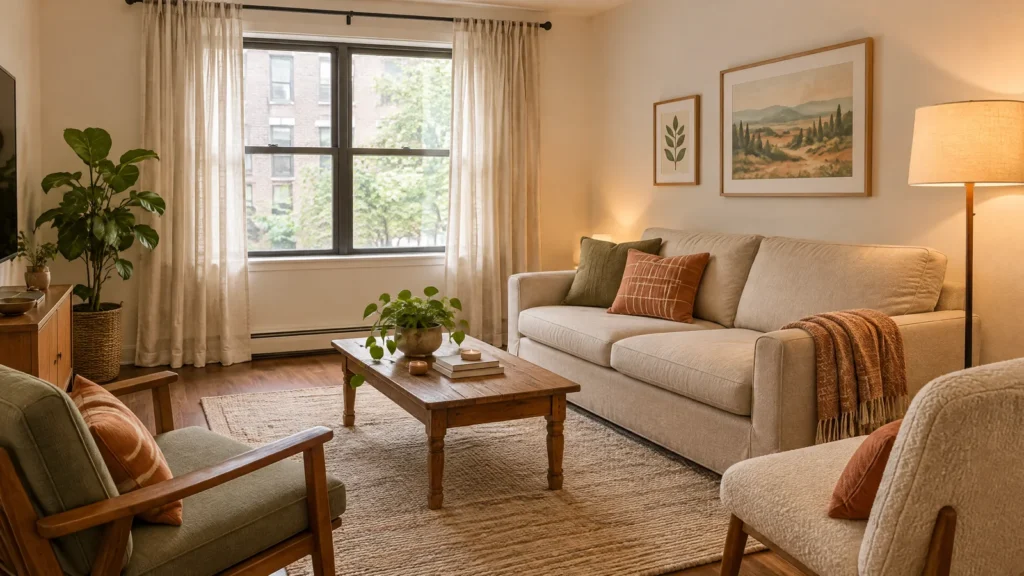
A budget living room makeover does not require a new sofa, matching furniture set or cart full of decorative objects. The most effective plan is to improve the room in a deliberate order: correct the layout, remove visual clutter, establish one palette, improve the lighting and then buy only what solves a measured problem.
This guide provides two practical U.S. budgets. The first is a no paint plan with $134.63 in listed purchases and $115.37 held back for a secondhand or room specific need. The second allocates $484.62 to listed products and keeps $15.38 as a checkout reserve, creating a total cap of $500. Prices were checked on September 13, 2026. Availability, tax, shipping, sales and local fulfillment can change, so confirm every item before buying.
The budget is a ceiling, not a spending target. If the room feels finished after rearranging the furniture and spending $134.63, keep the remaining money.
Budget Living Room Makeover at a Glance
| Decision | $250 no paint plan | $500 repaint and storage plan |
| Listed product subtotal | $134.63 | $484.62 |
| Money held for tax, shipping or a measured need | $115.37 | $15.38 |
| Paint included | No | Two gallons plus small-repair kits |
| Main upgrade | Rug, lighting and textiles | Paint, lighting, rug and closed storage |
| Existing sofa retained | Yes | Yes |
| Best for | Renters, first apartments and quick resets | Owners or permitted renters who need wall repair and clutter control |
| Maximum planned allowance | $250.00 | $500.00 |
The two plans use retail prices only as dated reference points, not endorsements or guaranteed checkout totals. A product may be unavailable in your ZIP code, and a sale price may end. Substitute by function and dimensions rather than trying to copy every item exactly.
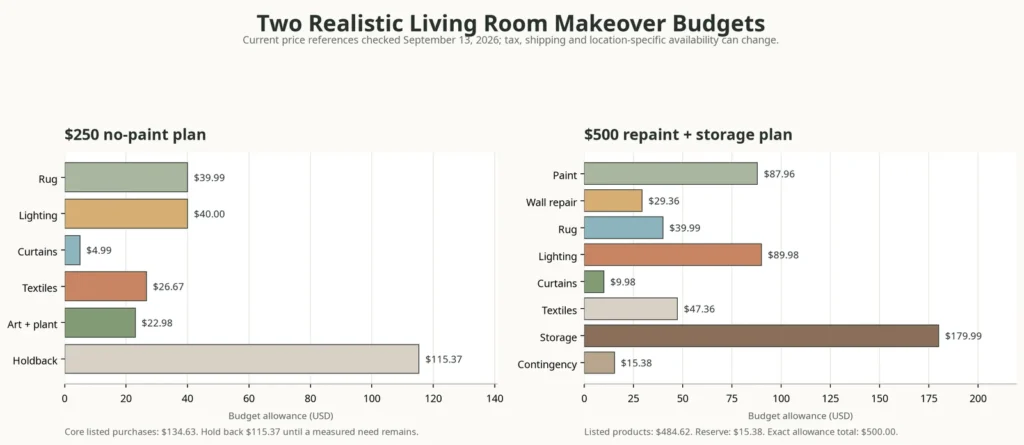
Budget allowances based on price references checked September 13, 2026. Tax, shipping and location specific availability may change.
Start With a Zero-Dollar Living Room Reset
Do not shop first. Remove small decor, loose blankets, unused baskets and anything that has migrated into the room without a clear purpose. Clean the floor, windows, baseboards, lampshades and upholstery according to their care instructions. A cleaner and quieter room makes the real problems easier to see.
Next, photograph the room from the doorway and each corner. Measure the walls, sofa, chairs, tables, door swings, windows, vents and the distance between furniture. Record the location of outlets so the final arrangement does not require cords across a walkway.
Choose one primary function. A living room designed mainly for conversation should pull chairs toward the sofa. A television focused room should provide comfortable sightlines without making the screen the only visual anchor. A family room may need a larger open area and closed storage more than a coffee table.
Rearrange What You Already Own
Place the largest seating piece first. Then turn loose chairs toward it rather than lining every item against a different wall. Keep the main path from the entry to the next doorway clear. A coffee table belongs close enough to reach from the seating, but the narrow gap around it should not become the room’s main passage.
Try side tables, lamps and art in new locations before buying replacements. Move a bedroom lamp into the living room for one evening. Test whether a chair from another room improves the conversation area. If the arrangement works for a week, then spend money on the missing function rather than on a guess.
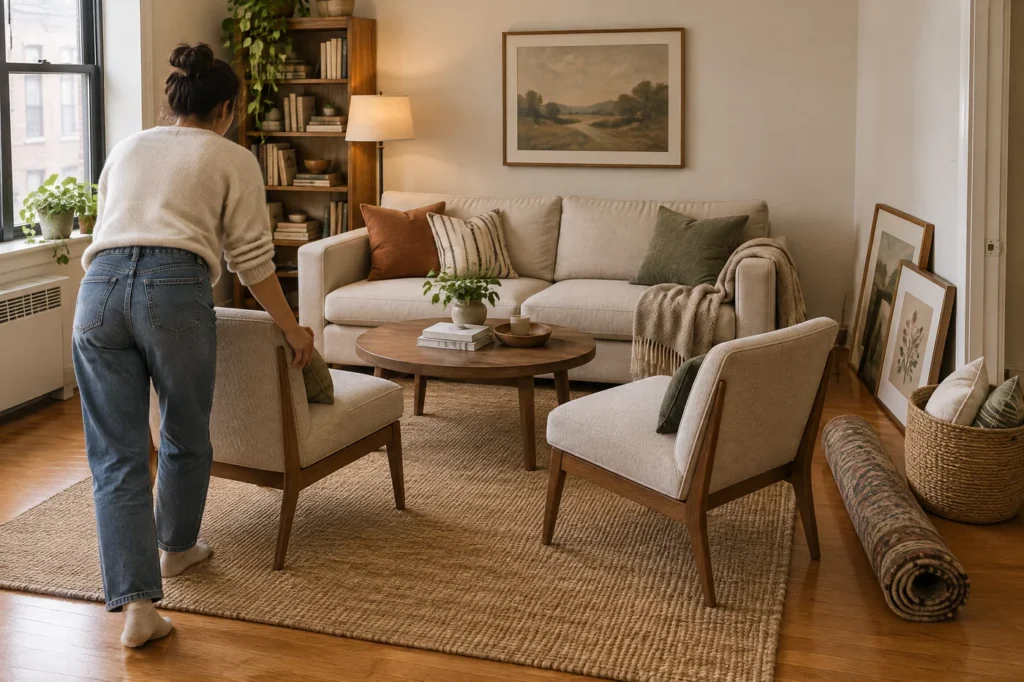
Use what you own concept: establish the furniture arrangement before choosing a rug, lighting or accessories.
A Measured 12×14 Living Room Layout
The example below assumes a 12 by 14 foot room, an 84 by 36-inch sofa, one 30 by 32 inch chair, a 36 by 24-inch coffee table and a 40 by 18-inch console. The front portion of the sofa sits on a 5 by 7 foot rug. The door swing remains open, and the principal entry route approaches the conversation zone from the open end of the rug. The 22-inch space between the chair and coffee table is a reach gap, not the main walkway.
This is a planning example, not a universal layout. Recreate it using your actual furniture and openings. Do not block a supply or return vent, baseboard heater, outlet or required exit route.
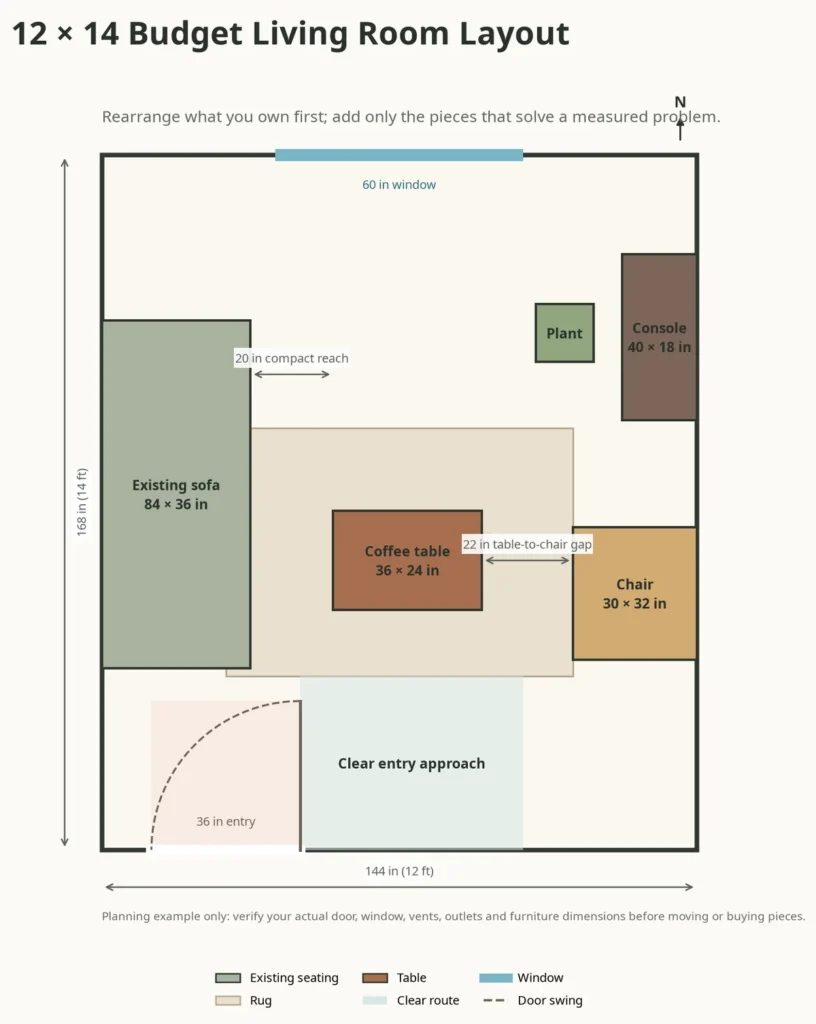
Measured planning example for a 12-by-14-foot living room. Verify every dimension in the actual room.
What the Layout Solves
The arrangement creates one recognizable seating group. The rug connects the front of the sofa, coffee table and chair instead of floating by itself in the center. The console provides a place for closed or contained storage without occupying the entry zone. The main route remains outside the compact reach distances around the coffee table.
If your room is narrower, remove the chair before shrinking the primary walkway. If the coffee table makes movement difficult, replace it with a small side table, nesting tables or an ottoman already owned. A room that is easy to use will look more intentional than a crowded room with more furniture.
The $250 No-Paint Living Room Makeover
This plan is designed for a room with usable walls, an existing sofa and at least one side surface for a lamp. The listed purchases total $134.63. The remaining $115.37 is a holdback, not an instruction to buy more decor.
| Category | Allowance | What the allowance covers |
| Large area rug | $39.99 | One 7-foot-3-inch by 9-foot-2-inch flatwoven rug reference |
| Lighting | $40.00 | Two $20 table lamps; the listing says each includes one LED bulb |
| Sheer curtains | $4.99 | One pair; existing rod and hardware required |
| Pillow covers and throws | $26.67 | One two cover pack at $20.69 plus two $2.99 throws; inserts not included |
| Art and plant | $22.98 | One four print pack at $9.99 and one 6-inch potted plant at $12.99 |
| Holdback | $115.37 | Tax, shipping, frames, hardware, a secondhand item or money not spent |
| Total cap | $250.00 | Core listed purchases are $134.63 before tax and shipping |
Step 1: Anchor the Seating With the Rug
Measure the seating group rather than the entire room. The reference rug is 7 feet 3 inches by 9 feet 2 inches and was listed at $39.99. In many rooms, a rug in this range can reach under the front legs of the sofa and chair. Confirm the actual dimensions and door clearance before ordering.
The cited price does not include the separately suggested rug underlay. Add an underlay only after checking the floor type and product instructions. If the room cannot accommodate this size, select a smaller rug intentionally; do not buy a large rug and fold or crowd it against vents and doors.
Step 2: Replace One Harsh Light Source With Layers
The $250 plan assigns $40 to two table lamps listed at $20 each, with one LED bulb included per lamp. Use them on existing side tables, a console or sturdy surfaces at different ends of the room. The goal is not to create perfect symmetry. It is to distribute light so the room is not dependent on one ceiling fixture.
If you already own two useful lamps, spend nothing here. Try warmer bulbs that match the lamp socket and fixture limits, or move an existing lamp to the darker end of the room.
Step 3: Soften the Window Without Buying New Hardware
The reference sheer curtains were listed at $4.99 per pair. They do not include a rod, hooks or clips, and they are not blackout curtains. This step works only when suitable hardware is already installed or owned.
Hang the panels as high and wide as the existing hardware safely allows. Keep fabric away from heat sources and follow the care label. If the lease does not permit drilling, retain the existing treatment and redirect the allowance.
Step 4: Limit the Textile Palette
Use two or three colors already present in the room. The reference textile allowance includes two pillow covers and two small throws. The pillow covers do not include inserts, so reuse inserts only if the sizes are compatible.
Place one throw on the sofa and use the second on a chair or in a basket. More pillows are not automatically better. Stop when the seating has enough support and the palette feels connected.
Step 5: Build One Art and Plant Moment
The plan uses a four pack of 8-by-10-inch prints listed at $9.99 and one 6-inch potted plant listed at $12.99. Frames, hanging hardware, a decorative planter and care supplies are not included.
Use owned frames or source them secondhand. Arrange the prints as one compact group rather than scattering them around the room. Check the plant’s care requirements, light needs and household suitability before purchase. If a live plant is inappropriate, reuse a vase, branch arrangement or object already owned.
Step 6: Keep the $115.37 Holdback Until the End
Live with the room for several days. If a functional gap remains, measure it and shop specifically for that need. A local Habitat may offer frames, tables, mirrors or storage, but inventory and pricing change continuously.
Do not spend the holdback simply because it appears in the plan. It exists to protect the budget from tax, shipping, missing hardware and room specific problems. Keeping the full amount is a successful outcome.
The $500 Repaint and Storage Living Room Makeover
The second plan is for a room that needs small wall repairs, a unified paint finish and closed storage. Listed products total $484.62. The remaining $15.38 is reserved for checkout costs or essential accessories. If taxes and delivery exceed that reserve, remove or substitute an item to keep the total under $500.
| Category | Allowance | What the allowance covers |
| Paint | $87.96 | Two one gallon containers at $43.98 each |
| Small wall repairs | $29.36 | Two repair kits at $14.68 each; cited scope is holes and cracks up to 3 inches |
| Large area rug | $39.99 | One large flatwoven rug reference |
| Layered lighting | $89.98 | One $20 table lamp, one $59.99 floor uplighter and one $9.99 compatible bulb pack |
| Sheer curtains | $9.98 | Two pairs; hardware not included |
| Pillow covers and throws | $47.36 | Two pillow-cover packs and two throws; inserts not included |
| Closed storage | $179.99 | One compact cabinet at the sale price visible on the reference date |
| Checkout reserve | $15.38 | Tax, shipping, rug underlay or essential hardware |
| Total cap | $500.00 | Listed products are $484.62 before tax and shipping |
Step 1: Decide Whether Paint Is Worth $117.32
Paint and repair supplies consume $117.32 of the plan before tools. Repaint only if the current finish is damaged, inconsistent or incompatible with the intended palette. If the walls are in good condition, use the no paint branch and redirect the allowance to storage, a better rug or savings.
The paint reference was listed at $43.98 per gallon. The plan assigns two gallons, but that is not a coverage promise. Measure wall area, subtract major openings, account for the number of coats and use the manufacturer’s calculator or label. Rollers, brushes, trays, tape, drop cloths and labor are not included unless already owned.
The repair kit reference was listed at $14.68 and is described for holes and cracks up to 3 inches. Larger damage, water staining, recurring cracks or loose material needs a different assessment.
If the home was built before 1978, disturbing old paint can create hazardous lead dust. The U.S. Environmental Protection Agency recommends determining whether lead based paint is present and using lead safe practices; it also recommends considering a lead safe certified contractor.
Step 2: Add the Rug After the Paint Cures
Remove or protect textiles and furniture while painting. Follow the paint label for ventilation, drying and recoat times. Return the rug only after the finish is sufficiently dry and the room has been cleaned.
Use the rug to define the seating footprint. Do not use it to cover damage, a floor vent or a trip hazard. Confirm whether the floor and rug require an anti slip underlay, then include that cost within the checkout reserve.
Step 3: Create Two Levels of Light
The lighting allowance combines a table lamp with an included bulb and a floor uplighter that requires a separate compatible bulb. Position one light near the seating and the second where it can illuminate a darker wall or corner.
Match the bulb base to the fixture. Do not exceed fixture limits or run cords under rugs. Keep cords along walls and away from walking paths. The product pages do not establish whole room brightness, so evaluate the result in the actual space before adding more lamps.
Step 4: Use Closed Storage for Visible Clutter
The cited cabinet was listed at a $179.99 sale price on September 13, 2026. It includes one drawer, two doors and adjustable shelves according to the retailer page. The item is online-only, requires assembly and may vary by seller, ZIP code and availability.
Before buying, measure its complete footprint and the space needed to open doors and drawers. Decide what it will contain. A cabinet should solve a defined clutter problem, not become another surface for miscellaneous decor.
Anchor top heavy furniture and televisions according to the manufacturer’s instructions. The U.S. Consumer Product Safety Commission specifically recommends securing top heavy furniture and installing supplied anti tip devices.
Step 5: Finish With Textiles, Curtains and Restraint
Repeat the same limited palette across pillow covers, throws and window fabric. The $500 plan includes two pairs of sheer curtains, four pillow covers and two small throws. It does not include curtain hardware or pillow inserts.
Use only what the room needs. If one curtain pair covers the window correctly, keep the second $4.99. If two pillow covers are enough, remove one pack and increase the checkout reserve.
A Renter-Friendly Living Room Makeover Without Paint
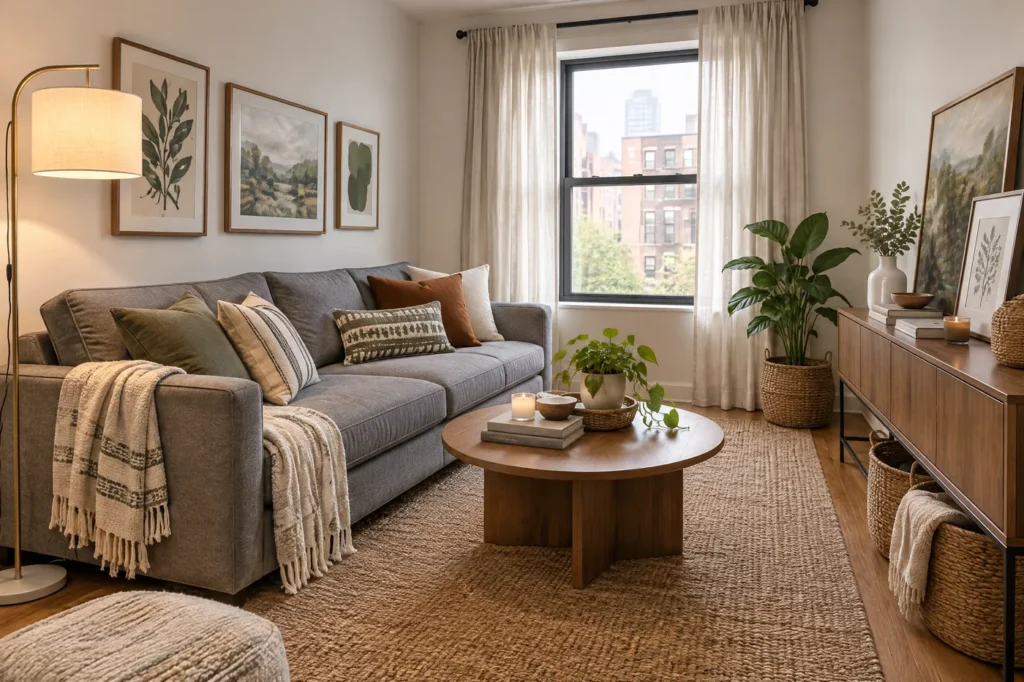
A renter can follow the $250 branch even with strict lease terms. Keep the existing wall color, use the installed curtain hardware, rearrange the seating, add plug-in lighting and style art on a console or existing shelf rather than creating new holes.
Review the lease before installing hooks, rods, wallpaper or anti-tip hardware. “Removable” does not guarantee damage free removal on every paint finish or wall condition. Test products in a hidden area and follow the manufacturer’s surface and weight limits. When wall anchoring is required for safety, ask the property owner or manager how it should be completed.
For more lease conscious ideas, continue with these renter-friendly decor ideas.
Choose a Palette Without Replacing the Sofa
Start with the sofa, flooring and largest fixed surface. Identify whether each reads warm, cool or neutral. Select one main neutral, one supporting color and one small accent. Repeat them across the rug, pillows, throw and art.
A beige or cream room can gain depth from medium wood, olive, rust, charcoal or muted blue. For a softer neutral direction, use the beige living room ideas as a palette reference. If the room needs more energy, review the colorful living room ideas and choose one controlled accent rather than several unrelated colors.
A modern result does not require all-new furniture. Clear lines, repeated finishes and deliberate spacing matter more than buying a matching collection. The modern living room designs can help narrow the final look after the budget and layout are fixed.
What Not to Buy During a Budget Makeover
A New Sofa Without a Functional Reason
Replacing the sofa can consume the entire budget and introduce delivery, fit and disposal costs. Keep it unless it is structurally damaged, uncomfortable beyond repair or wrong for the measured layout.
A Tiny Rug Chosen Only Because It Is Cheap
A low price is not useful if the rug floats between the seating and makes the room feel fragmented. Measure the furniture group and compare the rug’s actual dimensions before buying.
Decorative Storage Without a Storage Plan
Baskets and cabinets should have assigned contents. Buying containers before identifying the clutter often adds more objects without solving the problem.
Matching Sets That Remove Flexibility
A complete table or lamp set may look convenient, but it can overwhelm a small room. Buy one functional piece at a time and evaluate the result.
Trend Pieces That Do Not Match the Base Room
Use the sofa, floor and existing wood tones as constraints. A makeover will feel more coherent when new items connect to the permanent elements rather than compete with them.
A Two-Day Living Room Makeover Schedule
| Time | Work | Purchase required? |
| Day 1, morning | Remove small decor, clean, photograph and measure | No |
| Day 1, afternoon | Test two furniture arrangements and select the better route | No |
| Day 1, evening | Build a three-color palette and exact shopping list | No |
| Day 2, morning | Complete permitted wall repair or painting | Only for the repaint plan |
| Day 2, afternoon | Place the rug, lamps and storage | Yes, if missing |
| Day 2, evening | Add curtains, textiles, art and plant; remove anything unnecessary | Only as needed |
A repaint project may require more than two days because preparation, drying and recoating depend on the product and room conditions. Follow label instructions rather than forcing the work into a decorative timeline.
Frequently Asked Questions
Can I Make Over a Living Room for $250?
Yes, if the main sofa and essential furniture remain. The no-paint plan in this guide lists $134.63 in rug, lighting, curtains, textiles, art and plant purchases, leaving $115.37 for tax, shipping, one secondhand need or savings.
What Should I Buy First for a Budget Living Room Makeover?
Buy nothing until the layout is tested. After rearranging, prioritize the item that solves the largest visual or functional problem. That is often a correctly sized rug, better lighting or closed storage.
Is Painting the Cheapest Way to Change a Living Room?
Paint can create a large visual change, but it also requires preparation, tools, sufficient coverage and time. It is not the cheapest route when the existing walls are usable or the lease restricts painting.
How Can I Update a Living Room Without Buying Furniture?
Remove clutter, clean visible surfaces, rearrange chairs toward the sofa, move lamps between rooms, restyle owned art as one group and limit the color palette. These changes cost nothing and reveal whether a purchase is necessary.
What Is the Best Rug Size for a Small Living Room?
The correct size depends on the seating footprint. Choose a rug that connects the main seating pieces without blocking doors or vents. Measure the exact arrangement and mark the proposed rug corners on the floor before ordering.
How Do I Keep the Makeover Under $500 After Tax?
Treat the $15.38 contingency in the $500 plan as a checkout reserve rather than a product allowance. Calculate tax, shipping and required accessories before placing the order. If the total exceeds $500, remove textiles, a curtain pair or another nonessential item.
Do I Need to Disclose Product Links?
If you have a financial or other material relationship with a brand or retailer, disclose it clearly where readers will notice it. The Federal Trade Commission says disclosures should be hard to miss and placed with the endorsement message rather than hidden on a separate page. Do not claim personal experience with an item you have not used.
Final Budget Living Room Makeover Checklist
Before buying, confirm the room measurements, door swings, pathways, outlets, vents and furniture dimensions. Decide whether the project follows the no paint or repaint branch. Keep the sofa unless there is a clear functional reason to replace it. Recheck every price, size, stock status, tax and delivery charge. Use the holdback or contingency only for a measured need.
A successful living room makeover is not the one that spends closest to $500. It is the one that improves how the room looks and works while leaving unnecessary purchases and ideally some of the budget behind.