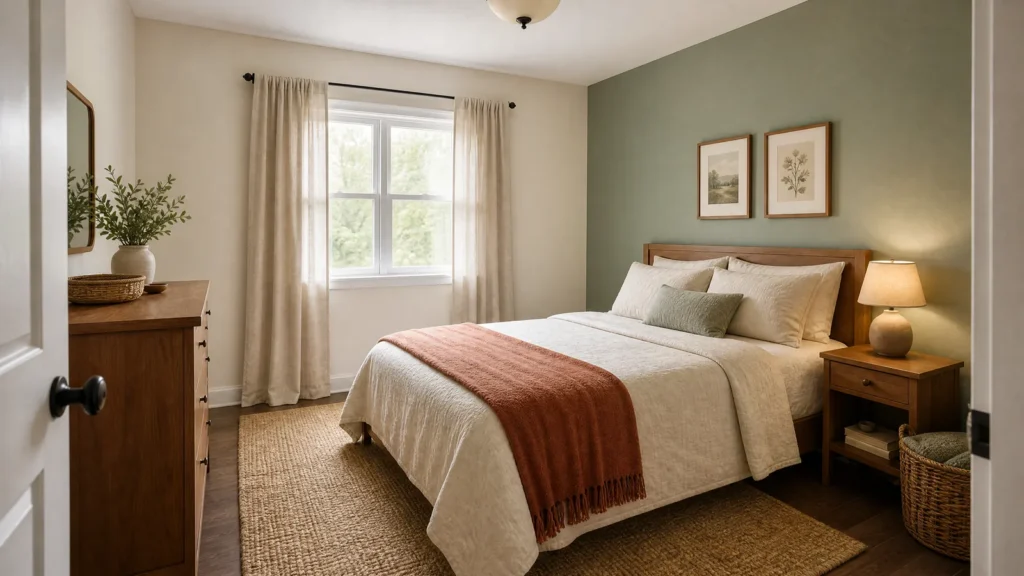
A budget bedroom makeover for $500 or less is realistic when you keep your bed, mattress, dresser and other major furniture. Spend first on the room’s largest visual surfaces and most-used elements: walls, bedding, lighting and window treatment. Then reserve enough money for installation supplies and unexpected costs.
This guide gives you two practical options: a basic $250 refresh and a more complete $500 makeover. It also includes a shopping order and a one-weekend makeover schedule.
The plan assumes a 10-by-12-foot U.S. bedroom with a queen bed, one dresser and usable flooring. Structural work, electrical work, hired labor, a new mattress and major furniture are not included in the budget.
Planning note: The room visuals in this article are design illustrations rather than photographs of a documented before-and-after project. The prices are category allowances rather than live retailer quotes. Check current prices, measurements, lease requirements and product instructions before buying or installing anything.
Quick Answer: Where Should the $500 Go?
A practical $500 bedroom makeover can allocate approximately:
- $110 to paint and supplies
- $120 to bedding and textiles
- $70 to lighting
- $50 to window treatment
- $40 to wall decor
- $60 to storage and accessories
- $50 to contingency
Keep your functional furniture and use the contingency allowance for tax, delivery or forgotten supplies. If the budget becomes tight, remove optional decorative objects before reducing the repair, lighting or privacy allowance.
What Can a $500 Budget Bedroom Makeover Include?
A bedroom makeover on a budget is a cosmetic improvement plan rather than a small renovation. The objective is to make the room look more coordinated and function better without replacing everything you own.
What This Budget Includes
The $500 plan can cover:
- Paint or a removable wall treatment
- Bedding and pillow covers
- A lamp or bulb upgrade
- Curtains or a simple shade
- Basic wall decor
- Practical storage
- Installation materials
- Minor cosmetic repairs
It can also cover small repairs, such as filling nail holes or replacing simple hardware, when the work is safe and within your skill level.
The allowance is flexible. A room with good bedding but poor lighting can move money from textiles to lamps. A renter who cannot paint can move the wall allowance to curtains, removable art or improved storage.
What This Budget Does Not Include
This plan does not include:
- A new mattress
- A new bed frame
- A large dresser
- New flooring
- Structural repairs
- Electrical work
- Hired labor
The plan also does not assume you will recover money by selling old items. If you sell something, record the proceeds only after the sale has been completed.
The category allowances leave $50 for contingency. Use this amount for tax, shipping, an extra coat of paint or a missing tool. If tax and delivery are higher than expected, reduce the optional decor allowance instead of exceeding the $500 cap.
The $250 and $500 Plans at a Glance
| Category | $250 refresh | $500 makeover | What it can cover |
|---|---|---|---|
| Paint and supplies | $75 | $110 | Paint, roller, brush, tape and patch material |
| Bedding and textiles | $60 | $120 | Duvet cover or coverlet, pillow covers and a throw |
| Lighting | $35 | $70 | Bulbs, one lamp or a renter-friendly plug-in light |
| Window treatment | $30 | $50 | Curtain panels or a basic shade solution |
| Wall decor | $20 | $40 | Printable art, thrifted frames or removable decor |
| Storage and accessories | $15 | $60 | Under-bed bins, basket, tray or simple hardware |
| Contingency | $15 | $50 | Tax, shipping, price changes or missing supplies |
| Total | $250 | $500 | Do not exceed the selected cap |
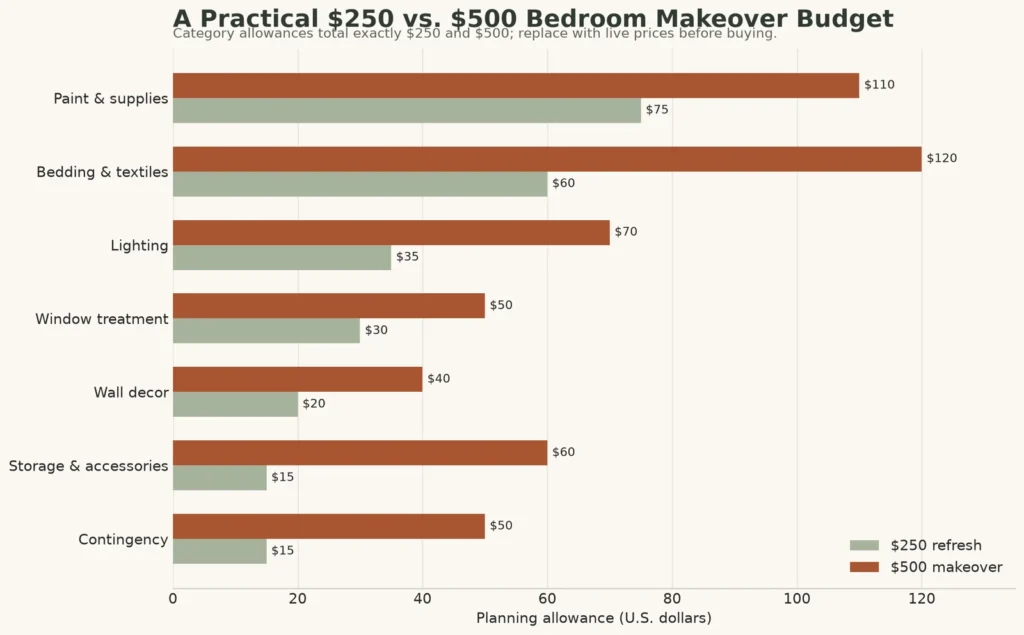
The $250 option is a focused refresh. It assumes you will reuse more of what you already own, limit painting to one wall if necessary and purchase fewer accessories.
The $500 version provides greater flexibility for bedding, lighting and useful storage, but it still depends on keeping your major furniture.
Start With a Bedroom Audit Before Spending Anything
The fastest way to waste a small budget is to shop before understanding the room. A short bedroom audit can reveal whether the primary problem is color, clutter, layout, lighting, privacy or worn textiles.
Measure the Room and Existing Furniture
Record the following measurements:
- Every wall length
- Ceiling height
- Bed dimensions
- Window width and height
- Door swing
- Dresser and nightstand dimensions
- Outlet, vent and switch locations
- Available under-bed clearance
Also examine the paths around the bed and leading to the closet. If furniture placement is the real problem, review these bedroom layout ideas before buying new decor.
Moving one dresser or removing an unnecessary chair may improve the room more than several small purchases.
Photograph What Is Not Working
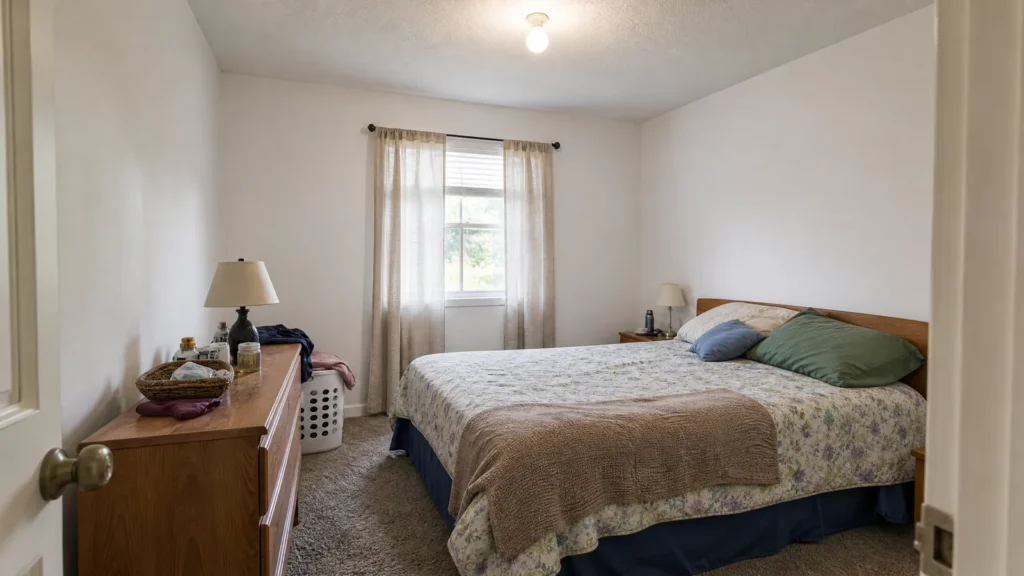
Take one photograph from each corner of the room during daylight. Do not clean or style the room before taking these photographs. The images should show the actual condition of the walls, bedding, window, lighting and visible clutter.
Sort the problems into seven categories:
- Layout
- Color
- Lighting
- Textiles
- Clutter
- Storage
- Damage
Choose the three issues that affect the room most. Those problems not a retailer’s product display should determine your spending priorities.
Choose One Makeover Goal
Write one sentence describing the result you want.
For example:
- Make the room warmer and less cluttered.
- Brighten a rental bedroom without permanent changes.
- Improve storage without replacing furniture.
- Make the bed and window look more coordinated.
One clear goal keeps the budget consistent. If an item does not support that goal or solve an identified problem, do not buy it.
Shop Your Home and Decide What to Keep
A cheap bedroom makeover should not mean purchasing the cheapest version of everything. A better approach is to keep expensive items that already work and spend money only where the room has a clear problem.
Keep the Most Expensive Functional Pieces
Begin with the bed, mattress, dresser and stable storage furniture. If these items are functional and safe, make them part of the new design instead of trying to replace or hide them.
| Decision | Use it when | Example |
|---|---|---|
| Keep | The item works and suits the room | Existing wood dresser |
| Move | It works better somewhere else | Move a lamp to the reading side |
| Repair | A small, safe repair restores function | Tighten a loose drawer pull |
| Refresh | A cosmetic update suits the material | Replace removable hardware |
| Remove | The item blocks movement or creates clutter | Remove an unused chair |
Do not paint vintage, laminated or unknown furniture until you understand its material and finish. An unsuccessful furniture project can consume both your budget and your weekend.
Move Items From Other Rooms
- Look for items elsewhere in your home that can solve a bedroom problem without costing anything.
- A living-room side table may work as a nightstand. An unused mirror can be placed above the dresser. Neutral curtain panels may suit the bedroom better, while existing frames can be combined into one coordinated wall arrangement.
- Only move items that provide a practical or visual benefit. Moving decorative clutter from one room to another does not save money.
Sell or Donate Before Buying
- Sell an unwanted item only if it has a realistic local market and the sale can be completed before shopping. Record sale proceeds separately in the final budget.
- Do not advertise a reduced “net cost” based on money you have not received.
- Donate pieces that are safe and usable but not worth the time required to sell. Dispose of damaged or recalled products responsibly.
Set the Makeover Style and Color Palette
A limited color palette makes affordable purchases appear intentional. It also prevents you from buying several attractive items that do not work together.
Use a Simple 60–30–10 Palette
Choose one dominant neutral, one secondary color and one smaller accent.
For example:
- Dominant color: Warm white
- Secondary color: Muted sage
- Accent color: Rust or terracotta
Treat the percentages as a visual starting point rather than a strict mathematical rule.
If your bed and dresser already have a medium wood finish, consider that wood part of the color palette. You do not need to repaint functional furniture simply because another finish is currently popular.
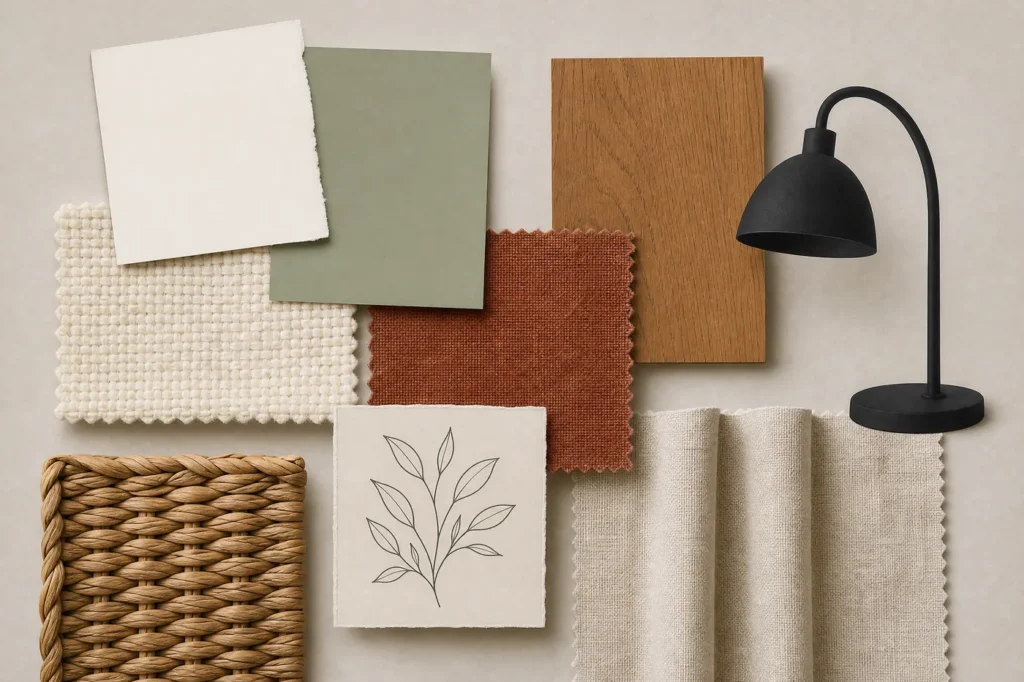
Build a Six-Item Mood Board
Limit the mood board to six elements:
- Wall color
- Bedding
- Wood or metal finish
- Curtain fabric
- Light source
- One accent color
Every planned purchase should either coordinate with this mood board or solve one of the problems identified during the bedroom audit.
For a broader planning method, use our complete bedroom design guide.
Test Colors in the Actual Room
- Place paint and fabric samples near the bed, window and darkest corner. Examine them during the day and under the room’s evening lighting.
- Do not rely only on a phone or computer screen when selecting paint and textiles. Screens, product photography and room lighting can all change how a color appears.
Spend First on Changes With the Biggest Visual Impact
The most practical spending order is:
- Repair, clean and declutter
- Improve the largest surface
- Refresh the bed
- Improve the lighting
- Upgrade the window treatment
- Add wall decor and accessories
This order prevents low impact decorative purchases from consuming money needed for functional improvements.
Priority 1: Repair, Clean and Declutter
- Remove broken items, clear flat surfaces, wash reusable bedding and curtains, clean baseboards and repair small holes if the surface is safe to work on.
- Ask a landlord or qualified professional to address moisture, damaged outlets, structural problems or repairs outside your experience.
- Once the room is clear and clean, you can identify which changes are still necessary.
Priority 2: Refresh the Largest Surface
- The walls and bed normally occupy the largest part of the room’s visible composition. Decide whether the space needs a full repaint, one accent wall or no paint.
- Sherwin-Williams states that one gallon of paint typically covers approximately 350 to 400 square feet, although surface condition, texture and application method affect the amount required.
- Measure your walls and use a manufacturer’s paint calculator. Do not assume that one gallon will always provide two complete coats.
Priority 3: Improve the Bed, Lighting and Window
- Refresh the bed with one coherent textile layer rather than an excessive number of decorative pillows.
- Improve lighting where you read, dress or prepare for the day. Make sure the window provides sufficient privacy and is visually coordinated with the room.
- Complete these functional improvements before spending money on decorative objects.
Refresh the Walls Without Overspending
Walls can change a room quickly, but the lowest-cost option depends on homeownership, lease conditions, surface quality and preparation requirements.
Option A: Paint the Whole Room
A complete repaint is useful when the existing wall color is the room’s primary problem.
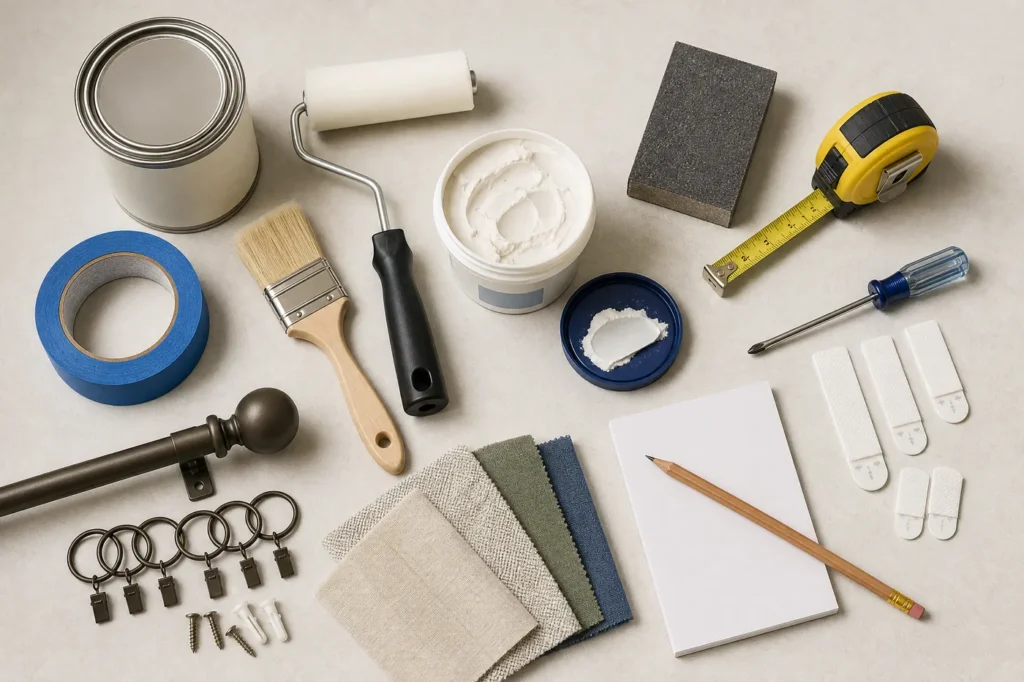
Include the following supplies in your budget:
- Paint
- Primer, if required
- Patch compound
- Painter’s tape
- Roller
- Brush
- Tray
- Protective floor covering
Follow the paint manufacturer’s preparation, ventilation, drying and curing instructions.
If the home was built before 1978 and the project may disturb existing paint, evaluate the possibility of lead-based paint before sanding, scraping or drilling. The U.S. Environmental Protection Agency recommends using lead-safe practices or hiring a lead-safe certified contractor where appropriate.[2]
Option B: Paint One Accent Wall
- An accent wall can reduce material costs and create a focal point behind the bed.
- It works best when the chosen wall already has a clear visual purpose. Painting a random wall can make an awkward room arrangement more obvious rather than improving it.
- Use leftover paint only when it is still usable and appropriate for the surface. Record reused materials as “reused—$0 spent” so the final budget remains transparent.
Option C: Use a Renter-Friendly Treatment
Renters can consider:
- Removable wallpaper
- Fabric panels
- Large lightweight art
- Peel-and-stick trim
- A no-paint textile-focused approach
No removable product is universally damage-free. Check your lease, read the manufacturer’s surface restrictions and test the product in a hidden area first.
See our bedroom paint ideas and renter-friendly decor ideas for more options.
Make the Bed Look Finished on a Budget
The bed is normally the visual anchor of a bedroom. That does not mean you need a new mattress or frame.
Start With One Reversible Foundation
Choose one washable duvet cover, coverlet or quilt that coordinates with your existing sheets.
A reversible neutral foundation can work with more than one color palette and is easier to update later.
Before buying, check:
- Material and fiber content
- Product dimensions
- Closure type
- Washing instructions
- Return policy
A low price is not useful if the product does not fit your bed or cannot handle your regular laundry routine.
Add Texture With Pillow Covers and a Throw
- Reuse pillow inserts when they are clean and supportive. One lumbar pillow or two decorative pillow covers are usually sufficient for a practical bed.
- Add a throw only when it provides useful warmth, texture or color.
- For additional textile inspiration, browse these cozy bedroom ideas.
Create a Low-Cost Headboard or Focal Point
Three affordable options are:
- A painted wall shape
- A removable wall panel
- A properly secured secondhand headboard
Choose one approach instead of combining all three.
Measure the bed and wall before selecting the width. Follow the product’s installation instructions and avoid placing heavy, inadequately secured objects above the bed.
Improve Bedroom Lighting Without Rewiring
Better lighting improves how the room functions and how its colors appear. A budget makeover should use safe portable or plug-in options rather than amateur electrical work.
Layer Ambient, Task and Accent Lighting
- Ambient lighting provides general illumination throughout the room.
- Task lighting supports a particular activity, such as reading, dressing or applying makeup.
- Accent lighting highlights a limited area or feature.
- A small bedroom does not need many light fixtures. One suitable overhead light and one well-positioned bedside or dresser lamp may be enough.
Use Lamps and Plug-In Options
- First, check whether your existing lamp is in good condition and uses an appropriate bulb.
- If you add a lamp or plug-in wall light, follow the manufacturer’s instructions. Make sure its cord can reach the outlet without tension or an unsafe extension arrangement.
- Use our bedroom lighting ideas and ambient lighting ideas for placement inspiration.
- Contact a qualified electrician about damaged outlets, permanent wiring or other electrical concerns.
Manage Cords Safely
Use a suitable removable cord channel or position cords beside stable furniture.
Do not:
- Run electrical cords under rugs
- Pinch cords behind furniture
- Stretch cords across walking paths
- Overload outlets or extension cords
Upgrade the Window Treatment for Less
Window treatments should provide privacy and operate safely before they improve the room’s appearance.
Measure Before Buying Curtains
Measure:
- The window width
- The window height
- Available wall width
- Distance from the rod position to the intended hem
- Existing rod and bracket dimensions
Check whether the existing rod can safely support the new panels.
Curtains can visually change the window’s proportions, but one hanging formula does not work for every room. Doors, radiators, furniture and low ceilings may affect placement.
Reuse or Hem Existing Panels
- Clean existing curtain panels and test them with the new color palette before replacing them.
- If the curtains are too long, use a hemming method suitable for the fabric. If they are too short or narrow, moving them to another room may be better than trying to disguise the incorrect size.
Choose Cordless Coverings Where Children Are Present
The U.S. Consumer Product Safety Commission states that cordless window coverings are the safest option when young children are present. The agency also recommends moving beds and furniture away from window covering cords. Safety should take priority over the planned room layout or decorating budget.
Add Wall Decor Without Filling Every Wall
Wall decor should support one focal area. It does not need to cover every empty surface.
Select One Focal Wall
Choose one of the following:
- The bed wall
- The dresser wall
- A narrow blank wall
The focal wall should be visible when entering the bedroom. It should not require unsafe installation of heavy items above the bed.
Use Printable Art, Existing Frames or Thrifted Pieces
Printable artwork and secondhand frames can be affordable when you measure before buying.
Record:
- Print dimensions
- Frame opening dimensions
- Outer frame dimensions
- Hanging method
- Total cost
For more options, explore these aesthetic bedroom wall decor ideas.
Leave Intentional Empty Space
- Empty wall space helps the focal area remain visually clear.
- Stop before the room becomes a collection of unrelated objects. If removing an item improves the composition, leave it out.
Add Storage Only Where Clutter Returns
Decorative containers can become clutter themselves. Observe the room for several days and identify which items repeatedly appear on the bed, dresser or floor.
Identify the Items That Need a Home
Common recurring items include:
- Clothing
- Chargers
- Books
- Shoes
- Cosmetics
- Spare linens
Choose storage based on the actual item, available dimensions and how often you need to access it.
Use Under-Bed and Vertical Space
Measure the space under the bed before purchasing bins.
Make sure the container:
- Fits beneath the bed frame
- Can be pulled out easily
- Does not block vents
- Can hold the intended items
Use vertical storage only when it is stable, appropriate for the wall and properly installed.
Secure Dressers and Tall Furniture
- The U.S. Consumer Product Safety Commission recommends securing top-heavy furniture and following the manufacturer’s instructions for anti-tip devices.[5]
- Treat furniture anchoring as a safety requirement, particularly in homes with children.
A Sample $500 Bedroom Makeover Shopping Plan
This shopping plan allocates every dollar without pretending to quote one particular retailer.
Use each amount as a spending limit. If an item costs more than planned, reduce a lower-priority category or use part of the contingency.
| Item | Quantity | Allowance | Lower-cost option |
|---|---|---|---|
| Interior paint | 1 project | $55 | Paint one accent wall |
| Patch and preparation materials | 1 set | $15 | Use suitable supplies already owned |
| Roller, tray and brush | 1 set | $25 | Borrow compatible tools |
| Tape and protective covering | 1 set | $15 | Reuse suitable coverings |
| Duvet cover or coverlet | 1 | $70 | Keep the existing foundation |
| Pillow covers | 2 | $20 | Reuse existing covers |
| Throw | 1 | $30 | Move one from another room |
| Table lamp | 1 | $45 | Reuse or buy secondhand |
| Appropriate bulbs | 1 set | $15 | Replace only unsuitable bulbs |
| Cord-management material | 1 | $10 | Reroute furniture safely |
| Curtain panels | 1 pair | $35 | Reuse existing panels |
| Curtain rod or hardware | 1 | $15 | Reuse safe existing hardware |
| Printable art | 2 | $10 | Use personal photographs or existing art |
| Thrifted or reused frames | 2 | $20 | Regroup frames already owned |
| Picture strips or hooks | 1 set | $10 | Reuse compatible hardware |
| Under-bed bins | 2 | $35 | Use existing containers |
| Basket or dresser tray | 1 | $25 | Repurpose a container |
| Contingency | — | $50 | Reduce optional decor first |
| Total | $500 | Maximum planned spend |
These figures are planning allowances rather than current retailer prices. Check local availability, product dimensions, quality, shipping, tax and return policies before buying. This plan contains no paid product placements or affiliate product links.
What to Buy First If Prices Increase
Protect the following categories first:
- Safe preparation and repairs
- One significant wall or surface improvement
- One functional lighting or privacy improvement
- Bedding, when the bed is the room’s primary visual problem
Remove optional wall art, decorative pillows, baskets and accessories before reducing essential supplies or contingency.
Do not reduce contingency to zero simply to preserve decorative purchases.
The $250 Version
| Category | Allowance | Reduced scope |
|---|---|---|
| Paint and supplies | $75 | Paint one wall or use a smaller treatment |
| Bedding and textiles | $60 | Choose one foundation and reuse existing accents |
| Lighting | $35 | Improve bulbs or buy one simple lamp |
| Window treatment | $30 | Reuse hardware and choose basic panels |
| Wall decor | $20 | Use existing frames and inexpensive prints |
| Storage and accessories | $15 | Solve one recurring clutter problem |
| Contingency | $15 | Maintain a small reserve |
| Total | $250 | Focused refresh rather than full makeover |
The $250 plan should not promise the same scope as the $500 version. It works best when the room already has usable paint, furniture and window hardware.
The Use-What-You-Own Version
Begin without shopping.
- Declutter, clean, wash textiles, rearrange the furniture, move a lamp, regroup existing artwork and test useful items from other rooms.
- Live with these changes for several days. Buy something only when a problem remains clear.
- Record reused items as “reused—$0 spent.” Do not assign imaginary savings to items you already own.
Complete the Makeover in One Weekend
- A one-weekend bedroom makeover is possible only when your products, tools and measurements are ready before Friday.
- Drying times, repairs and unexpected problems may require a longer schedule.
Friday Evening: Clear, Measure and Prepare
Remove small objects and textiles. Confirm the room and furniture measurements. Photograph the starting condition, clean the work area and organize the supplies.
Do not scrape, sand or drill into painted surfaces in a pre-1978 home before evaluating the possibility of lead-based paint.
Saturday: Complete the Largest-Surface Change
- Paint or install the selected wall treatment first. Follow all preparation, ventilation, drying and curing instructions.
- When the work area is ready, move the furniture into the planned arrangement and install functional lighting or window-treatment elements.
- Avoid styling the room while tools, wet paint or installation materials remain in the work area.
Sunday: Make the Bed, Add Storage and Edit
- Add the bedding, necessary storage and limited wall decor.
- Route electrical cords safely and secure top-heavy furniture according to the manufacturer’s instructions.
- Photograph the finished room from the same angles as the starting photographs. Complete one final editing pass and remove at least one object that does not support the makeover goal.
Budget Bedroom Makeover Mistakes That Waste Money
Buying Decor Before Fixing the Layout
Accessories cannot fix a blocked walkway or poorly positioned bed. Resolve the layout first and then purchase only what the selected arrangement needs.
Spreading the Budget Across Too Many Categories
A room often benefits more from two or three noticeable improvements than from ten weak purchases.
It is reasonable to spend more on bedding when the bed is the main visual problem. It is also reasonable to spend more on lighting when the room does not function properly after dark.
Ignoring Tax, Shipping and Installation Supplies
A product’s displayed price may not be its final cost.
Include:
- Sales tax
- Delivery charges
- Installation hardware
- Tools and supplies
- Possible return expenses
This is why the plan includes a contingency allowance.
Buying a Matching Set Without Solving a Problem
A complete matching set can consume the budget while leaving poor lighting, limited privacy or clutter unresolved.
Buy according to the bedroom audit rather than the way a product collection is displayed by a retailer.
Calling a Product Renter-Safe Without Testing It
Removable products can react differently to paint quality, wall texture, humidity and installation time.
Check the lease, read the manufacturer’s instructions and test the product in a hidden area. Do not assume or promise that removal will be damage free.
What This Budget Plan Can Change
The concept used in this guide keeps the main bed and existing wood furniture. The visual change comes from:
- A coordinated wall color
- Quieter bedding
- One accent textile
- Improved curtains
- A practical bedside lamp
- Limited wall art
- Controlled storage
Because the room visuals are concepts rather than a documented physical project, this guide does not claim an actual before-and-after result or final spend.
When applying the plan to your own room, record the measurements and costs. Photograph the same angles in similar lighting and prepare a final table showing:
- Planned cost
- Actual cost
- Difference
- Tax and shipping
- Returned products
- Gifted items
- Reused items
Also note which purchase was worth the money, which item could have been skipped and which part required more time than expected.
Frequently Asked Questions About Budget Bedroom Makeovers
Can You Really Make Over a Bedroom for $500?
Yes, provided you keep the major furniture and avoid structural work, professional labor and a new mattress. Focus the budget on cosmetic changes such as paint, bedding, lighting, curtains and limited storage. Measure first and maintain a contingency allowance.
What Should I Buy First for a Bedroom Makeover?
Begin by repairing, cleaning and decluttering. Next, improve the largest visual surface, followed by the bed, lighting and window treatment. Purchase wall decor and accessories last.
How Can I Make My Bedroom Look Better Without Buying Furniture?
Rearrange the bed and dresser, clear visible surfaces, wash or rotate textiles, regroup existing art and move a lamp from another room. Spend money only on the problems that remain after completing these no-cost changes.
What Makes the Biggest Difference in a Cheap Bedroom Makeover?
The answer depends on the room. Paint or bedding can create the largest visual change. Lighting, privacy or storage may create the largest functional improvement. Photograph the room and identify its three most important problems before buying anything.
How Much Paint Do I Need for a Bedroom?
Measure the wall area and use the paint manufacturer’s calculator. Sherwin-Williams states that one gallon typically covers approximately 350 to 400 square feet. However, wall texture, surface condition, application method and desired coverage can change the amount required.
Is This Makeover Plan Suitable for Renters?
Yes, but renters should check the lease and avoid unapproved permanent changes. Replace paint with removable art, textiles, portable lighting and freestanding storage where necessary. Test removable products in a hidden area first.
Should a New Mattress Be Included in the $500 Budget?
No. This plan treats a mattress as a separate, needs-based purchase. Trying to include a mattress in a cosmetic makeover budget can lead to poor product decisions and leave too little money for the room refresh.
Final Takeaway
- A successful budget bedroom makeover is a spending plan rather than a long shopping list.
- Keep the bed and major furniture, define one goal and invest in the room’s largest visual or functional problems. Measure before buying, reserve money for tax and supplies, and stop when the selected budget is reached.
- Use the $250 plan when the room needs a focused refresh. Use the $500 plan when the bedding, lighting, window treatment and storage all need attention.
- For help coordinating the entire space, continue with our complete bedroom design guide.