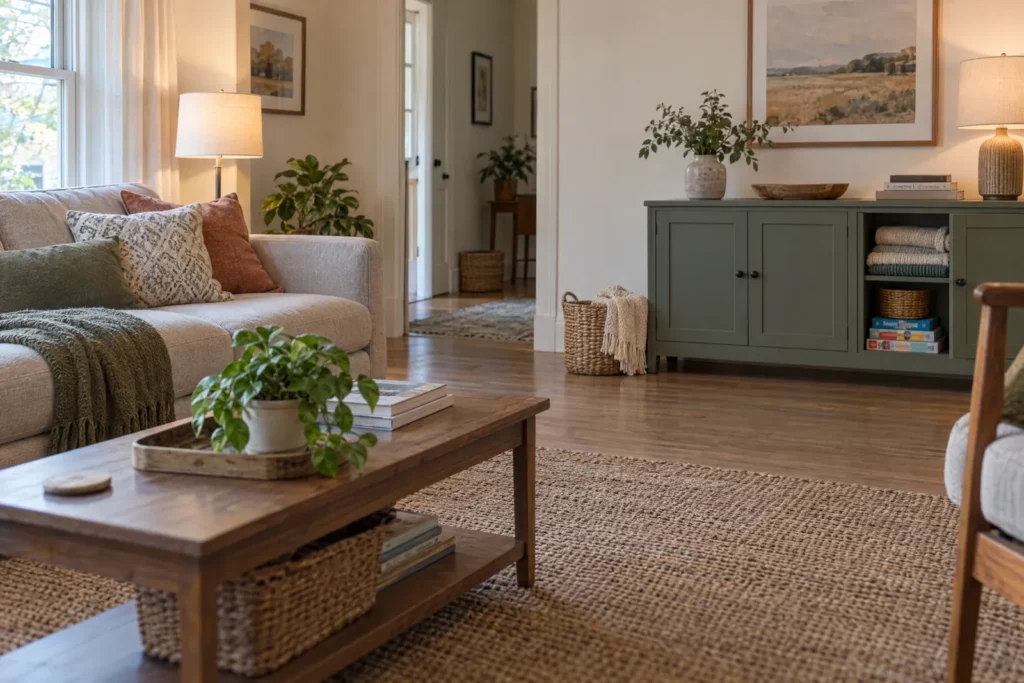
A storage cabinet should earn its place by fitting the belongings you already have and by working during an ordinary evening. Start with an inventory, sort each category by how often it is used, and measure both the usable interior and the narrowest opening. Then test every door, drawer, basket, or lid in the room before you buy or build anything. This inventory-first approach turns attractive living room storage ideas into a decision you can check.
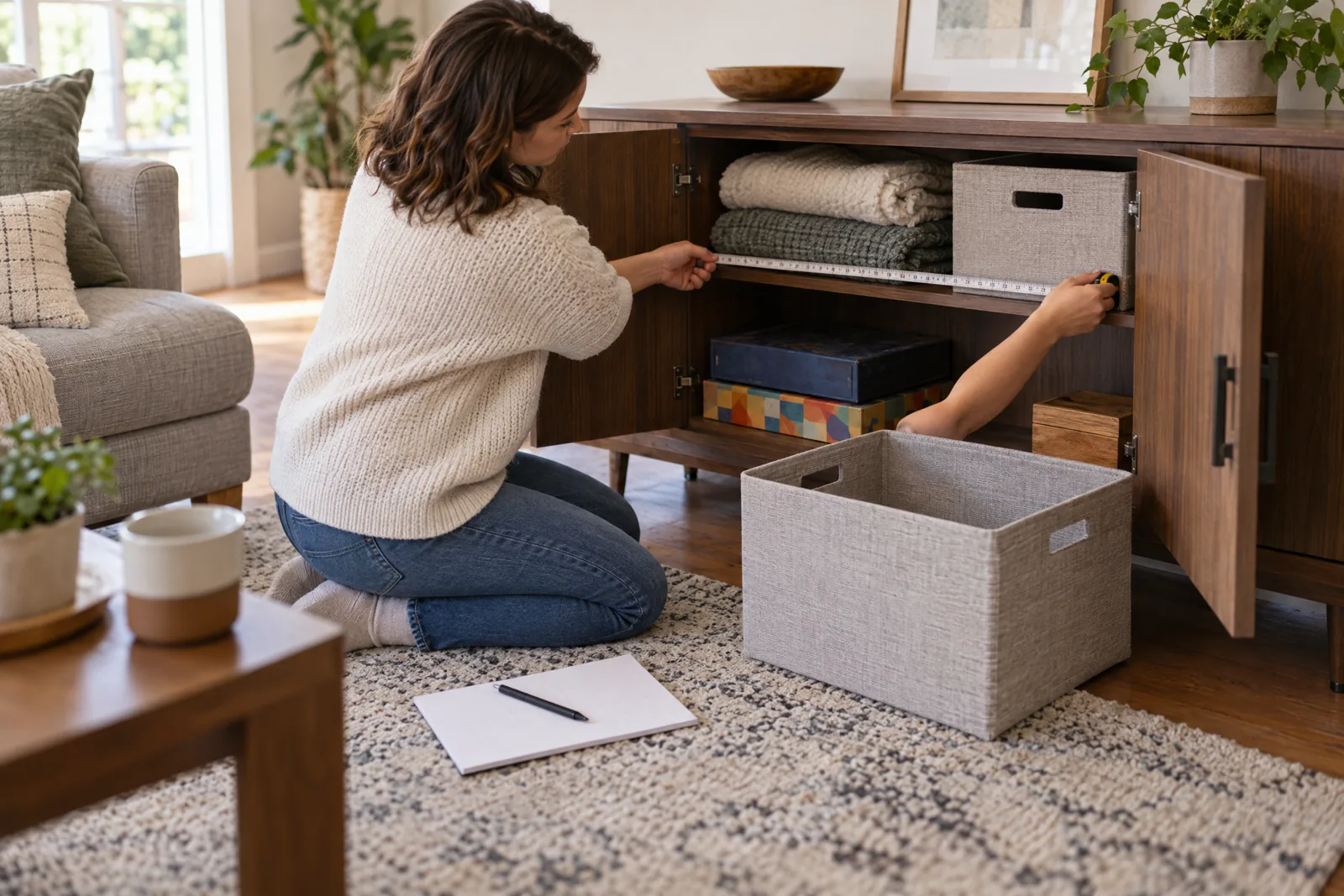
Start with what your household actually stores
Do not begin with the cabinet you like. Begin by gathering the things that need a home in the room. Include items currently sitting on the floor, sofa, coffee table, or a nearby surface, as well as items you plan to bring back from another room when storage changes.
Make separate groups for blankets and pillow covers, toys and stuffed animals, building sets, art supplies, board games, puzzles, books, magazines, remotes, controllers, chargers, cables, discs, consoles, streaming devices, pet supplies, and occasional decor. Keep items to relocate, donate, recycle, or discard in a separate group. They are not storage capacity problems if they should not remain in the room.
For each group, record four things:
- The count or amount you actually have.
- The largest item, folded stack, or boxed game.
- Whether loose pieces need a container.
- Who retrieves the category and how often.
A category can be small in volume and still deserve a convenient location. Remotes used during every television session should not be placed behind a heavy lid merely because they take up little space. A seasonal throw can tolerate a less direct location if retrieving it does not require an awkward or unsafe movement.
Inventory and frequency worksheet
Use one row for each category. If a group has very different sizes or access needs, give it more than one row.
| Category | What to measure or count | Frequency | Likely user and access need | Candidate location to test |
|---|---|---|---|---|
| Throws, blankets, pillow covers | Folded stack size and number of stacks | Daily, weekly, or seasonal | Seated adult or child with supervision | Low cabinet, basket, bench, or ottoman |
| Toys, stuffed animals, building sets | Largest piece, loose-piece volume, and sorting needs | Daily or weekly | Child access for suitable items, supervised for small pieces | Open cubby, contained bin, or low shelf |
| Board games and puzzles | Box length, depth, height, and fragile pieces | Weekly or occasional | Standing or seated adult, sometimes child | Cabinet shelf, drawer, or closed console |
| Books and magazines | Tallest book, total row length, and reading frequency | Daily or weekly | Seated adult or child | Open shelf, drawer, or cabinet shelf |
| Remotes, controllers, chargers, cables | Count, longest cable, and small-item grouping | Daily | Seated adult, easy return after use | Shallow drawer, tray, or small bin |
| Media equipment and discs | Device footprint, cable route, discs, and controls | Daily or weekly | Seated adult, with ventilation and signal needs | Open media shelf or approved cabinet bay |
| Pet supplies | Package size, leash length, and spill risk | Daily or weekly | Standing adult, sometimes supervised child | Closed cabinet, basket, or dedicated drawer |
| Seasonal or occasional items | Largest piece and months of use | Seasonal | Adult retrieval, less direct route acceptable | Higher cabinet area or relocated storage |
| Items that do not belong here | Destination and disposal decision | Not applicable | Not applicable | Relocate, donate, recycle, or remove |
The candidate column is a starting hypothesis, not a promise that the furniture will work. A basket may be convenient but too wide for an opening. A drawer may hold controllers but fail when its pull requires a coffee table to move. Let the measurements and the routine decide.
Sort storage by how often each item is used
Use four access tiers so that every category has a practical home rather than an attractive hiding place.
Daily and within reach
These are items used during most room sessions, such as a favorite throw, a controller, a book in progress, or a remote. The storage location should allow retrieval without moving another piece of furniture, emptying a container, or lifting a heavy lid. It should also make returning the item easy, because a difficult return route often creates a new pile on the nearest surface.
Weekly and normal effort
Board games, puzzles, extra books, and less frequently used blankets may work in a drawer, closed cabinet, reachable basket, or shelf. Test the real item, not an empty container. A boxed game can catch on a hinge or opening even when the cabinet interior appears large enough.
Seasonal or occasional
Reserve less convenient locations for items that do not need to be reached during every visit to the room. A higher shelf, deeper cabinet, or lidded container may be reasonable when the person retrieving it can do so safely and the route remains clear. Do not place heavy or awkward items in a location that requires unstable reaching.
Relocate or remove
Some items are not asking for better furniture. They may belong in a hobby area, entry, pet zone, bedroom, recycling stream, donation box, or another household location. Quantify what remains after this edit before sizing a cabinet. Overflow is easier to judge when it is visible as a named category rather than described as clutter.
Measure the belongings and the usable opening
Furniture labels usually describe an outside dimension. Your storage decision needs the space the item can occupy, plus the route by which it enters and leaves.
Measure the usable interior width, depth, and height after accounting for shelf thickness, drawer hardware, hinges, back panels, door thickness, and fixed dividers. Then measure the clear opening at its narrowest width and height. Record whether the opening changes when a door is partly open or a sliding panel is moved aside.
For baskets and bins, record both the outside dimensions and the inside dimensions. The outside measurement determines whether the container fits the shelf or opening. The inside measurement determines whether the belongings fit inside the container. Fabric sides, handles, lids, rims, and thick walls can make those measurements meaningfully different.
Also measure the item as it will actually be stored. Use the folded blanket stack, the closed game box, the grouped cables, or the largest toy piece. Do not compress an item beyond what the household will realistically do each time it is put away.
Interior versus opening worksheet
This example uses made-up measurements to show the method. It is not a recommended cabinet size or a capacity promise. Replace every dimension with your own measurements.
| Candidate and item | Usable interior, W x D x H | Narrowest clear opening, W x H | Item or container to pass through | Fit result and reason |
|---|---|---|---|---|
| Lower cabinet bay with two fabric bins | 31 x 13 x 18 inches | 29 x 16 inches | Each bin is 13 x 12 x 9 inches outside, 11.5 x 10.5 x 8.5 inches inside | Fits in the example. Two bin widths total 26 inches, depth is 12 inches, and each bin height is 9 inches. Each bin also passes the opening. |
| Old hutch shelf with folded throw stack | 28 x 14 x 10 inches | 24 x 8 inches | One folded stack measures 10 x 12 x 9 inches | Does not fit through the opening. The interior height looks sufficient, but the 9 inch stack exceeds the 8 inch opening height. |
| Media drawer with controller tray | 23 x 10 x 3.5 inches | 21 x 2.75 inches | Tray is 18 x 7 x 2 inches outside | Fits in the example if the tray enters flat and the drawer hardware leaves the recorded interior. Check cable routing separately. |
| Closed shelf for game boxes | 31 x 13 x 18 inches | 29 x 16 inches | Two stacks, each 12.2 x 10.1 x 7.2 inches | Fits in the example. Each stack is below the interior height, and the combined width of 24.4 inches is below the interior width. |
| Lift-top compartment for four blankets | 30 x 16 x 10 inches | Top opening measured by the lid travel | Four folded throws, each 11 x 10 x 4 inches | Two stacks side by side, each two throws high, would occupy 22 x 10 x 8 inches. This is an interior-only check; lid travel, load and hand access remain pending. |
The arithmetic in a worksheet is only a screening step. A bin can fit through an opening and still be hard to grip, catch on a door, or block a walkway when pulled out. Mark a result as full, partial, or no fit, and name the overflow. For example, if two measured bins hold the toys that are played with regularly but not the oversized building pieces, keep the regular toys in the room and assign the larger pieces another location instead of silently overfilling the bins.
Draw the door, drawer, lid, and basket operating space
A closed cabinet footprint tells you where furniture sits. It does not tell you where a person stands, where a door travels, or how far a drawer or basket extends. Use painter’s tape to outline the closed footprint and each full-open position on the floor. Include handles and the position of the user’s body.
Open the component fully on the sketch. Pull the bin or drawer to the position where the stored item can actually be grasped. Stand or sit as the real user would. Remove the largest item. Carry it toward its intended destination, then return it to storage. In a shared room, imagine another person using the main route at the same time. Record the tightest point and the object that causes the conflict.
A sliding door needs its own check. The cabinet may have a generous interior, but the panel can cover part of the opening when moved aside. A lift-top needs a check for the lid’s arc and the user’s hand position. A deep basket needs a check for how far it must be pulled before the contents at the back are reachable.
Opening and retrieval test
The following is a copyable test table. A result marked pass means it passed your own observed test, not that the furniture is universally suitable.
| Component | What to open or pull | What to observe | Main route or object at risk | Result to record |
|---|---|---|---|---|
| Hinged cabinet door | Open through full travel | Can the user stand, reach, remove the largest item, and close the door? | Sofa, coffee table, wall, window, or another door | Pass, revise, or reject |
| Drawer | Pull to usable position | Can small items be seen and returned without moving furniture? | Knees, seated reach, table edge, or walkway | Pass, revise, or reject |
| Basket or bin | Pull or lift the actual container | Can the container be gripped and carried without tipping or scraping? | Person route, pet route, or nearby seating | Pass, revise, or reject |
| Lift-top or trunk lid | Lift to the position needed for retrieval | Does the lid arc interfere with a person, lamp, wall, or screen view? | Seating, table surface, child movement, or wall | Pass, revise, or reject |
| Media access | Open door, use remote, and inspect cables | Does the equipment receive the intended control signal and retain its required ventilation? | TV sightline, cable route, outlet, or heat source | Pass, revise, or pause |
If an item is used every evening but the test requires two hands, a table to move, or a lid to hold open, treat that as a failed daily-use match. You can keep the furniture and move that category, choose an easier opening, reduce the stored amount, or assign the piece to occasional storage.
Test the storage piece in the room and on its delivery route
Measure the outside footprint and then test the full operating footprint. Check the route from the entry door through hallways, turns, stairs, and the living room. A piece that fits against a wall may not make the corner turn, and a cabinet that arrives in parts may have a different assembly route than its final footprint suggests. If the cabinet competes with the sofa or walking route, test the full furniture arrangement before ordering either piece.
In the room, check the main path to the next room, the sofa and chair movement, nearby doors, windows, vents, radiators, heaters, outlets, switches, and fireplace or heat zones. Check the TV viewing position and the sightline when doors or lids are open. Include the movements that actually happen in the household, such as a child carrying toys, a pet passing behind the sofa, or an older adult using a familiar route.
There is no universal clearance number that can settle this test. The relevant space depends on the room, the furniture, the opening type, and the people using it. Tape the actual outlines and observe the tightest condition with the room in its normal arrangement. Any dimensions in a worked example should be treated as that example’s measurements only.
If moving a console changes the relationship between seating and a rug, retest the room rather than assuming the old arrangement still works. The rug placement guide can help with that separate seating and rug check after the storage footprint is known.
Match the storage type to the job
Choose an opening and location that match the category’s access tier. The most concealed option is not automatically the most useful one.
| Storage type | Useful for testing | Tradeoff to consider | What must pass before keeping it |
|---|---|---|---|
| Open shelf or cubby | Books, displayed objects, and frequently returned baskets | Visibility and dust exposure remain high | Item row, basket outer size, route, and visual tolerance |
| Closed cabinet | Toys, games, blankets, and visual concealment | Door swing, hinges, and slower retrieval can create conflicts | Interior, clear opening, full door travel, and anchoring needs |
| Media console | Components, discs, controllers, and cables | Ventilation, signal passage, and cable access need separate checks | Equipment instructions, cable path, remote operation, and stable support |
| Storage ottoman | Throws, pillows, and soft items near seating | Lift effort and lid operation can discourage return | Lid travel, hand position, seated retrieval, and stability |
| Bench or window seat | Soft goods and occasional items | Seat use and storage access may compete | Lid or drawer operation, user weight instructions, and route |
| Lift-top coffee table | Items used around the seating area | Open top can affect reach, view, and table use | Lid arc, body position, item weight, and return effort |
| Under-sofa container | Low-frequency soft or flat items | Floor access may require bending and a clear sofa edge | Container height, grip, dust exposure, and retrieval posture |
| Mobile cart | Small grouped supplies that need to move | Wheels can migrate and the cart can enter a route | Wheel behavior, parking location, and cable or child interaction |
| Built-in storage | Large, settled categories and long-term planning | Installation, wall conditions, and permission add constraints | Drawings, product instructions, mounting, service access, and route |
Reuse can be the best answer when an existing piece passes the tests. Reconfigure it when a shelf position, basket size, or category assignment is the only problem. Buy when the measured need is clear and the candidate passes the fit and operating tests. Build only after wall, floor, electrical, heat, and installation questions are addressed. Relocate or remove when the category does not belong in the room or makes every candidate awkward.
After the measurements are complete, a measured budget living-room reset can help set spending priorities. It is usually easier to decide what to buy after rearranging and identifying the specific storage failure.
Give media its own fit and ventilation check
Media storage is not just another shelf. Measure each console, streaming device, disc player, speaker, or other component as it will sit in the furniture. Record the cable direction, connector depth, power strip location, remote operation, and any access panel.
Read the current manuals for the equipment and the furniture. Follow the equipment manufacturer’s ventilation requirements, including any specified space around vents or restrictions on enclosed operation. Do not infer that an open-looking door, decorative cutout, or rear gap is adequate. A cabinet that fits a device dimensionally may still be unsuitable if it blocks required airflow or makes the cables bend sharply.
Test the remote from the normal seat with the doors in the position used during viewing. If the signal does not pass through the closed front, decide whether the door stays open during use, whether the equipment moves to an open shelf, or whether the candidate should be rejected. Keep the TV viewing and cable route visible in the room test, and follow the television and furniture instructions for support and mounting.
Make toy and family storage reachable without making it climbable
Child-accessible describes who can reach an item. It does not certify that the storage is safe. Put suitable everyday toys where the child can return them without climbing, pulling on unstable furniture, or opening a heavy lid. Keep small parts, sharp tools, fragile items, messy materials, and supervision-heavy activities according to the household’s needs and the adult’s ability to supervise.
Inspect pinch points around doors and drawers. Check whether a bin can tip when pulled, whether a shelf encourages climbing, and whether a heavy object could fall when a child reaches for something above it. Do not place tempting toys on top of furniture if doing so invites climbing. Recheck the arrangement after the furniture is loaded, because stored weight and daily behavior can change the way it operates.
Safety check for tall, top-heavy, or TV-supporting storage
A tall, top-heavy, leaning, wall-mounted or TV-supporting piece needs a product-specific restraint and support check. Follow the furniture and television manufacturers’ instructions, and consider a qualified installer when the product or wall condition is uncertain. Keep toys and other tempting objects away from furniture that children might try to climb.
Treat that guidance as a safety prompt, not as certification of your chosen cabinet or room plan. Use the hardware specified for the product and wall conditions, and ask the manufacturer, landlord, local authority, or a qualified trade professional when mounting, electrical, fireplace, heat, or built-in work is involved. Do not place a TV on furniture that is not designed to support it. Confirm the product’s load, mounting, and restraint instructions before use.
A hypothetical worked example
The following example shows how a household could reach a decision without assuming a standard cabinet capacity. It is fictional and uses reader-substituted measurements.
The household has four folded throws, six board games, nineteen books, two controllers, three remotes, a small cable pouch, and enough everyday toys to fill two measured fabric bins. The toys are used most days, the games are used most weeks, the throws are used daily in colder weather, and the books are split between daily and occasional reading.
The proposed cabinet has one lower bay with a usable interior of 31 by 13 by 18 inches and a narrowest opening of 29 by 16 inches. Each fabric bin measures 13 by 12 by 9 inches outside and 11.5 by 10.5 by 8.5 inches inside. Two bin widths total 26 inches, which is less than the 31 inch interior width. Their 12 inch depth is less than the 13 inch interior depth, and each 9 inch height is less than the 18 inch interior height. Each bin also passes the 29 by 16 inch opening. The example therefore records two bins as a fit, pending the pull-out and room-route test.
The same cabinet has a shelf where the six game boxes form two stacks, each 12.2 by 10.1 by 7.2 inches. Each stack fits the recorded interior height, and the two stacks total 24.4 inches across, less than the 31 inch interior width. The example records the games as a fit if the shelf load and stack stability instructions also allow that arrangement. It does not turn that result into a promise for another cabinet.
The daily-use test changes the decision. When the lower cabinet door is opened in the taped room plan, it overlaps the edge of the coffee table’s normal position. The household can either move the table, move the cabinet, choose a different opening, or assign the everyday toys to an easier location. Since the toys are returned most days, the example moves the bins to an open low cubby that passes the same opening and retrieval checks. The cabinet remains a candidate for the weekly games and seasonal throws, subject to the door, route, load, and anchoring checks.
Example decision record
| Category | Fit result | Access result | Room or safety result | Example decision |
|---|---|---|---|---|
| Everyday toys in two bins | Two bins fit the lower bay and opening | Hinged door conflicts with the coffee table during ordinary use | No daily-use pass in that position | Reconfigure to a tested low cubby or change the cabinet location |
| Six board games | Two measured stacks fit the shelf and opening | Weekly retrieval is workable after the door test | Verify shelf instructions and route | Keep in the cabinet if verification passes |
| Four folded throws | Two side-by-side stacks, each two throws high, occupy 22 x 10 x 8 inches in the illustrated 30 x 16 x 10 inch compartment | Occasional retrieval might suit a lift-top | Lid travel, product load and hand access still need testing | Hold the decision until the full-open test passes |
| Remotes, controllers, and cable pouch | Drawer and tray dimensions have not been recorded in this household example | Daily return should be easy from the seated position | Measure the clear opening, drawer hardware and actual items first | Keep the proposed drawer marked pending rather than claiming a fit |
| Nineteen books | Individual book sizes and shelf capacity have not been recorded | Daily books may be easier on an open shelf | Count and measure each group and check product load instructions | Split by reading frequency, then test shelf fit and relocate any overflow |
This is a planning illustration, not a structural or safety assessment. Your result may be to reuse an existing piece, buy a smaller item, move storage out of the room, reduce the category, or wait until a better opening appears.
Make the final decision from the tests
Record the result for fit, retrieval, room route, and safety separately. A candidate should not pass simply because it satisfies one of those conditions.
| Test result | Next decision |
|---|---|
| Item fits the usable interior and narrowest opening, retrieval works, route works, and instructions are verified | Keep or buy the solution, then label the location by category |
| Capacity works but daily retrieval requires moving furniture or lifting too much | Move the category closer, choose an easier opening, or reduce the stored amount |
| Outside footprint fits but a fully open door, drawer, lid, or basket blocks a route | Rotate, relocate, reconfigure, or reject the candidate |
| Item does not pass through the clear opening despite interior volume | Reject that location or choose a container with a larger measured opening |
| Media equipment fits but ventilation, cable, or signal requirements are unknown | Pause and check the current equipment and furniture instructions |
| Furniture needs anchoring, mounting, or TV support but wall and product conditions are unknown | Pause and verify with the manufacturer, landlord, local authority, or qualified professional |
| Only occasional overflow remains after a fair inventory | Rotate, relocate, donate, recycle, or quantify off-site storage rather than adding untested furniture |
Frequently asked questions
How do I check whether a storage bin will fit?
Measure the bin’s outside width, depth, and height, then compare those dimensions with the usable interior and the narrowest clear opening. Confirm that it can be gripped, pulled out, and carried through the room without blocking a route. The example measurements here are only a method, not a promise for another cabinet.
How should I check media equipment in a closed cabinet?
Read the current equipment and furniture instructions for ventilation, cable access, signal passage, and support. Test the remote from the usual seat and do not assume that a door, cutout, or rear gap provides enough airflow. Pause the plan if a required specification is unknown.
When should living room storage be anchored?
Use the product’s restraint and support instructions for tall, top-heavy, leaning, wall-mounted, or TV-supporting storage. Verify the hardware against the product and wall conditions, and ask the manufacturer, landlord, local authority, or a qualified professional when those conditions are uncertain. This is a safety check, not a certification.
Print the worksheets and retest after setup
Before shopping, copy the inventory table and fill in the categories that truly belong in the room. For each candidate, add the measured interior and opening. On a floor sketch, mark the closed footprint, door or drawer travel, basket extraction, lift-top arc, person position, and route to the intended destination.
After the furniture and actual containers arrive, repeat the test. Load the real items, open each component fully, retrieve the largest stored item, and return it. Confirm that daily categories still feel easy to put away and that media equipment still meets its own manual requirements. If the household stops returning an item, treat that behavior as useful evidence and adjust the category or location.
The right storage plan may end with a cabinet purchase, but it may also end with a rearranged shelf, two correctly measured bins, a relocated overflow category, or no new furniture at all. The useful result is not an attractive storage label. It is a tested place for the belongings your household actually uses.